

For a reliable sports team airport transfer, start with the itinerary and equipment plan, then choose transportation that fits the group’s needs. When arrivals, departures, passengers, and bulky gear all need to stay coordinated, planning those details early can help keep the travel day organized.
Passenger count alone doesn’t show how much room the team’s equipment requires or whether everyone is following the same schedule. A transfer plan works better when it accounts for the full traveling party, their luggage and gear, and the trip timing together.
This guide explains how to compare sedan, SUV, and Mercedes Sprinter van categories with your group’s needs, prepare a passenger and equipment list, and choose between point-to-point transfers and hourly service. With those decisions in order, you can build a more coordinated transportation plan.
Key Takeaways
- Start with the itinerary, passenger group, and equipment list to coordinate team travel.
- Compare sedan, SUV, and Mercedes Sprinter categories with your group’s needs, without assuming capacity or equipment space.
- Separate personal luggage from team gear, and identify bulky or unusually shaped items before choosing a vehicle category.
- Choose point-to-point service for defined journeys and hourly rental when the itinerary includes planned stops or other travel needs.
- Prepare one clear set of trip details, including timing, passengers, equipment, vehicle category, and service format.
Why sports team airport transfers need a coordinated travel plan
A team’s airport journey involves more than getting from the terminal to the next destination. Travelers may arrive at different times, have luggage to manage, and need to follow a fixed schedule. When each person arranges a separate ride, organizers have several pickup plans to coordinate while keeping athletes, coaches, and staff informed. Start with one itinerary that brings together the group’s timing and equipment needs.
First, define the transfer. An airport pickup takes arriving travelers onward from the airport, while a drop-off brings the group to the airport for departure. A direct journey has different requirements from a schedule with additional destinations or planned stops. The right arrangement depends on who is traveling, when they need transportation, and what they’re bringing, not just the team’s roster size.
For teams traveling to away games, ground transportation is one part of a broader itinerary. The Road game overview describes travel considerations for teams, including transportation and overnight stays. Keep the transfer details together in one itinerary so organizers can work from a shared plan. That won’t replace the need to account for each traveler and item, but it makes the details easier to review.
Which team travel details affect the transfer plan?
Count the whole traveling party, including athletes, coaches, and accompanying staff, rather than estimating from the active lineup alone. Record arrival and departure timing, whether travelers share a flight, and any planned stops. Together, these details show who needs transportation, when they need it, and whether the trip is a direct transfer or a more involved itinerary.
If flights arrive at different times, record each arrival separately. This makes it clear which travelers need to be included in each part of the plan. Keep the equipment inventory alongside the passenger list. Both are needed to compare vehicle categories with the trip’s actual requirements.
When does a private airport transfer make sense for a team?
Private, chauffeur-driven transportation can suit a team that wants ground travel organized around a shared itinerary. One-way or round-trip point-to-point service fits defined journeys between specific locations. Hourly service is a separate format for a schedule with multiple planned stops or a need for a vehicle over a period of time. The itinerary, rather than an assumption about speed or cost, should guide the choice.
Map the trip from the airport pickup or drop-off through any other scheduled destinations. Then compare the route with the passenger list and gear inventory. A sedan, SUV, or Mercedes Sprinter van may suit different travel needs, so choose based on the trip details rather than team size alone. A clear plan also helps organizers see whether travelers can stay together or whether equipment needs a separate arrangement.
Compare airport transfer vehicle types for teams and their gear
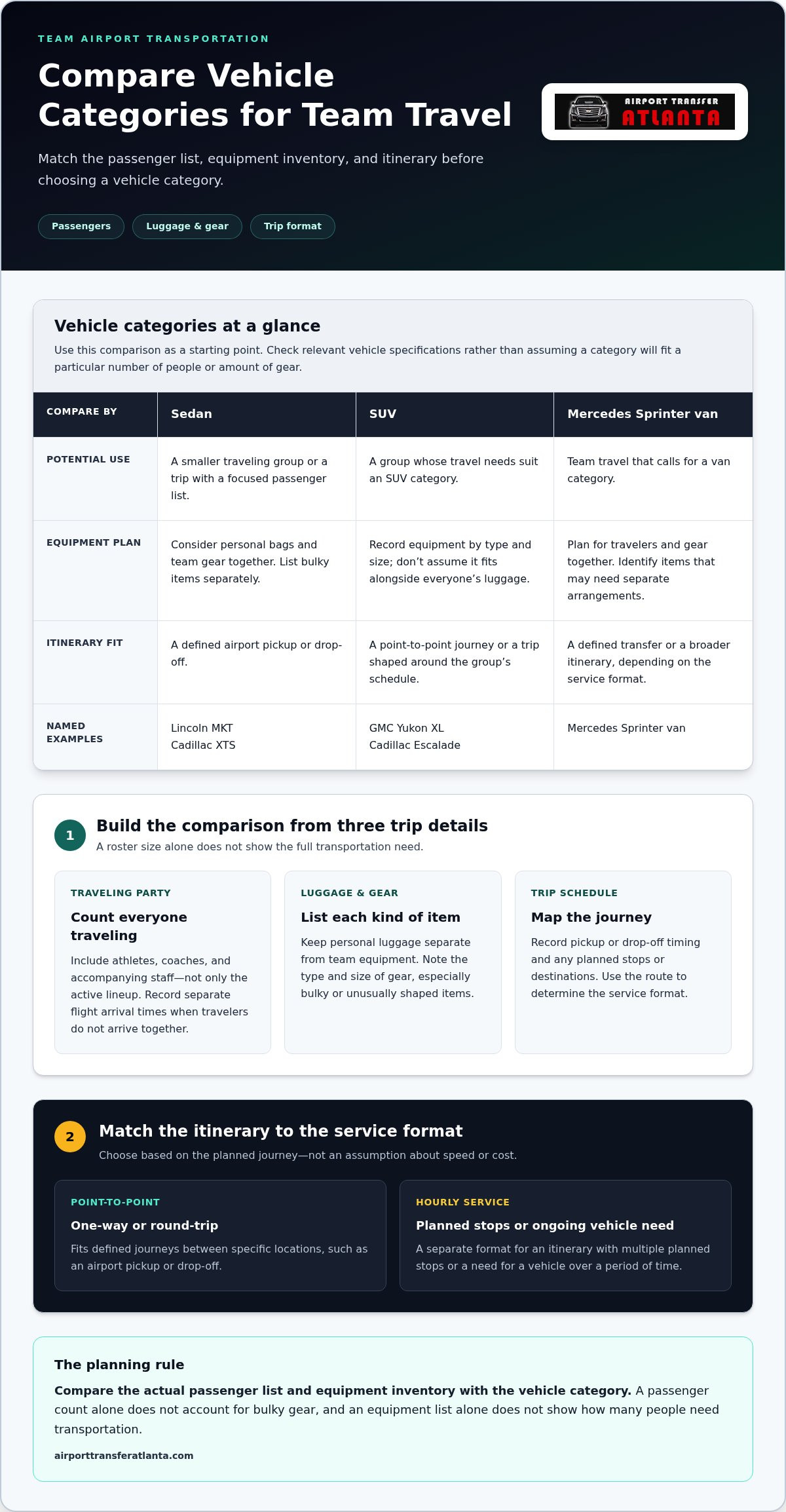
Compare the traveling group, trip schedule, and equipment inventory before choosing a vehicle category. A sedan, SUV, or Mercedes Sprinter van may suit different itineraries, but don’t assume a category will fit a particular number of people or amount of gear without checking the relevant specifications. Use the comparison below as a starting point, then match the category to the trip details.
| Vehicle category | Potential use case | Equipment planning | Itinerary fit |
|---|---|---|---|
| Sedan | A smaller traveling group or a trip with a focused passenger list | Consider how personal bags and team gear affect the plan. List bulky items separately. | A defined airport pickup or drop-off |
| SUV | A group whose travel needs suit an SUV category | List equipment by type and size rather than assuming it will fit alongside everyone’s luggage. | A point-to-point journey or a trip shaped around the group’s schedule |
| Mercedes Sprinter van | Team travel that calls for a van category | Plan for passengers and equipment together, and identify items that may need separate arrangements. | A defined transfer or a broader itinerary, depending on the service format |
When might a sedan or SUV suit a team itinerary?
Sedan options include Lincoln MKT and Cadillac XTS service. SUV options include GMC Yukon XL and Cadillac Escalade service. These categories may suit different passenger groups and schedules. Use the full passenger and equipment inventory to decide whether sports gear needs a separate transport plan rather than treating it as an afterthought.
A trip with only a few designated travelers may call for a different category from one involving more of the traveling party. That’s not a claim about capacity. It’s a reminder to compare the actual passenger list and equipment details with the vehicle category before settling the plan.
When should a team consider a Mercedes Sprinter van?
A Mercedes Sprinter van is a chauffeur-driven group-transportation option. Consider it when the itinerary calls for a van rather than a sedan or SUV. Plan for travelers and gear together: a passenger count alone doesn’t account for bulky or unusually shaped equipment, and an equipment list alone doesn’t show how many people need transportation.
For more detail, read the Mercedes Sprinter rental with driver guide. As you compare categories, keep one consolidated list of travelers and equipment, then align it with the trip format. Explore private chauffeur-driven airport transfers.
Plan sports equipment and luggage before booking an airport transfer
A useful transfer plan accounts for every traveler and every item the group expects to bring. Personal suitcases, team equipment, and bulky or unusually shaped gear all affect the transport arrangement. Record a ski bag separately from a standard suitcase, for example. Naming each item helps planners understand the group’s needs without assuming it will fit in a particular vehicle.
Prepare the details in this order before selecting a vehicle category:
- Count the travelers. Include athletes, coaches, and accompanying staff who need transportation on each part of the itinerary.
- List the gear. Record equipment types and approximate quantities, along with each traveler’s personal luggage.
- Group bulky items. Note which pieces travel together and identify rigid, delicate, oversized, or unusually shaped gear, such as ski bags or long equipment cases.
- Map the itinerary. Organize flight details, pickup or drop-off timing, destinations, and scheduled stops so the transportation plan reflects the actual trip.
How should a team make an equipment inventory?
Make the inventory specific enough to guide planning. Instead of writing “sports gear,” name the equipment types and estimate how many of each item the team will bring. Note which items are packed or transported together, and flag anything bulky, rigid, or delicate. This gives the organizer a clearer picture of the full load.
List personal luggage separately from team equipment, but keep both in one trip inventory. For instance, record suitcases as personal bags and shared equipment as its own category. This makes it easier to spot missing items and compare the complete group arrangement with the planned vehicle category. Avoid assumptions about luggage space or equipment fit.
What should the itinerary account for on travel day?
Put flight details, pickup timing, destination, and scheduled stops in one itinerary. If travelers arrive on separate flights or have different departure plans, show those timing differences clearly. One organized record helps the team contact coordinate updates and keeps passenger and equipment information aligned with the correct trip leg.
Assign one team contact to maintain the shared travel details and communicate the current plan. That person can consolidate information from athletes, coaches, and staff, reducing the chance that different versions of the passenger list or gear inventory circulate. Keep the record factual by listing the team’s planned times and locations.
Before settling the arrangement, compare the full passenger group and equipment inventory with the itinerary. Vehicle suitability depends on how travelers and gear fit into the overall plan, not just on headcount. A detailed inventory makes separate equipment needs visible before travel day.
Choose between point-to-point and hourly team airport transportation
Choose a service format that matches the itinerary. A direct airport journey has different requirements from a schedule that uses a vehicle for several planned stops. Compare the route and timing first so the arrangement reflects the trip instead of defaulting to one format for every travel plan.
Point-to-point service is organized around defined locations. One-way transfers suit a single journey, while round-trip transfers can cover a planned journey to a destination and a return. Hourly rental is chauffeur-driven service arranged by time. It can suit an itinerary that needs a vehicle over a defined period, particularly when it includes multiple stops. Neither format automatically fits every team’s schedule.
When is point-to-point service the clearer fit?
Consider a team traveling directly from the airport to its scheduled destination. With the journey endpoints established, the transportation plan has a clear origin and destination. A one-way transfer can suit that leg, while a round-trip arrangement can cover a planned return journey. Point-to-point may be less suitable when the schedule includes several stops or the vehicle is needed between destinations.
List the pickup location, destination, and whether the team needs a return transfer. If the itinerary changes from a direct journey to several planned stops, reassess the service format rather than assuming a point-to-point arrangement covers every leg. For a sports team airport transfer Atlanta, route details help distinguish a defined transfer from a schedule that calls for time-based transportation.
When can hourly service fit a multi-stop schedule?
Hourly rental is a chauffeur-driven option for a vehicle needed over a defined period. It may suit a schedule with several destinations or planned stops within the same itinerary. Before arranging it, write down the time period the team needs and map the intended route. This helps you compare a time-based rental with separate point-to-point journeys.
Review the booking’s stated mileage allowance per hour and how mileage beyond that allowance is handled. Don’t infer mileage terms from the hourly format alone. Include the route and planned stops in the service details so the arrangement reflects the team’s schedule.
Use a simple decision rule: choose point-to-point for specified journey endpoints and hourly service when the itinerary calls for a vehicle over a planned period. For more on planning chauffeur-driven transportation, the professional airport limo service guide offers additional service-planning context.
Set the itinerary format before selecting the vehicle category, then align both with the passenger and equipment plan. Arrange a chauffeur-driven airport transfer for your team’s planned journey.
Book a team airport transfer with clear passenger and equipment details
A well-organized booking starts with one accurate record of the team’s travel needs. Bring together the itinerary, passenger group, equipment inventory, vehicle category, and service format. This gives the organizer a consistent reference and reduces the risk of different people working from conflicting schedules or incomplete gear lists.
Prepare these details before arranging the transfer:
- Itinerary: Record flight details, transfer timing, pickup and destination locations, and planned stops.
- Passenger group: Include athletes, coaches, and accompanying staff who need transportation for each trip leg.
- Equipment and luggage: List personal bags and team gear separately, including bulky, rigid, delicate, or unusually shaped items.
- Vehicle category: Compare the sedan, SUV, or Mercedes Sprinter van category with the full passenger and equipment plan.
- Service format: Identify whether the schedule calls for a defined one-way or round-trip point-to-point journey or hourly transportation.
What details should the trip organizer prepare?
Compile flight and transfer information in one place before beginning the booking process. Summarize who is traveling, provide the complete equipment and luggage inventory, and identify differences in arrival or departure timing. Then map the planned route and stops. This gives the organizer a practical basis for selecting a vehicle category and service format without relying on headcount alone.
Keep the details specific and factual. Distinguish team equipment from personal suitcases, and describe oversized items by type rather than using a general label such as “gear.” A complete record helps the transportation plan reflect the actual group and itinerary.
How can the organizer keep team travel coordinated?
Assign one person to maintain the passenger list, equipment inventory, and finalized itinerary. That organizer can share the current details with the traveling group, including timing, destinations, and planned stops. If a flight or schedule changes, update the central record and circulate the revision so the team isn’t relying on separate versions.
Before finalizing the arrangement, review the information as a set. Check that the itinerary matches the service format and that the vehicle category reflects both travelers and their listed belongings. This review can reveal missing details, such as a staff member omitted from the passenger group or a bulky item left off the equipment list.
For a team traveling together, private chauffeur-driven transportation can bring ground-transfer details into one coordinated plan. Choose point-to-point service for defined journeys or hourly service for an itinerary planned around a period of vehicle use. Share the finalized details with the group so everyone works from the same plan.
Review chauffeur-driven airport transfer options and choose the service format that fits your team’s itinerary.
Set Your Team’s Transfer Plan in Motion
A coordinated ground travel plan gives the team organizer a clear reference to share, a consistent point of contact for updates, and a defined transportation arrangement as the itinerary takes shape. Keep the plan current if flight details or team requirements change, and distribute the same version to the traveling group.
For your sports team airport transfer Atlanta, align the service format and vehicle category with the group’s schedule and complete travel needs. Airport Transfer Atlanta offers one-way and round-trip point-to-point transfers, hourly chauffeur-driven rentals with a mileage allowance per hour, and sedan, SUV, and Mercedes Sprinter categories. Compare these options with your trip details and choose the arrangement that fits your team’s plan.
Review chauffeur-driven airport transfer options and arrange transportation for your team’s itinerary.
Frequently Asked Questions
Can a sports team take its equipment in an airport transfer?
Teams can plan to travel with sports equipment, but the full passenger and equipment arrangement determines which vehicle category suits the trip. Include every item in the inventory, especially equipment that is bulky, rigid, or unusually shaped. Don’t assume it will fit alongside passengers and personal luggage. A complete list helps the organizer plan around the actual load.
Which vehicle type is best for a team airport transfer?
There isn’t one best category for every team. A sedan, SUV, or Mercedes Sprinter van may suit different passenger groups and trip arrangements. For a sports team airport transfer Atlanta, compare the full traveling party, luggage, and equipment with the itinerary before choosing. Don’t base the decision on roster count alone: not every roster member may travel, and gear needs can vary between trips.
Should a team book a one-way transfer or hourly service?
Choose one-way service for a defined journey in one direction, such as an airport-to-destination trip. A round-trip point-to-point transfer can suit a planned return between specified locations. Hourly chauffeur-driven service may fit a schedule that needs a vehicle over a set period. Compare the itinerary, planned stops, and booking terms, including the hourly mileage allowance and how additional mileage is handled.
How should a team prepare ski equipment for an airport transfer?
List ski bags separately from ordinary suitcases. Note how many there are, who they belong to, and whether other equipment travels with them. Include them in the complete passenger and luggage plan rather than treating them as an afterthought. Because ski bags can be long or bulky, don’t assume they’ll fit in a particular vehicle. Include the inventory in the transfer details.
Can a team use hourly chauffeur service for multiple stops?
Yes. Hourly chauffeur-driven rental can suit an itinerary that needs a vehicle over a defined period and includes multiple planned stops. Prepare the stop sequence and timing so the intended use is clear. The booking has a mileage allowance per hour, and additional mileage may result in additional charges. Compare this format with the planned journey and its terms before choosing.
What information should a coach provide when arranging airport transportation?
A coach should provide flight and transfer timing, pickup and destination details, planned stops, the full passenger list or count, and an inventory of team equipment and personal luggage. Identify separate arrival times and flag bulky or delicate items. One team contact can keep the information consistent as plans change, helping prevent omissions and giving the transportation plan a clear record to follow.


