

What if the vehicle has room for your family but not for the car seats and luggage? An airport transfer for family with car seats works best when you plan the child restraints, passenger count, bags, and pickup details together. Choose a vehicle category based on the full travel load, not just the number of people.
It’s reasonable to want a clear plan before travelling with children. Decide which car seats your children need and whether you’ll bring them, then share your passenger and luggage details when arranging the ride. We offer private point-to-point transportation in sedan, SUV, and Mercedes Sprinter van categories. Consider which category best suits your party and belongings, while following the seat manufacturer’s instructions for fit and installation.
This guide explains how to organize your child-seat and luggage plan, compare vehicle categories, and make airport pickup more straightforward. You’ll also learn which trip details to provide and how one-way, round-trip, and hourly service options can fit different itineraries. A few decisions before departure can help keep the group together and the transfer organized.
Key Takeaways
- Plan child restraints, passenger count, luggage, and schedule as one travel arrangement.
- Use the child-seat manufacturer’s instructions and applicable vehicle manual to guide restraint selection and fit.
- Compare sedan, SUV, and Sprinter options based on your party’s seating and luggage needs. Don’t assume capacity.
- For an airport transfer for family with car seats, provide accurate pickup, destination, passenger, and luggage details when arranging the trip.
- Choose one-way, round-trip, or hourly transportation to match your itinerary and keep the family travelling together.
Airport transfer for a family with car seats: plan around the real travel constraints
Travelling with children means managing more than a pickup time. Child restraints, carry-ons, checked bags, strollers, and the airport schedule all affect the ride. A reservation alone doesn’t show whether the full party and its belongings can travel comfortably together. For an airport transfer for family with car seats, plan these details together rather than treating vehicle selection as a separate step.
A private airport transfer is a chauffeured ride arranged for your party and route. It differs from a self-drive rental, where your family operates the vehicle, and a shared shuttle, where passengers from different bookings travel together. With a private transfer, you can plan around your own passengers, restraints, luggage, and itinerary.
A family-ready transfer plan aligns four logistics: passengers, child restraints, luggage, and the trip schedule.
What makes an airport transfer workable for a family?
Start with the people travelling, not just the vehicle category. Count every adult and child, including children who need their own seating position. Then identify the restraint each child will use. A child seat takes up space and affects how passengers can be seated, so account for it before choosing between a sedan, SUV, or Sprinter.
Next, make a realistic luggage list. A family travelling with a stroller, several suitcases, and a child seat has different space needs from a party with the same number of passengers carrying only small bags. Don’t choose a vehicle based on passenger count alone. Consider the complete travel load without relying on an unverified capacity estimate.
Child seats come in different types and serve different stages of a child’s growth. For general background, consult this Child safety seat overview. Follow the seat manufacturer’s instructions and the applicable vehicle manual for guidance on the specific restraint and its installation.
Which details should shape the plan first?
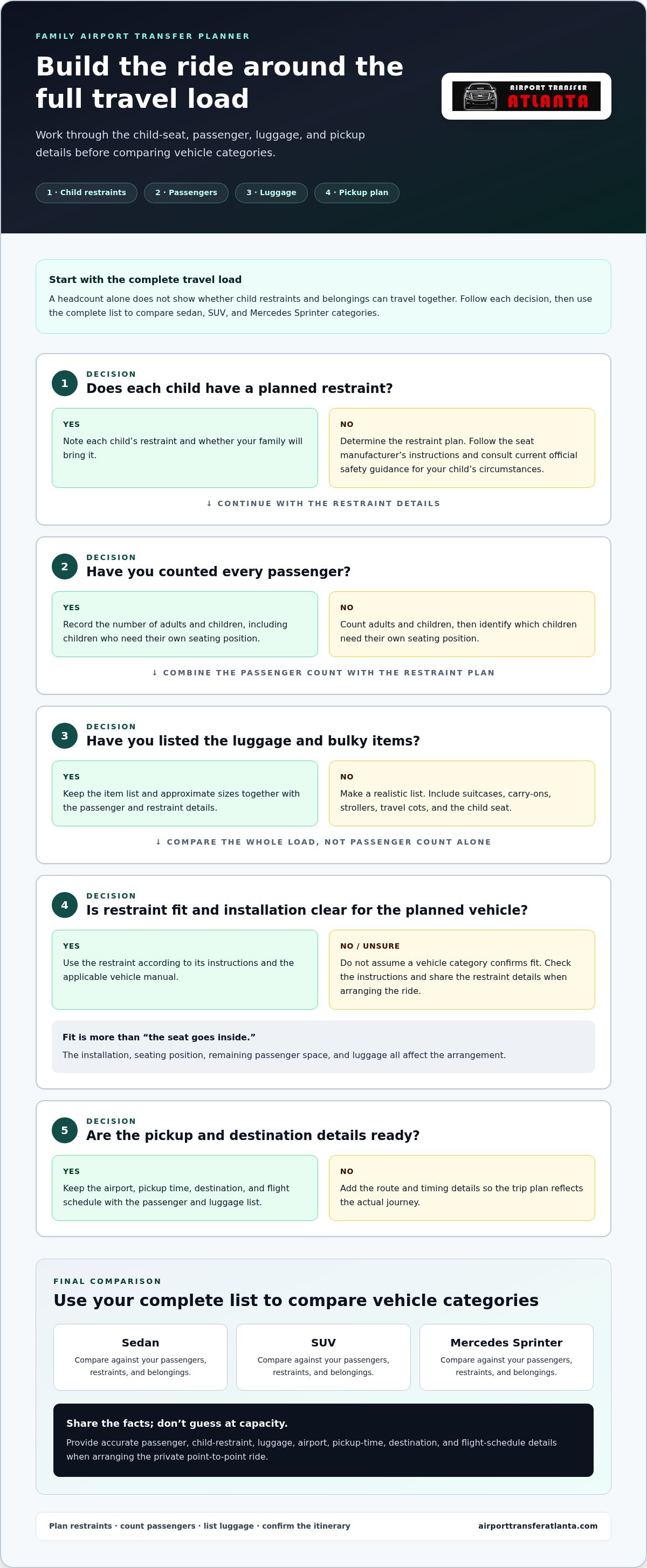
Build the plan in sequence. Record the number of adults and children, then note each child’s restraint needs and whether your family will bring the seat. Once that’s clear, estimate the luggage by item and approximate size. This gives you a more useful basis for comparing vehicle space than a headcount alone.
- List passengers and identify children who need their own seating position.
- Describe each child restraint and include bulky items such as strollers or travel cots.
- Record the airport, pickup time, destination, and flight schedule.
Include your itinerary when arranging point-to-point transportation. The airport and destination establish the route, while the pickup time and flight schedule help define the timing. Keep these details with your passenger and luggage list so the vehicle choice reflects the actual journey, not an incomplete reservation summary.
We provide private chauffeur-driven transportation in sedan, SUV, and Mercedes Sprinter categories. Use your passenger, restraint, and luggage plan to guide your choice, then match it to the pickup itinerary. This approach gives your family a clearer plan for travelling together.
Car seat types and fit: what families should check before an airport transfer
Choosing a restraint is separate from choosing a vehicle. Infant seats, forward-facing child seats, and booster seats are broad categories, but the right option depends on the child and the specific seat. Avoid relying on a general age guideline alone. Follow the seat manufacturer’s instructions and consult current official safety guidance for your child’s circumstances. The NHTSA Car Seat Recommendations explain how to choose and install car seats and booster seats.
Correct restraint selection and installation depend on the child, the seat, and the vehicle. That matters for an airport transfer for family with car seats because a familiar seat still needs to be used according to its instructions in the vehicle travelling that day.
How should families plan to travel with their own car seat?
Before departure, review the seat manual and identify its approved installation methods. Note any required components and keep them with the seat. If you’re unsure how the instructions apply to your vehicle, use an official child passenger safety resource rather than guessing.
Plan the seat’s journey through the terminal as well as its use in the car. Consider how you’ll carry or transport it alongside children, bags, and any stroller. A bulky seat, for example, may be harder to manage through check-in and boarding than a compact travel setup. Decide who will handle it at each stage, and keep the manual and necessary parts accessible rather than buried in checked luggage.
- Review the seat’s instructions before travel and note the permitted installation methods.
- Pack required components together so they’re available at pickup.
- Plan how the restraint will move through the terminal and into the vehicle.
What does car-seat fit mean in a chauffeured vehicle?
Fit involves more than whether a seat can be placed inside a vehicle. The restraint must be installed according to its instructions, the seating position must work for that installation, and the remaining space must accommodate other passengers. Luggage also affects the overall arrangement. A vehicle category alone doesn’t establish that a particular seat will fit or can be installed in a specific position.
When arranging private chauffeured transportation, describe the child restraint you’ll bring along with your passenger and luggage details. This helps you consider the vehicle choice in light of the full trip, without assuming seat compatibility or a specific capacity. We offer sedan, SUV, and Mercedes Sprinter transportation categories for private trips. Families can plan a private airport transfer around their itinerary and the travel equipment they expect to bring.
If installation questions remain, consult the seat manufacturer’s guidance and current official child passenger safety resources. Requirements and recommendations can depend on your location and circumstances, so use guidance that applies to your trip. Prepare the restraint, its instructions, and a clear plan for using it in the vehicle before travel day.
Which airport transfer vehicle fits a family, car seats, and luggage?
The best vehicle category isn’t necessarily the largest or most prestigious. For an airport transfer for family with car seats, compare the full travelling party, the seating positions they’ll occupy, the restraints being brought, and the actual luggage load. A sedan may suit one itinerary, while a family with more travellers or bulkier items may want to consider an SUV or van. Category names alone don’t establish capacity or car-seat compatibility.
When might a sedan, SUV, or Sprinter suit the itinerary?
Use this comparison as a planning guide, not a promise about fit. The right choice depends on the specific passenger and luggage arrangement.
| Vehicle category | Possible trip profile | Seats and restraints to consider | Luggage planning |
|---|---|---|---|
| Sedan | A smaller travelling party with a relatively compact load. | Count every occupied seating position, including those needed by children. Consider the restraint and its installation requirements. | List suitcases and any bulky items. Don’t assume they’ll fit based on passenger count. |
| SUV | A party considering a different vehicle format for its passenger and luggage arrangement. | Account for each traveller and child restraint. A larger category doesn’t establish that a particular seat will fit. | Include strollers and other oversized items alongside bags. |
| Mercedes Sprinter van | A group considering a van for shared private travel. | Map occupied seats and restraint needs to the actual party rather than assuming compatibility. | Estimate the complete load, including bags and family equipment. |
How should families compare usable space?
Make a simple inventory before selecting a category. Count adults and children, then identify how many seating positions will be occupied. Next, list luggage by type and size. A family with a stroller, several suitcases, and a child restraint needs a different space plan from a group carrying only smaller bags, even if both include the same number of travellers.
Our sedan options include the Lincoln MKT and Cadillac XTS. SUV options include the GMC Yukon XL and Cadillac Escalade, while the Mercedes Sprinter is a van option for group travel. Assess each category against your passenger, restraint, and luggage details. For more background, read the luxury SUV service guide and consider how the vehicle types described compare with your trip needs.
A larger vehicle isn’t automatically the best choice. It may not suit a smaller party’s itinerary, and it doesn’t guarantee that a particular restraint will fit. Choose based on the full travel load and schedule, not vehicle prestige. Sharing accurate details gives your vehicle selection a practical basis and helps your family plan to travel together in a private chauffeur-driven transfer.
How to book an airport transfer for a family with car seats
A useful reservation starts with a clear account of the trip, not just a pickup address. For an airport transfer for family with car seats, work through the details in order so the vehicle category and booking format reflect your family’s needs. A private point-to-point transfer keeps your party together for the airport journey.
What information should be ready before making a reservation?
Before booking, gather the travel date, airport pickup details, destination, and flight schedule. Decide whether you need a one-way ride, transportation in both directions, or a chauffeur for a set period. For broader guidance on arranging private airport transportation, see this professional airport limo service guide.
- Set the child-seat plan. Identify the restraint each child will use and whether you’ll bring it. Keep the seat instructions available so your family can follow the manufacturer’s directions.
- Count the travelling party. List adults and children, including each child who needs an individual seating position. This count is the starting point for considering the vehicle, not a substitute for assessing space.
- Inventory the luggage. Note suitcases, carry-ons, strollers, and other bulky items. Describing the items and their approximate size gives a more realistic picture than listing only the number of bags.
- Select a vehicle category. Consider the full combination of passengers, restraints, and belongings when choosing among sedan, SUV, and Sprinter options. Don’t assume a category guarantees a particular seat fit or capacity.
- Provide the itinerary. Share accurate pickup and destination details for a point-to-point transfer, along with the flight schedule and whether the trip is one-way or includes a return.
These booking formats suit different itineraries. A one-way transfer covers a single point-to-point journey. A round-trip arrangement plans transportation for both the outbound and return journeys. Hourly chauffeur-driven service is organized around a period of time rather than one direct airport-to-destination trip. Choose the format that matches the journey you need to arrange.
How can families prepare for pickup day?
Keep travel documents, the child-seat manual, essential child items, and any restraint components easy to reach. After landing, allow time to leave the terminal, collect baggage, organize children and equipment, and reach the designated pickup point. Build these steps into your itinerary rather than assuming everyone can move straight from the aircraft to the vehicle.
Complete trip details give pickup coordination a clearer foundation. Accurate flight, location, passenger, and luggage information helps align the reservation with your family’s travel plan. Use those details to arrange a private chauffeur-driven transfer that fits your itinerary, and arrange your airport transfer with the travel information ready.
Arrange a smoother family airport transfer with private chauffeur service
A well-planned family transfer follows a clear sequence: settle the child-restraint plan, count the adults and children, inventory luggage, choose a vehicle category, and set out the pickup itinerary. This turns the reservation into a practical travel plan. We provide private chauffeur-driven transportation in Lincoln MKT and Cadillac XTS sedans, GMC Yukon XL and Cadillac Escalade SUVs, and a Mercedes Sprinter van.
Choose among these categories based on the complete travelling party and its belongings, not vehicle prestige alone. Include child-seat details and a luggage inventory in your plan, and follow the seat manufacturer’s instructions and relevant safety guidance for restraint selection and installation. Vehicle categories don’t establish capacity or compatibility with a particular seat by themselves.
Which service format fits the family itinerary?
Match the booking format to the structure of your trip. A one-way transfer covers a single airport journey, such as travel from the airport to a destination. A round-trip arrangement covers planned travel in both directions. Hourly rental is chauffeur-driven transportation organized by time, which can suit an itinerary that calls for transportation over a period rather than just one point-to-point journey.
These formats serve different purposes. Base your choice on where and when your family needs transportation, including whether a return journey is part of the plan. Keep the itinerary clear so the selected service structure reflects the trip you intend to make.
What should the final plan make clear?
Before completing your reservation, make sure the trip details are consistent and complete. Include the selected service format, travel date, passenger count, luggage plan, child-restraint information, pickup location and time, flight schedule, and destination. For a return journey, include those details as well. Accurate information gives the reservation a clear basis for coordinating the planned pickup and vehicle category.
Keep the restraint instructions accessible for travel day. Follow the seat and vehicle instructions, along with current safety guidance relevant to your circumstances, when selecting and installing the child seat. The chauffeur-driven transfer organizes the transportation; families should make their restraint plan according to those instructions and guidance.
With the restraint plan, party size, luggage, vehicle category, and itinerary aligned, you can arrange transportation around your family’s needs. Select the one-way, round-trip, or hourly format that fits your schedule, then provide the pickup and destination details. Arrange your family airport transfer.
Set your family transfer plan in motion
Before travel day, save the reservation details and child-seat instructions where the travelling adults can access them. Agree who will keep track of the restraint and essential child items, and who will coordinate the group and bags at pickup. This simple handoff can make your airport plan easier to follow when everyone is focused on getting children and luggage together.
A well-prepared airport transfer for family with car seats starts with decisions made before the journey, not at the curb. Keep your itinerary details current and use them to arrange transportation that reflects your family’s needs. With the plan organized, you can approach the airport journey with greater clarity.
Start arranging your family’s airport transportation and take the next step toward a more orderly trip.
Frequently Asked Questions
Can I travel with my own car seat in a private airport transfer?
Yes, families can travel with a car seat they own in a private airport transfer. Before departure, check the seat manual and relevant vehicle guidance for approved installation methods. Plan how you’ll carry it from the terminal to the pickup point, and keep its instructions and required components accessible. Include the restraint in your airport transfer for family with car seats plan. If installation questions remain, consult an official child passenger safety resource.
Is a car seat required for every child in an airport transfer?
Requirements depend on applicable laws and the child’s circumstances, and rules can vary by jurisdiction. Don’t use a general travel article as a legal determination. Before travelling, consult current official guidance for the places involved and follow the car-seat manufacturer’s instructions. If your trip includes travel across jurisdictions, review the rules that apply to each part of the journey, then plan the seating arrangement around the appropriate restraint.
How much luggage can a family bring when travelling with car seats?
There isn’t one luggage amount that fits every family transfer. The practical load depends on the vehicle, passenger count, space occupied by restraints, and the dimensions of the bags. Make an itemized estimate that includes suitcases, carry-ons, a stroller, and any bulky child equipment. A stroller plus several large cases can change the space plan even if the number of travellers is modest. Share the inventory when arranging transportation.
Can an infant car seat be installed rear-facing in a chauffeured vehicle?
It depends on the specific seat, the child’s fit, and the vehicle seating position. Follow the seat manufacturer’s manual and relevant vehicle guidance, and don’t assume a restraint fits every vehicle or seating position. Check the instructions before travel so you understand the permitted installation method. If you’re unsure whether the seat can be installed as directed, consult an appropriate child passenger safety resource before the journey.
Can I book a one-way or round-trip airport transfer for my family?
Yes, both one-way and round-trip point-to-point transfers are available. A one-way booking suits a single airport journey, such as arrival travel when you have separate plans for the return. Choose round-trip transportation when organizing both airport journeys as part of the itinerary. Before reserving, have the flight schedule, pickup and destination details, passenger count, and luggage plan ready so the arrangements reflect the trip in each direction.
What happens if our flight schedule changes after arranging transportation?
A flight change may affect your planned pickup time, so review your reservation details when the itinerary changes. Use the booking channel associated with your reservation to provide updated trip information. Don’t assume the driver is automatically tracking the flight or that pickup arrangements change without updated details. Keep your revised flight time, airport pickup information, and reservation record together so you can refer to the correct itinerary when making an update.


