

What if a vehicle has enough seats for your group but too little room for its luggage? Choosing multi-passenger executive transport means accounting for both, along with arrival times, passenger needs, and the itinerary. The right arrangement depends on how your group will travel, not just how many people are going.
This guide explains how to match passengers and luggage to a suitable vehicle category, then choose a booking format that fits the schedule. Airport Transfer Atlanta offers chauffeur-driven Lincoln MKT and Cadillac XTS sedans, GMC Yukon XL and Cadillac Escalade SUVs, and Mercedes Sprinter vans for group and executive travel.
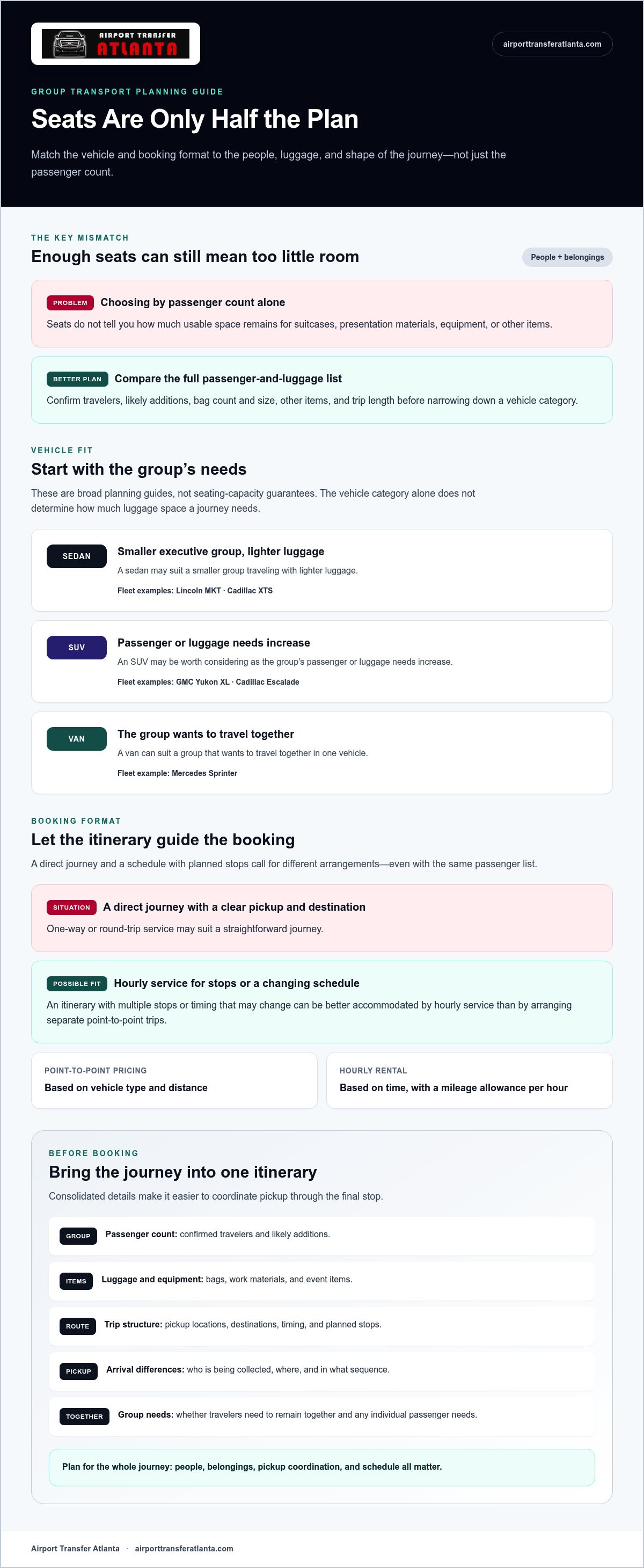
You’ll learn when a one-way or round-trip transfer may suit a direct journey, and when hourly service can better accommodate multiple stops or a changing schedule. Point-to-point pricing is based on vehicle type and distance, while hourly rentals are based on time and include a mileage allowance per hour. Use these details to plan a coordinated journey from pickup through the final stop.
Key Takeaways
- Plan multi-passenger executive transport around both the number of travelers and the luggage they’ll bring.
- Compare seating needs with usable luggage space; enough seats don’t automatically mean enough room for bags.
- Match the booking format to the itinerary: a direct journey differs from a plan with multiple stops or changing timing.
- Consolidate pickup locations, destinations, and timing in one itinerary to help coordinate the group journey.
- Use your group’s size, luggage, and schedule to narrow down the most suitable vehicle category.
When Does Multi-Passenger Executive Transport Make Sense?
Multi-passenger executive transport is pre-arranged, chauffeur-driven travel for a group whose journey benefits from coordinated pickup and transportation. It can suit airport journeys, business travel, meetings, and group events where colleagues or guests need to reach the same destination or follow a shared schedule. Look beyond the passenger count: consider luggage, pickup arrangements, and whether the itinerary is direct or includes planned stops.
Private group transportation keeps the vehicle and itinerary focused on your group. A shared shuttle, by contrast, may carry passengers with separate destinations or pickup arrangements. A private vehicle can make coordination simpler when travelers need to move together, while a shared service follows its own passenger arrangements.
Private group transport is a practical fit when keeping travelers together makes the pickup plan, schedule, or journey easier to coordinate.
Which group journeys benefit from a private vehicle?
Consider a team traveling from an airport to a meeting, or guests heading together to an event. A designated vehicle gives the organizer one group itinerary to coordinate instead of asking each traveler to manage a separate ride. The chauffeur-driven fleet includes sedans, SUVs, and Mercedes Sprinter vans, with the choice guided by the group’s passenger and luggage needs.
A direct airport journey has a clear pickup and destination. A business itinerary with a meeting, another appointment, and a final drop-off has a different structure. Planned stops may make an hourly booking more suitable than arranging separate point-to-point trips. For context on how a coach differs from other bus types, see Coach (bus). A coach is a distinct vehicle category, not a description of every private group journey.
What should an organizer assess before choosing?
Start with a confirmed passenger count, including likely additions. Then list suitcases, presentation materials, equipment, and any other items traveling with the group. Seating and luggage space are separate considerations: a passenger count alone doesn’t show whether everything will fit. Record pickup points, destination, timing, planned stops, and whether travelers need to stay together.
If travelers arrive at different times, make a pickup plan that states who is being collected, where, and in what sequence. Put those details into one itinerary so the group has a clear schedule. Account for different arrival times or passenger needs instead of assuming everyone will be ready at once.
- Passenger count: Include expected late additions.
- Luggage and items: Account for bags, equipment, and materials.
- Trip structure: Note pickup locations, timing, destinations, and stops.
- Group coordination: Decide whether travelers need to remain together.
This assessment gives you a clearer basis for choosing a vehicle category and booking format. A direct transfer and a day with several scheduled stops call for different planning, even if the passenger list is the same.
Matching Executive Vehicles to Passenger and Luggage Needs
Start with the people and items traveling, then compare vehicle categories. A simple planning table can clarify the choice, especially when you’re balancing a tight itinerary with mixed luggage or work materials. Use four columns: passenger count, luggage and equipment, trip length, and vehicle category to consider. Treat the result as a planning guide, not a seating-capacity guarantee.
Assess luggage alongside passenger count because available seats don’t tell you how much usable space remains for bags and other items. A group with carry-on bags has different space needs from the same number of travelers bringing larger suitcases, presentation materials, or event equipment. Include every confirmed traveler and consider possible additions or extra bags. Don’t select a vehicle based only on how many people can be seated.
How should passenger count and luggage shape the choice?
Build a simple comparison before selecting a category. Record the confirmed number of travelers, the type and amount of luggage, any equipment, and how long the group will be in transit. On a longer journey, personal space and access to belongings may matter more. For a brief transfer, fitting the group and its items for a direct trip may be the main consideration. Keep these factors visible together rather than treating them as separate decisions.
- Passenger count: Include all travelers and likely additions.
- Luggage volume: Note the number and general size of bags.
- Other items: Account for work materials or event equipment.
- Trip length: Consider how long the group will travel.
- Vehicle category: Compare sedan, SUV, and van options against the full list.
Leave a practical margin in the plan. If the passenger list or luggage may change, choosing based on the minimum expected requirements can result in a poor fit. The goal is not simply to find enough seats, but to plan a journey where people and belongings can travel together appropriately.
When might a sedan, SUV, or van suit the group?
A sedan may suit a smaller executive group with lighter luggage. An SUV may be worth considering as passenger or luggage needs increase. A van can suit a group that wants to travel together in one vehicle. These are broad categories, not interchangeable solutions, and the category alone doesn’t determine how much luggage space a particular journey requires.
The chauffeur-driven fleet includes Lincoln MKT and Cadillac XTS sedans, GMC Yukon XL and Cadillac Escalade SUVs, and Mercedes Sprinter vans. Use your passenger and luggage comparison to guide the category choice, then consider the trip structure. Review the chauffeur-driven vehicle options alongside your travel requirements.
Point-to-Point or Hourly Executive Transport: Which Fits Your Itinerary?
The right booking format depends on how your group’s schedule is structured. A point-to-point transfer is arranged between specified pickup and destination locations. An hourly rental is based on reserved time and can suit a continuing itinerary with multiple planned stops. Compare the route, expected waiting periods, and likelihood of schedule changes before choosing.
Each format uses a different pricing basis. Point-to-point pricing is based on vehicle type and distance. Hourly rental pricing is based on time and includes a mileage allowance per hour. Additional costs apply if the trip exceeds the applicable mileage allowance. Consider both the route and the time commitment when organizing multi-passenger executive transport.
When is a point-to-point transfer the clearer fit?
Choose a point-to-point structure for a defined journey, such as a pickup followed by a direct trip to an airport, office, or event venue. It can also suit a planned round trip with specified locations. With a clear route, the organizer can coordinate the group around a known pickup and destination instead of planning transportation throughout a longer schedule.
Before booking, assemble the pickup and destination details for each leg, including whether the group needs a one-way transfer or a return journey. This format is most straightforward when the itinerary has limited stops and the destination is established in advance. The point-to-point price is tied to vehicle type and distance, so the cost basis follows the planned route.
When can hourly service support a more flexible schedule?
Hourly service can fit a continuing group itinerary, especially when it includes several planned stops, meetings, or an event followed by another destination. Instead of organizing each leg as a separate point-to-point trip, the organizer can plan around a reserved period of service. This can simplify coordination when the group needs transportation across several locations.
Map the stops and estimate the route before choosing an hourly format. The mileage allowance is included per hour, so consider planned distance as well as the time the itinerary may require. Additional costs apply when mileage exceeds the applicable allowance. A longer time reservation doesn’t remove the need to account for distance.
Use this quick comparison to narrow down the format:
- Defined pickup and destination: Point-to-point, with pricing based on vehicle type and distance.
- Specified return journey: Point-to-point legs can suit a clear outbound and return plan.
- Several planned stops: Hourly service can support a continuing itinerary.
- Route with mileage to track: Hourly service includes a mileage allowance per hour; additional costs apply beyond applicable limits.
Write down the stops and their sequence, then decide whether the group needs transportation for one direct journey or across a block of time. A stable, direct route generally points toward point-to-point service. An itinerary with multiple scheduled locations may align better with hourly rental. Match the booking format to the trip rather than trying to make the schedule fit the service.
How to Plan a Smooth Executive Group Journey
A clear itinerary gives passengers and the transportation arrangement one shared reference point. Build it before travel, update it when details change, and share the final version with everyone involved. For multi-passenger executive transport, keep pickup locations, destination details, and timing together instead of relying on separate messages or individual assumptions.
What details belong in a group travel plan?
Include the confirmed passenger list, pickup addresses, destination, travel dates, and planned stops. For an airport journey, add each traveler’s flight details and arrival information so the organizer can account for different arrival needs. Record luggage, presentation materials, and event equipment, too. These details help align the vehicle plan with the group’s actual requirements.
Use this ordered checklist to prepare the journey:
- Confirm the travelers. Set the passenger count and identify anyone whose attendance is still changing.
- Gather trip details. Record travel dates, pickup addresses, final destination, and planned stops.
- Coordinate arrivals. For airport pickups, compile flight details and note when each traveler is expected to arrive.
- List luggage and equipment. Include bags, work materials, and event items that need to travel with the group.
- Set the schedule. Note the meeting time, departure plan, stop sequence, and timing constraints.
- Choose a group contact. Identify the person responsible for sharing updates and communicating the final itinerary.
- Distribute one final plan. Send the same itinerary to all passengers and make updates in that shared version.
How can an organizer reduce day-of confusion?
Give passengers one itinerary with the meeting location, departure time, pickup sequence, and destination. Name a group point of contact so questions and schedule changes don’t circulate through multiple people. Set a clear meeting plan, including where travelers should gather and when the group is expected to depart. If a passenger or bag is added, update the shared plan and notify the group.
Keep the itinerary easy to scan. Separate pickup information from destination details, and list stops in travel order. If you’re considering a Sprinter van, include it in the vehicle plan alongside passenger and luggage requirements, so the choice reflects the group’s needs as well as the itinerary.
Before travel, review the final version for missing addresses, conflicting times, passenger changes, and unlisted stops. A single, current itinerary helps the organizer communicate a consistent plan and gives passengers a clear reference. See the group transportation options when planning a coordinated journey.
Choose Chauffeur-Driven Executive Transport for Your Group
A well-matched group journey starts with the travelers, not the vehicle name. Confirm how many people are going, account for luggage and other items, then map the itinerary. Once those details are clear, choose a booking format that fits the trip. This sequence helps you plan multi-passenger executive transport around the group’s actual needs rather than relying on seat count alone.
Airport Transfer Atlanta offers chauffeur-driven sedans, SUVs, and Mercedes Sprinter vans, along with one-way, round-trip, and hourly service. Each category serves a different planning need. Use passenger and luggage requirements to narrow down the vehicle type, then let the route and schedule guide the booking format.
What service options does the provider offer?
The sedan category includes Lincoln MKT and Cadillac XTS service. GMC Yukon XL and Cadillac Escalade service are available in the SUV category. Mercedes Sprinter vans offer another vehicle category for group transportation. These options aren’t interchangeable by name alone: compare the passenger list, luggage, and planned journey to determine which category aligns with the trip.
Booking format matters just as much. A one-way transfer suits a single, defined journey, while a round trip accounts for planned outbound and return travel. Hourly rental is structured around time and can suit an itinerary with multiple scheduled locations. Point-to-point pricing is based on vehicle type and distance; hourly pricing is based on time and includes a mileage allowance per hour.
How do you take the next step?
Use this sequence to turn your travel details into a practical plan:
- Confirm the group. Set the passenger count and note any likely changes.
- Account for belongings. Include luggage, work materials, and event equipment.
- Choose a vehicle category. Compare the group’s needs with sedan, SUV, and Mercedes Sprinter van options.
- Map the itinerary. List pickup points, destinations, stops, and timing in order.
- Select the service format. Choose a one-way or round-trip transfer for a defined route, or hourly service for a time-based itinerary.
Before finalizing the plan, review the passenger count, luggage list, and route together. If the itinerary includes several stops, factor in the planned time and hourly mileage allowance. For a direct trip, keep the pickup and destination details clear. A complete plan makes it easier to align the vehicle and service format with the group’s requirements.
Compare the chauffeured transportation options with your group’s passenger count, luggage, and itinerary.
Set Your Group Journey in Motion
A well-planned trip gives every traveler a clear expectation of what happens next. Before booking, bring the final travel decisions into one place and make sure the group is working from the same plan. If details change, update that shared reference so no one relies on an outdated message. This helps make multi-passenger executive transport a coordinated part of the journey rather than another moving piece for each traveler to manage.
With the group’s requirements organized, you can select the arrangement that fits. Match the vehicle category to the passengers and their belongings, then choose a transfer or hourly service based on the itinerary.
Review chauffeur-driven group transportation options and plan a coordinated trip around your group’s travel needs.
Frequently Asked Questions
What is multi-passenger executive transport?
Multi-passenger executive transport is pre-arranged, chauffeur-driven travel organized for a group. It can be useful when colleagues, clients, or event guests need a coordinated journey rather than separate rides. For example, an organizer can plan one pickup arrangement for a team traveling to a meeting. The service format and vehicle category depend on the group’s itinerary, passenger needs, and belongings.
How do I choose the right vehicle for a group and its luggage?
Compare the passenger list with the luggage and items the group will bring, then choose a vehicle category that suits both. A group traveling with small personal bags has different space needs from one carrying presentation cases or event equipment. Consider the full trip, too: belongings that stay with passengers during a longer journey may affect the preferred arrangement. Don’t use seat count alone to judge the fit.
Is hourly executive transport better than a point-to-point transfer?
Neither format is automatically better; the trip structure determines the better fit. A transfer is useful for travel between set locations, such as a pickup and a single destination. Hourly service can suit a group attending appointments at different locations before continuing to a final stop. For a changing itinerary, consider the time needed and planned mileage; for a fixed route, focus on the specific distance and vehicle category.
Can a chauffeur-driven vehicle accommodate a group and its airport luggage?
It depends on the number of passengers, the amount and size of their luggage, and the vehicle category. A group with several large suitcases has different requirements from one carrying compact bags, even if the passenger count is identical. Make a complete luggage list, including carry-ons and work items, and consider it alongside the traveler count. This gives the vehicle selection a more realistic basis than seats alone.
What information should I prepare when arranging executive group transportation?
Prepare the passenger names or count, travel date, pickup and destination addresses, and the group’s luggage needs. For airport travel, include flight details and arrival times, especially if travelers arrive separately. Add planned stops, departure timing, and any items that need space. Choose one person to manage updates, then share a single itinerary so passengers can refer to the same current instructions.
What is the difference between executive van service and a shared shuttle?
Executive van service is chauffeur-driven transportation arranged for a specific group, with the journey planned around that group’s travel details. A shared shuttle carries passengers who may not be traveling together and can follow a route serving multiple riders. For a corporate team or event party that needs to coordinate its own pickup and destination, a private van arrangement keeps the group’s travel plan distinct.


