

A client’s first impression may take shape before the first meeting begins. A polished airport pickup isn’t a display of luxury; it’s a coordinated handoff that respects the client’s time and makes the next step clear. If you’re considering how to impress clients with airport pickup, start with the details that prevent confusion: a clear plan, useful arrival instructions, and transportation suited to the itinerary.
A delay or vague pickup directions can set the wrong tone, but a professional welcome doesn’t need to be elaborate. It needs to be organized, considerate, and easy for your client to follow.
This guide explains how to share pickup information without overwhelming a traveler, plan the transition from landing to the destination, and choose transportation that fits the passenger group and schedule. You’ll also learn when a point-to-point transfer or an hourly chauffeur-driven rental may suit the itinerary, and how to consider sedan, SUV, and van options. The goal is to make arrival feel like a well-managed part of the business visit.
Key Takeaways
- Learn how to impress clients with airport pickup by treating the arrival as a coordinated business handoff, not a grand gesture.
- Use a simple planning sequence to align the pickup with the client’s arrival, passenger needs, and onward schedule.
- Match the transportation format and vehicle category to the itinerary, group, and luggage requirements.
- Share concise meeting instructions that make it easier for a client to find the pickup and continue the journey.
- Follow a calm response sequence when travel plans change, so unexpected delays don’t add avoidable confusion.
Why an Airport Pickup Can Shape a Client’s First Impression
Welcoming a client after a long flight can feel like a high-stakes task. They may be tired, carrying luggage, and focused on reaching their next appointment. A polished arrival doesn’t require a grand gesture. It requires a plan that makes the next step clear and respects the client’s time.
Airports involve multiple routes, facilities, and points of movement. A general overview of airport operations and infrastructure helps explain why vague meeting directions can add friction. You don’t need to explain every detail of the airport. You do need to give the client the right information at the right time.
A smooth pickup combines preparation, communication, and suitable transport. Punctual coordination and clear instructions demonstrate consideration before the client reaches the vehicle. The aim is to support their comfort and schedule, not to use luxury as a substitute for thoughtful service.
What a client notices before reaching the vehicle
From the client’s perspective, two practical questions come first: who is meeting them, and where should they go? Answer both in one concise message. Identify the meeting person or driver, describe the agreed meeting point, and provide a direct way to communicate if the client can’t locate it.
Send the details in time for the client to refer to them during arrival, and keep them easy to find. Focus on what the client needs to do next. Don’t assume they want a conversation, help with luggage, or a formal greeting. A courteous introduction and attention to their cues let the welcome suit the person.
This is where how to impress clients with airport pickup becomes less about appearance and more about reducing uncertainty. A premium vehicle may contribute to comfort, but it can’t compensate for instructions that leave a traveler unsure where to go. A simple, well-timed message can do more for the handoff than extra details the client has to sort through while moving through the terminal.
Why the handoff matters to the business relationship
The pickup is part of the client’s working day. If they have to search for the meeting point, repeat details, or work out transportation on arrival, those small frictions can distract from the discussion ahead. A coordinated handoff signals respect for the client’s time and helps make the transition from travel to business straightforward.
That first interaction can set a professional tone, but it doesn’t determine the outcome of a relationship or meeting. Treat it as one practical part of the overall experience: share clear information, follow the agreed plan, and give the client room to settle in. Consideration works best when it matches their preferences and schedule.
How to Plan a Client Airport Pickup Before Travel Day
A reliable pickup starts with a shared plan, not a last-minute message. Align transportation with the client’s arrival time and onward schedule, including any meeting or hotel destination. Work through the details in sequence so the vehicle, meeting instructions, and timing all support the same itinerary.
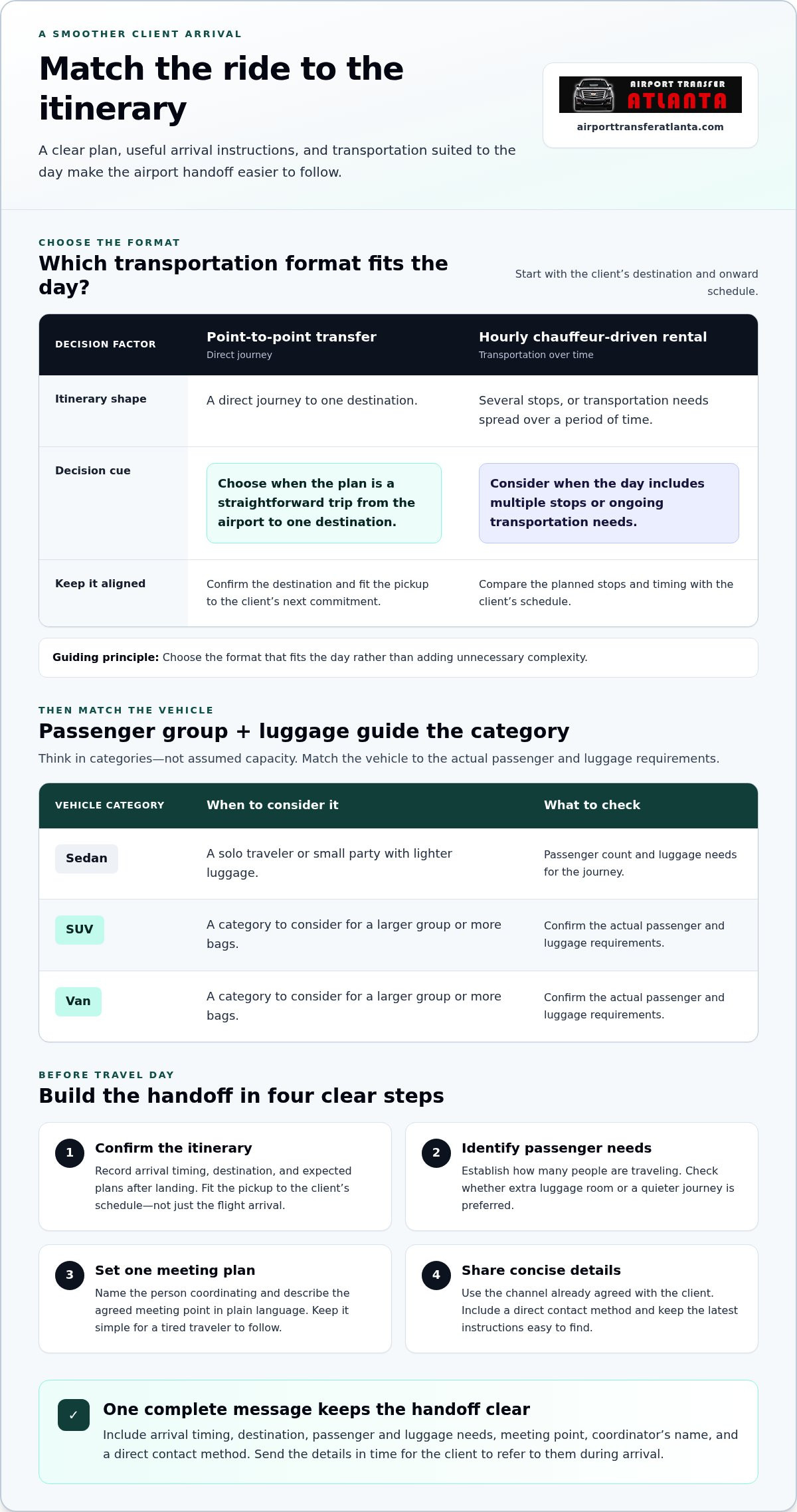
- Confirm the itinerary. Record the arrival timing, destination, and expected plans after landing. Make sure the pickup fits the client’s schedule rather than treating the flight arrival as the only commitment.
- Identify passenger needs. Establish how many people are travelling and whether luggage may affect the vehicle category. Ask practical questions that help plan the ride, such as whether the group needs extra luggage room or has a preference for a quieter journey.
- Set the meeting plan. Decide who is coordinating the pickup and describe the agreed meeting point in plain language. Keep the plan simple enough that a tired traveler can follow it without choosing between several possible locations.
- Share concise details. Send the instructions through the channel already agreed with the client. Include a direct contact method for day-of coordination, and keep the latest version easy to find.
For the vehicle choice, think in categories rather than assuming capacity. A sedan may suit a solo traveler or small party with lighter luggage; an SUV or van may be a better category to consider for a larger group or more bags. Match the vehicle to the actual passenger and luggage requirements.
Confirm the itinerary and passenger requirements
Before finalizing the arrangement, compare the arrival details with the client’s next commitment. A direct journey to one destination may call for a point-to-point transfer. A schedule with several stops or transportation needs spread over a period of time may suit an hourly chauffeur-driven rental. Choose the format that fits the day rather than adding unnecessary complexity.
Keep questions focused. Passenger count, destination, luggage considerations, and ride preferences relevant to the journey are usually more useful than personal details unrelated to transportation.
Make pickup instructions easy to use
Write the meeting instructions as if the client will read them while moving through the airport. Name the person coordinating, describe the agreed meeting point clearly, and provide a direct way to reach that person. Send one complete message through the agreed channel instead of scattering details across several updates that could conflict.
Before travel day, share the arrival timing, destination, passenger and luggage needs, meeting point, coordinator’s name, and direct contact method.
Once the itinerary and instructions are organized, a private chauffeur-driven airport transfer gives the host one transportation plan to coordinate, with point-to-point and hourly options for different schedules.
Choose Airport Transportation That Fits the Client and Itinerary
Transportation should match the journey, not just the occasion. Leaving a client to arrange their own airport ride gives them control, but also leaves them to manage the transition after landing. A pre-arranged private chauffeur-driven transfer gives the host one transportation plan to coordinate and lets the client focus on the visit. The right choice depends on the client’s preferences, schedule, passenger group, and luggage.
Use this framework to match the trip with a practical vehicle category and service format:
| Itinerary type | Passenger group | Luggage needs | Suitable vehicle category |
|---|---|---|---|
| Direct airport-to-destination journey | Individual traveler or small party | Light luggage | Sedan |
| Direct journey with a group | Several passengers | More luggage to accommodate | SUV or van |
| Multiple scheduled stops or time-based plans | Individual or group, depending on the itinerary | Consider the luggage across the full schedule | Sedan, SUV, or van, matched to the party |
Match vehicle category to the travel party
A sedan service, such as a Lincoln MKT or Cadillac XTS, can suit an individual traveler or small party. For a group or greater luggage needs, consider an SUV such as a GMC Yukon XL or Cadillac Escalade, or a Mercedes Sprinter van. Choose based on passenger and baggage requirements rather than assuming a vehicle’s suitability from its appearance alone.
Keep the decision practical. A larger vehicle category can make sense when the party’s luggage is a factor, while a sedan may fit a simpler journey. The aim is a comfortable match, not the largest option by default.
Choose point-to-point or hourly service
For a defined trip from the airport to one destination, a point-to-point transfer fits the journey directly. Its flat-rate pricing is based on mileage. If the client’s itinerary includes multiple scheduled stops or transportation over a period of time, an hourly chauffeur-driven rental is structured around time. Hourly rentals include a mileage allowance per hour, with additional costs for exceeding the limit. Choose the format that reflects the day’s route and schedule.
Thinking through these factors is central to how to impress clients with airport pickup: a suitable vehicle and service format can make the arrival plan feel considered without adding unnecessary ceremony. For broader context on assessing service options, see this professional airport limo service guide.
Keep the Airport Pickup Composed When Plans Change
Travel plans can shift, even when the pickup has been carefully arranged. A delayed arrival or a changed meeting time is different from confusion caused by unclear directions. You can’t control every change, but you can keep the handoff professional by responding in a clear sequence and sharing only the information people need to act.
Use this response sequence when new information affects the plan:
- Identify the change. Establish what has shifted, such as the arrival timing, destination, or meeting schedule.
- Update the relevant people. Notify the client and the person coordinating transportation through the agreed communication channel.
- Reset the meeting plan. Restate the meeting point, coordinator, and next step if any detail has changed.
- Continue calmly. Keep the updated plan consistent and avoid unnecessary messages or speculation.
Use one coordinated communication channel for the pickup rather than several competing message threads. If details change, send a clear update in the agreed channel so the client and host can refer to the same plan. The host should communicate when reliable new timing or instructions are available, without promising live flight monitoring or automatic updates.
Respond to arrival delays without adding confusion
Once revised timing is known, share it promptly and state what the client should do next. For example: “Your arrival time has changed. Please use the same meeting point; I’ll update you here if the plan changes.” Keep the message factual, brief, and free of uncertain estimates. If the meeting schedule also needs to shift, tell the relevant people directly rather than assuming they’ll infer the change.
Calm, direct updates help preserve a professional handoff, even when the schedule moves. A delay may be outside your control; conflicting directions or silence about a known change are avoidable.
Complete the handoff and protect the meeting schedule
After the client connects with the coordinator, make sure they know the destination and what happens next. Leave practical transition time between the airport journey and the first meeting, rather than planning as if arrival and readiness happen at the same moment. That buffer gives the client room to settle in without assuming every journey will follow an exact timeline.
During the ride, keep conversation professional and follow the client’s cues. Some travelers may want to discuss the visit; others may prefer a quiet journey after traveling. A composed pickup makes room for either preference and keeps transportation from becoming another source of pressure.
These habits put how to impress clients with airport pickup into practice: prepare for a change, communicate the next action, and keep the arrival plan coherent. For a coordinated private journey, arrange a private airport transfer that fits the client’s itinerary.
Make a Professional Airport Pickup Easy to Arrange
A polished pickup is easier to manage when the planning details sit in one clear brief. Bring together the client’s passenger needs, itinerary, meeting instructions, and suitable vehicle category. This gives the host a practical reference for coordinating transportation and sharing consistent information with the client. It also keeps the arrangement focused on the journey rather than unnecessary ceremony.
Turn the plan into a clear booking brief
Before arranging the ride, gather the details that shape it:
- Airport journey: Record the arrival timing and the destination after pickup.
- Passenger group: Note how many people are travelling and consider relevant luggage needs.
- Schedule: Identify whether the client needs a direct journey or transportation that supports several scheduled stops.
- Vehicle category: Match the party and luggage requirements to a sedan, SUV, or van category.
- Meeting instructions: Keep the client-facing meeting point and coordinator details aligned with the final transportation plan.
For a defined trip from the airport to one destination, a point-to-point transfer provides a straightforward format. If the itinerary extends beyond a direct journey, an hourly rental may better suit transportation planned around time and multiple stops. The hourly limo rental guide offers more context for considering that format. Select the service according to the day’s itinerary, then make sure the client’s pickup instructions describe the arrangement that’s in place.
Arrange the transfer with Airport Transfer Atlanta
Airport Transfer Atlanta offers private airport transfers for point-to-point journeys and chauffeur-driven hourly rentals for time-based transportation. Vehicle categories include sedans, SUVs, and a Mercedes Sprinter van. This range lets the host consider the passenger group and luggage needs when organizing the journey, without treating one vehicle type as the right fit for every client.
A private transfer gives the host one transportation plan to coordinate instead of leaving the client to arrange the airport journey independently. Before finalizing the arrangement, review the itinerary, destination, passenger and luggage details, service format, and meeting instructions together. This keeps the booking details and the client’s arrival information consistent.
Clear preparation is the practical answer to how to impress clients with airport pickup. A thoughtful plan respects the client’s schedule, makes the handoff easier to follow, and keeps the welcome professional. The vehicle is part of that plan, not a substitute for it.
Review private airport transfer options for a service format and vehicle category suited to the client’s itinerary.
Make Your Next Client Arrival a Consistent Experience
Use the next visit to make a good pickup a repeatable part of your client-hosting process. Keep a simple arrival brief your team can adapt for each traveler, then assign one person to coordinate the details. After the visit, note any useful preferences the client shared, such as their preferred communication style or pace. Apply those details thoughtfully next time, without assuming every traveler wants the same welcome.
That consistency is the practical value behind how to impress clients with airport pickup. A clear standard helps your team prepare without making the experience feel scripted. It also gives the client a smoother transition into the visit, while leaving room to adjust to individual needs and changing schedules.
For your next arrival, choose a transportation plan that fits the itinerary and gives your host a clear point of coordination. Plan a professional airport transfer for a well-organized visit from the start.
Frequently Asked Questions
How do you make a client feel welcome at the airport?
Make the arrival easy to navigate and the greeting personal without demanding the client’s attention. To understand how to impress clients with airport pickup, think about what they need in the moment: a clear point of connection and a courteous welcome. If you’re meeting them yourself, introduce yourself promptly and let them set the pace for conversation. A brief welcome message before landing can also help the client recognize the person coordinating their arrival.
What should I tell a client before their airport pickup?
Give the client the essentials they’ll need to identify the pickup and reach the next destination. Include the agreed meeting point, the name of the person coordinating, a direct contact method, and the destination. If the plan changes, send one updated message through the same agreed channel so the client isn’t left comparing different versions. Keep the note easy to find, such as in the existing travel-planning conversation.
Is a chauffeur-driven airport pickup appropriate for a business client?
Yes. A private chauffeur-driven pickup can be a suitable choice when the host wants to organize the airport journey as part of the business visit. It gives the client a pre-arranged transportation plan rather than requiring them to decide how to travel after landing. Consider whether the client values a direct, organized arrival and whether a private ride fits the schedule. The arrangement should support the visit, not imply a particular business outcome.
Should I arrange a sedan, SUV, or van for a client airport pickup?
Choose the vehicle category based on the travel party and luggage, not on a desire to make the biggest impression. A sedan such as a Lincoln MKT or Cadillac XTS may suit an individual or small party. For a group or greater luggage needs, consider an SUV such as a GMC Yukon XL or Cadillac Escalade, or a Mercedes Sprinter van. Match the choice to the actual requirements rather than assuming capacity.
Can I use an hourly car service for an airport pickup and business itinerary?
Yes. An hourly chauffeur-driven rental can suit a visit that continues beyond a direct trip from the airport, such as a schedule with several planned stops. This format is based on time, while a point-to-point transfer is structured around a defined journey and mileage. Review the shape of the day before choosing: if transportation is needed across a sequence of appointments, an hourly arrangement may fit better.
What should I do if a client’s arrival time changes?
Share a revised plan as soon as you have reliable new timing. Keep the update factual and say what the client should do next, such as continuing to the agreed meeting point or using the established contact channel. Notify the person coordinating the transportation as well, so everyone works from the same information. Avoid sending speculative estimates or implying that automatic flight updates are part of the service.
How can I make an airport pickup feel professional without overdoing it?
Focus on the client’s comfort and the needs of the visit instead of adding ceremony. Use a concise welcome, make the next step clear, and let the client guide the level of conversation during the ride. A formal greeting or elaborate gesture may not suit every traveler. Professionalism is often best conveyed through a composed handoff, thoughtful timing, and a pickup plan that feels appropriate rather than excessive.


