

What if the greatest vulnerability in your corporate travel program happens after the flight touches down? When an unvetted rideshare driver cancels at a crowded terminal curb, executives face roadside delays, surprise surge fees, and luggage capacity issues that derail carefully planned schedules. Implementing a rigorous travel coordinator checklist for airport transport is the single most effective way to eliminate these ground-level risks before wheels hit the tarmac.
You already know that untangling fragmented expense receipts across multiple platforms and fielding panicked calls from arriving leadership drains hours of administrative productivity. Flawless airport logistics require structured verification, active flight tracking, and dedicated chauffeur standards rather than guesswork. This guide delivers an actionable, step-by-step framework to help you master corporate airport ground transportation from initial dispatch to post-trip reconciliation. Below, you'll explore standardized chauffeur vetting protocols, exact vehicle classification strategies for executive groups, and transparent billing systems that guarantee predictable, on-time arrivals on every trip.
Key Takeaways
- Capture complete flight numbers, direct passenger contacts, and internal project codes during initial intake to eliminate roadside dispatch confusion.
- Match fleet classes directly to group size and baggage requirements by deploying executive sedans for individual travelers and full-size luxury SUVs or passenger vans for executive delegations.
- Establish an end-to-end travel coordinator checklist for airport transport that verifies commercial chauffeur licensing, primary insurance coverage, and formal duty of care protocols.
- Prevent curbside delays and missed departures through active flight tracking paired with advance driver staging in airport holding areas.
- Simplify corporate expense audits by adopting transparent, flat-rate billing agreements that eliminate unpredictable surge fees and fragmented travel receipts.
Pre-Booking Checklist: Gathering Passenger Data and Flight Details
Precision at intake prevents failure at pickup. Corporate travel managers often spend hours fixing ground transfer issues that could have been resolved during the initial booking conversation. A structured travel coordinator checklist for airport transport begins long before a chauffeur arrives at the terminal gate. Capturing full travel details ensures seamless coordination between commercial dispatch software and airport ground teams.
Every reservation requires standard operational parameters. Travel coordinators must record the following points systematically:
- Commercial Flight Architecture: Document operating carriers rather than just ticketing partners, operating flight numbers, and exact origin cities. Codeshare flights frequently cause confusion; an aircraft ticketed through a global carrier might actually be operated by a regional partner arriving at an entirely separate concourse.
- Passenger and Administrative Contacts: Collect direct mobile numbers for arriving passengers and backup contacts for their executive assistants. Chauffeurs must have reliable communication channels during terminal staging.
- Internal Billing References: Tag each reservation with company cost centers, internal project codes, or departmental client billing identifiers to eliminate multi-layered accounting discrepancies after trip completion.
- VIP and Security Requirements: Identify whether executives require baggage claim meet-and-greet assistance, private curbside staging, or specific security-sensitive pickup zones.
Essential Itinerary Information to Collect
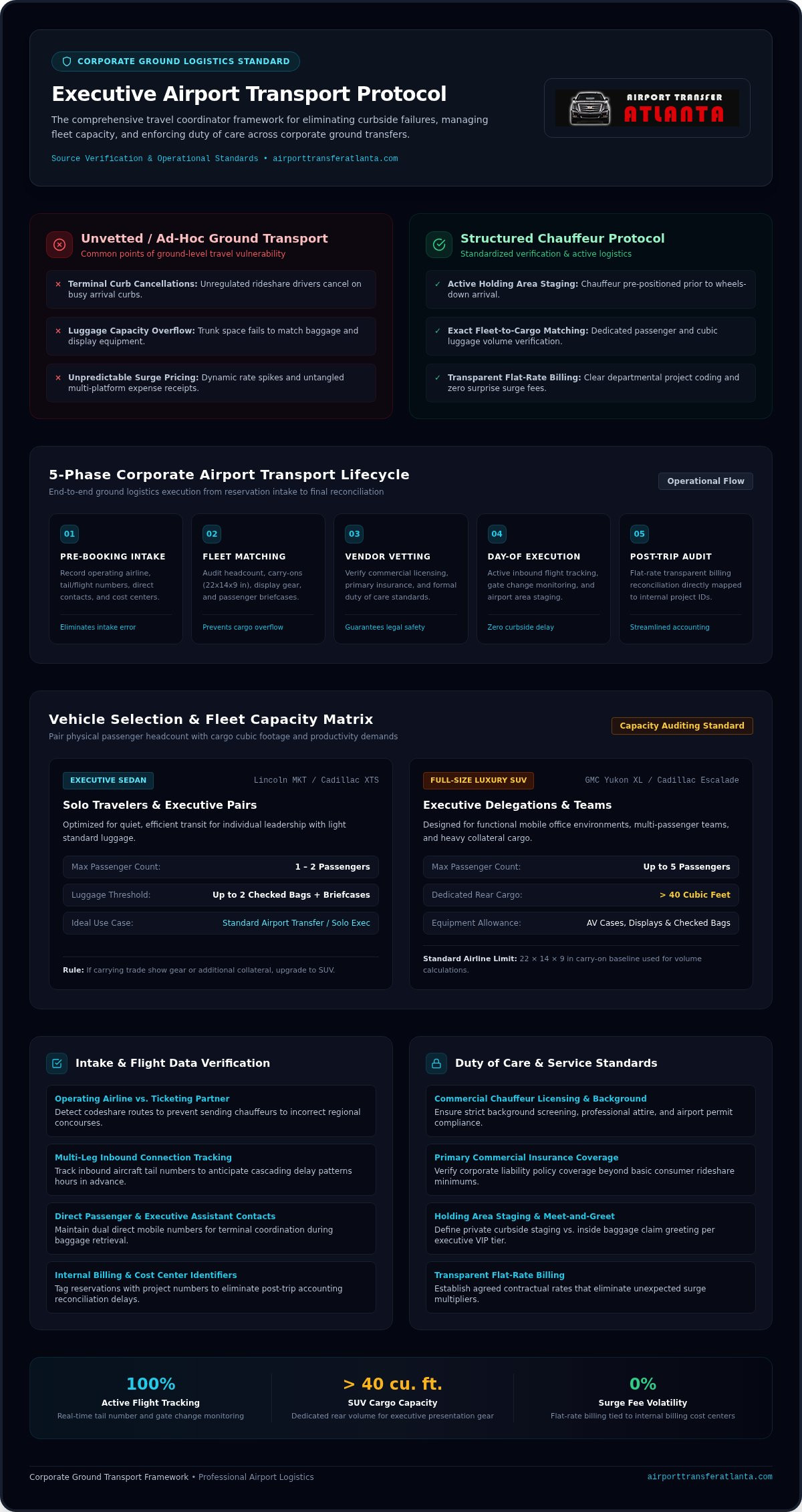
Inbound flight numbers change across multi-leg journeys. Recording every connection allows dispatchers to monitor incoming legs and catch cascading delays hours ahead of schedule. While coordinating logistics through an internal corporate portal or an external Travel Management Company (TMC), travel managers must maintain real-time oversight of inbound aircraft tail numbers and gate changes. This visibility allows dispatchers to direct vehicles to the right baggage claim door without delay.
Luggage and Equipment Capacity Audits
Luggage miscalculations create immediate ground failures. Standard commercial airline carry-on limits are set at 22 x 14 x 9 inches, but business travelers frequently carry additional garment bags, rolling briefcases, and trade show presentation materials. Corporate teams often transport heavy product displays, collateral cases, or sensitive audio-visual hardware that will not fit into a standard trunk alongside standard passenger bags.
Integrating a baggage audit into your travel coordinator checklist for airport transport prevents curbside vehicle rejections. Travel coordinators must calculate physical bag dimensions against passenger count before confirming vehicle reservations. If three executives travel with two standard checked bags each plus presentation gear, reserving a standard sedan guarantees cargo overflow. Identifying oversized luggage requirements during pre-booking allows dispatch teams to assign appropriately sized vehicles without disruption.
Vehicle Selection Checklist: Matching Fleet Types to Executive Itineraries
Selecting vehicle classes based solely on passenger count invites logistical failure. A comprehensive travel coordinator checklist for airport transport pairs physical headcount with actual luggage cubic footage, in-transit productivity requirements, and meeting itineraries. Reviewing established standards for a professional airport limo service helps coordinators align corporate vehicle policies with executive expectations.
Sedan vs. SUV Capacity Parameters
Executive sedans, such as the Lincoln MKT or Cadillac XTS, provide quiet, efficient transit for solo travelers or pairs carrying up to two standard checked bags and personal briefcases. When executives require functional mobile office environments or carry presentation cases, full-size luxury SUVs like the GMC Yukon XL or Cadillac Escalade are mandatory. These platforms accommodate up to five passengers while maintaining over 40 cubic feet of dedicated rear cargo volume behind the third row. Travel planners can review cabin dimensions and seating configurations in the luxury sedan service reference guide to ensure the right fit.
Group Transit Logistics: Mercedes Sprinter Solutions
Dividing executive delegations across multiple uncoordinated rideshares fragments arrival timing and multiplies corporate administrative overhead. High-roof luxury Mercedes Sprinter passenger vans solve this by consolidating board members, departmental teams, or roadshow delegations into a single vehicle. Stand-up cabin clearance, individual leather captain's chairs, and partitioned rear luggage sections eliminate baggage compromise. Coordinators looking to streamline multi-passenger itineraries can learn how corporate coordinators configure bookings with a Mercedes Sprinter rental with driver.
Booking Format: Flat-Rate vs. Hourly Chauffeur Hire
Booking structure dictates cost control and operational flexibility. As highlighted in recent GBTA ground transportation research, duty of care and travel spend predictability remain top organizational priorities. Coordinators must select booking formats using these operational criteria:
- One Way Airport Transfer: Reserve point-to-point flat rates for straightforward direct arrivals where passengers head immediately to a single hotel or office address.
- Hourly Limo Rental: Secure an hourly reservation when executives manage tight schedules, fluid meeting stops, or need a driver staged on standby between executive briefings.
You can compare service structures using our reference guide to hourly limo rental options. When planning complex itineraries, partnering with airporttransferatlanta.com ensures your team secures properly classed, commercial-grade vehicles matched perfectly to your executive schedule.
Vendor Vetting Checklist: Duty of Care, Licensing, and Reliability
Corporate duty of care requires knowing precisely who is behind the wheel. Relying on gig-economy mobile apps exposes companies to substantial compliance vulnerabilities, unverified operators, and inadequate insurance coverage. A rigorous travel coordinator checklist for airport transport protects traveling staff by setting strict legal and operational benchmarks for every carrier you engage. Travel managers can evaluate transportation partners systematically by referencing the professional guide to limo companies.
Every vetted ground carrier must clear three non-negotiable operational checkpoints:
- Active Operating Authority: Verify that the provider holds valid commercial operating authority from regional and state transport authorities. Unlicensed liveries present major legal risks for corporate organizations.
- Direct Dispatch Oversight: Ensure the carrier maintains direct flight-monitoring capabilities and dedicated operational dispatch support. Automated peer-to-peer applications cannot reassign drivers when inbound itineraries suddenly shift.
- Fleet Maintenance Logs: Demand scheduled maintenance compliance. Commercial passenger vehicles must undergo recurring multi-point safety inspections to prevent mid-transit mechanical breakdowns.
Compliance and Insurance Verification Protocols
Standard personal auto policies exclude paid passenger livery. Coordinators must request a current Certificate of Insurance (COI) issued directly from the vendor's underwriter before dispatching a single employee. This certificate must confirm primary commercial auto liability coverage, typically ranging between $1 million and $5 million depending on vehicle capacity, alongside general liability protection. Review operating authority numbers directly with regulatory transport bodies to confirm licenses remain active and in good standing.
Driver Standards and Professional Chauffeur Protocols
A professional chauffeur is an extension of your company's executive team. True livery services mandate multi-panel drug testing protocols, clean motor vehicle records, and recurring local and federal criminal background checks. Chauffeurs must also complete certified defensive driving programs and sign formal corporate non-disclosure agreements to preserve executive privacy during calls.
Establishing these verification requirements inside your travel coordinator checklist for airport transport ensures passengers receive professional, confidential service. Professional chauffeurs follow defined executive etiquette, maintain clean black-suit attire, and provide proactive curbside assistance rather than expecting passengers to load heavy luggage unassisted.
Day-of-Travel Protocol: Real-Time Monitoring and Arrival Execution
Execution day tests the rigor of your preparation. When commercial flights face airborne holding patterns or ground stops, uncoordinated transport plans collapse. A robust travel coordinator checklist for airport transport replaces day-of chaos with automated tracking, strategic vehicle staging, and verified communication channels between dispatchers and passengers.
Step 1: Automated Flight Tracking and Schedule Adjustments
Never rely on scheduled arrival times printed on an airline itinerary. Advanced dispatch platforms monitor FAA transponder feeds and aircraft tail numbers in real time to detect holding patterns and early landings. When a flight faces a two-hour rolling delay, the dispatch system automatically adjusts the chauffeur pickup window. Professional livery agreements include built-in baggage grace periods, giving travelers 45 to 60 minutes after domestic touchdown to deplane and retrieve bags before wait-time charges accrue.
Step 2: Chauffeur Staging and Dispatch Coordination
Timing ground staging properly eliminates airport terminal gridlock. Dispatchers must confirm that vehicles stage in authorized commercial holding zones thirty minutes before wheels touch down. Travel coordinators should establish an automated notification sequence:
- Direct Traveler Dispatch: Transmit the chauffeur's legal name, direct mobile contact, and vehicle license plate directly to the passenger via SMS before landing.
- Administrative Tracking: Provide the travel coordinator with live GPS vehicle positioning to verify on-site readiness.
- Direct Line Routing: Maintain an immediate phone link between administrative staff and dispatchers for immediate rerouting if the airline shifts terminal concourses.
Step 3: Meet-and-Greet vs. Curbside Pickup Execution
Tailor your terminal greeting strategy to executive preference. For incoming guests or board members unfamiliar with terminal layouts, schedule an inside meet-and-greet. The chauffeur stages at the secure baggage claim exit holding prominent corporate digital signage, takes immediate possession of heavy luggage, and escorts the passenger to the waiting vehicle.
For frequent corporate commuters moving with carry-on luggage only, coordinate an express curbside pickup. The passenger contacts the staged driver upon entering the terminal vestibule, receiving instructions to step outside at a designated commercial outer-curb door number. Incorporating these protocols into your travel coordinator checklist for airport transport guarantees zero lost transit time. To establish reliable, flight-tracked pickups for your traveling executives, book executive airport transfers with Airport Transfer Atlanta.
Post-Trip Reconciliation Checklist: Expense Auditing and Travel Reviews
The ground transportation lifecycle ends only when the final invoice clears accounting. Fragmented employee expense receipts, surprise fuel adjustments, and unverified waiting surcharges regularly derail travel budgets. Completing a structured travel coordinator checklist for airport transport through the post-trip phase protects corporate accounts from financial leakage and guarantees service accountability.
A thorough post-travel review requires coordinators to cross-examine three core operational areas:
- Quote-to-Invoice Reconciliation: Compare final invoiced charges directly against initial confirmation sheets. Professional chauffeur reservations use flat-rate or hourly billing models that eliminate metered traffic surges.
- Pass-Through Verification: Scrutinize secondary pass-through expenses. Official electronic road tolls and airport commercial parking fees must match local facility rates precisely rather than inflated vendor estimates.
- Wait-Time Auditing: Check billing timestamps against airline gate arrival logs. If an airline arrives thirty minutes late, automated tracking should adjust staging times so that scheduled domestic grace periods apply before wait fees start.
Billing and Receipt Verification Best Practices
Auditing manual receipts across dozens of separate corporate profiles drains internal administrative time. Coordinators should demand consolidated, itemized monthly billing statements tagged with exact cost-center numbers and client billing codes. This direct linkage eliminates ambiguous charges, simplifies corporate accounting reviews, and speeds up internal ledger balancing. When billing statements link directly to unique trip identifiers, accounting teams close books faster without chasing traveling personnel for lost paper receipts.
Performance Reviews and Transportation Program Optimization
Financial accuracy matters, but service quality defines executive safety and satisfaction. Travel coordinators must log performance data after every trip, focusing on chauffeur punctuality, cabin cleanliness, route selection, and driver discretion. Collecting brief feedback from traveling executives helps identify whether ground partners meet strict corporate standards.
Establishing these post-trip audits within your travel coordinator checklist for airport transport enables your department to reward elite transportation partners with preferred booking volume. Centralizing corporate reservations with Airport Transfer Atlanta streamlines ongoing account management, giving organizations predictable luxury travel, fixed billing structures, and reliable duty of care on every executive journey.
Standardize Your Airport Transportation Protocol
Managing executive travel logistics demands precision from initial intake to final invoice auditing. Implementing a structured travel coordinator checklist for airport transport replaces airport curbside guesswork with structured operational certainty. Verifying commercial livery insurance, calculating physical luggage capacity against fleet parameters, and monitoring active flight transponders ensures your leadership team arrives on schedule every time.
Eliminate terminal curb friction and fragmented expense reports by partnering with dedicated ground transportation specialists. Airport Transfer Atlanta provides professional commercial chauffeurs with rigorous background checks, guaranteed flat-rate transfers, and flexible hourly booking structures. Whether your itinerary calls for an executive Lincoln or Cadillac sedan, a full-size Cadillac Escalade or GMC Yukon XL SUV, or a luxury Mercedes Sprinter van for traveling delegations, our fleet delivers uncompromising reliability. Book your executive airport ground transportation with Airport Transfer Atlanta to secure seamless, executive-ready arrivals across every corporate itinerary.
Frequently Asked Questions
What information does a travel coordinator need before booking airport ground transport?
A coordinator must collect the operating airline carrier, complete flight number, origin city, traveler mobile number, and internal project billing code. Adding physical baggage counts and cargo dimensions to your travel coordinator checklist for airport transport prevents vehicle sizing issues. If passengers carry oversized presentation equipment or multiple checked cases, identifying those needs during intake ensures accurate fleet assignment.
How do professional chauffeur services handle sudden flight delays or cancellations?
Professional services track inbound aircraft using real-time transponder data and flight numbers rather than relying on scheduled timetables. When a flight is delayed, dispatch teams adjust the chauffeur's staging time automatically. If an airline cancels a route, dispatchers hold the reservation or reassign vehicles based on updated rebooking information, protecting the organization from unnecessary no-show penalties.
What is the difference between curbside pickup and airport meet-and-greet service?
Curbside pickup directs the traveler to an outer commercial terminal door where the staged vehicle pulls up immediately after contact. Meet-and-greet service places the chauffeur inside the terminal near the baggage claim carousel holding personalized digital signage. The chauffeur assists with luggage handling and escorts the passenger directly to the vehicle, making it ideal for first-time visitors and senior executive VIPs.
How do I choose between an executive sedan, luxury SUV, and passenger van?
Base your vehicle selection on passenger count, baggage volume, and productivity needs. Executive sedans like the Lincoln MKT or Cadillac XTS suit one or two passengers traveling light. Full-size luxury SUVs like the GMC Yukon XL or Cadillac Escalade accommodate up to five passengers with extensive luggage. For executive delegations or board members traveling together, reserve a luxury Mercedes Sprinter van.
When is hourly chauffeur service better than flat-rate point-to-point airport transfers?
Hourly chauffeur service is ideal when executive itineraries involve multiple off-site stops, rolling meeting schedules, or unpredictable timelines requiring a vehicle on immediate standby. A one-way airport transfer works best for straightforward point-to-point trips directly between the airport terminal and a single hotel or corporate headquarters. Selecting the right format depends on whether the traveler requires constant on-demand flexibility.
What grace period is typically included for commercial airport arrivals before wait fees apply?
Most professional commercial transfer providers offer a complimentary grace period of 45 to 60 minutes for domestic commercial arrivals once the aircraft records official touchdown. This window accounts for taxiing, deplaning, and baggage claim collection. Incorporating this grace buffer into your travel coordinator checklist for airport transport protects corporate travel accounts from unexpected wait-time surcharges during standard terminal baggage delays.
How do private chauffeur services satisfy corporate duty of care requirements?
Private chauffeur services satisfy duty of care by providing commercially licensed, thoroughly vetted drivers backed by commercial auto liability policies. Unlike peer-to-peer rideshare applications, professional livery operators conduct comprehensive criminal background screenings, mandate regular drug testing, and enforce strict fleet maintenance standards. Travel coordinators maintain direct communication with dispatchers, ensuring full visibility and traveler safety throughout the trip.


