

Would you trust your safety to a basic platform checklist, or do you require a driver backed by a rigorous federal regulatory framework? Many travelers now face significant anxiety regarding inconsistent vehicle maintenance and the varying depth of background checks in the gig economy. It's frustrating to book a ride for a critical executive meeting only to find the service quality doesn't meet professional standards. Understanding the specific professional driver vs rideshare driver qualifications is essential for anyone who values reliability and passenger protection over mere convenience.
You recognize that a driver's license alone isn't enough to guarantee a high-end experience. This article bridges the gap by explaining the legal and safety requirements that separate commercial chauffeurs from casual app-based drivers. We'll examine the strict 2026 FMCSA standards for commercial licenses, the new mandates for electronic medical document submissions, and the vehicle age requirements that define professional fleets. You'll gain the clarity needed to justify choosing a dedicated car service for your business travel and know exactly which credentials ensure your peace of mind.
Key Takeaways
- Understand the regulatory distinctions between independent contractors using personal vehicles and commercially licensed chauffeurs operating under livery laws.
- Analyze the professional driver vs rideshare driver qualifications regarding vetting, contrasting basic platform checks with rigorous, ongoing background monitoring.
- Learn how the legal concept of "duty of care" and high-limit commercial insurance policies provide a superior safety net for executive travelers.
- Evaluate the safety benefits of professionally managed fleets, such as the GMC Yukon XL or Cadillac Escalade, which follow strict maintenance protocols.
- Use a professional checklist to verify transportation credentials and ensure your choice aligns with the highest standards of reliability and punctuality.
Defining the Gap: Rideshare Driver vs. Professional Chauffeur Standards
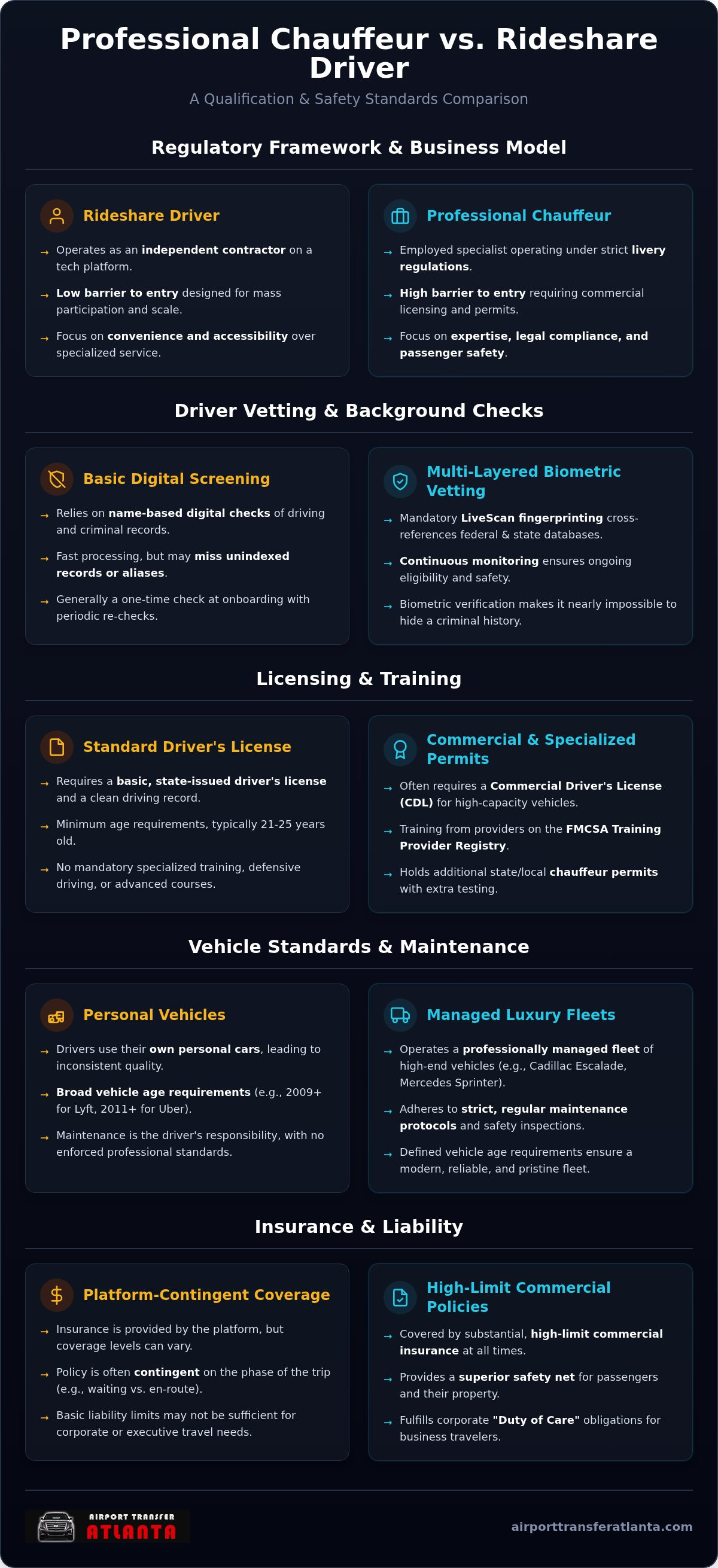
The primary difference in professional driver vs rideshare driver qualifications begins with the underlying business model and regulatory framework. A Ridesharing company typically operates as a technology platform that connects independent contractors with passengers. These drivers use their personal vehicles and pass a platform-level vetting process designed for high-volume recruitment. In contrast, a professional chauffeur is a commercially licensed specialist who operates under specific livery regulations and strict corporate oversight. This distinction creates two very different service levels:
- Rideshare: Designed for accessibility and scale, utilizing personal assets and basic screening.
- Professional: Focused on specialized expertise, high-limit insurance, and rigorous legal compliance.
This creates a significant contrast between a low barrier to entry and a high barrier to entry. Rideshare platforms are designed for mass participation, allowing almost anyone with a clean driving record and a modern car to start working quickly. Professional transportation requires a deeper commitment to licensing, permits, and specialized vehicle maintenance. For corporate travel managers, these distinctions are vital for meeting duty of care obligations. Passenger safety isn't just about the driver's intent; it's about the legal and regulatory structures that hold the service provider accountable.
The Rideshare Minimum: Entry-Level Requirements
When evaluating professional driver vs rideshare driver qualifications, it's clear that rideshare standards are built for the general public. In 2026, the minimum age for drivers is generally 21, though some markets require drivers to be at least 25. The vehicle requirements are also broad. Uber generally requires vehicles from 2011 or newer, while Lyft accepts vehicles from 2009 or newer in most markets. While these drivers must pass a basic background check, the process lacks the depth of commercial screening. There's no requirement for specialized commercial training, defensive driving courses, or advanced navigation skills. The model relies on personal driving history, which doesn't always translate to the precision required for executive transport.
The Professional Benchmark: Commercial Livery Standards
Professional standards represent a much higher benchmark of excellence. For high-capacity vehicles like a luxury Mercedes Sprinter Van, drivers must hold a Commercial Driver’s License (CDL). This process includes comprehensive medical exams and training from providers listed on the FMCSA Training Provider Registry. Beyond the basic license, professional drivers must often obtain state or local chauffeur permits that require additional testing and fingerprinting. Top-tier limo companies adhere to these national standards to ensure every trip is handled by an expert. This level of qualification ensures that the driver isn't just a participant in the gig economy but a dedicated professional trained in logistics and client safety.
Driver Vetting and Background Checks: A Multi-Layered Approach
Passenger safety depends on the depth of the initial and ongoing vetting process. Most app-based platforms utilize digital, name-based background checks that scan criminal records and driving histories. While these systems are fast, they often miss records that haven't been correctly indexed or aliases used by an applicant. The difference in professional driver vs rideshare driver qualifications is most apparent when moving from basic digital screening to biometric verification and continuous monitoring. Professional standards prioritize a multi-layered security approach that ensures the person behind the wheel is both verified and constantly eligible.
Beyond the Digital Check: Fingerprinting and Physical Vetting
Professional chauffeurs frequently undergo LiveScan fingerprinting. This biometric process cross-references prints against federal and state databases, making it nearly impossible for a driver to hide a criminal history under a different identity. Government agencies continue to enhance rideshare safety by proposing similar biometric standards, but professional car services already treat this as a mandatory baseline. Unlike the one-time approval common in the gig economy, commercial drivers are often subject to real-time monitoring that alerts employers to any new violations immediately.
Health and wellness also play a critical role in professional vetting. Operating a vehicle like a GMC Yukon XL or a Mercedes Sprinter requires a valid medical examiner’s certificate. Drivers must pass physical exams every two years to ensure they're fit for the road. Starting July 27, 2026, many jurisdictions will mandate the electronic submission of these medical reports to the Department of Transportation to prevent fraud. This physical vetting ensures that your driver isn't just legally allowed to drive, but physically capable of doing so safely under any conditions.
Specialized Chauffeur Training and Etiquette
Professionalism extends beyond the steering wheel. A chauffeur is trained in soft skills that a standard rideshare driver isn't required to possess. This includes client confidentiality, advanced route planning to avoid congestion, and refined etiquette. Many professional drivers also hold defensive driving certifications. These courses focus on collision avoidance, space management, and anticipating the mistakes of other motorists. This training turns a driver into a safety-conscious logistics manager rather than just an operator.
Rideshare drivers typically view a trip as a simple task of moving from point A to point B. A professional chauffeur treats the journey as a managed experience where punctuality and client comfort are the primary metrics of success. Booking a professional sedan service guarantees you're working with someone whose career depends on maintaining these rigorous standards. This specialized training creates a predictable, high-quality environment that the gig economy can't replicate through a mobile app alone.
Insurance and Regulatory Compliance: Protecting the Passenger
The legal framework surrounding professional driver vs rideshare driver qualifications often centers on financial liability and passenger protection. Professional transportation providers operate under a "duty of care," a legal obligation to adhere to a standard of reasonable care while performing acts that could foreseeably harm others. This standard is significantly higher than that of a casual motorist. While rideshare platforms provide basic coverage, the depth of protection varies based on the driver's current app status, creating potential gaps in liability that commercial services eliminate through constant, high-limit coverage.
Commercial Livery Insurance vs. Rideshare Policies
A primary distinction lies in the insurance limits. Professional vehicles, such as the Lincoln MKT or Cadillac XTS, are backed by commercial livery policies that typically start at $1 million in coverage. This insurance remains active at all times the vehicle is in service. Conversely, rideshare insurance is divided into periods. When the app is off, the driver's personal policy applies. When the app is on but no trip is active, coverage is often lower. Full platform coverage only kicks in during an active trip. This tiered structure can lead to complex legal disputes following an incident. A professional car service provides a single, robust policy that protects the passenger from the moment of pickup to the final destination.
Regulatory Compliance and Operating Permits
Reliability is built on strict adherence to federal and local laws. High-capacity vehicles like the Mercedes Sprinter must comply with Federal Motor Carrier Safety Administration (FMCSA) regulations, which mandate specific maintenance logs and driver hour limits. Professional airport limo services must also maintain valid permits to operate on airport grounds. These permits require proof of commercial insurance and regular vehicle inspections that far exceed the basic requirements of a personal auto registration.
Compliance also extends to pricing transparency. Professional services utilize flat-rate pricing, ensuring that the cost of your transfer is predictable. This contrasts with the surge pricing models used by rideshare companies, where costs can fluctuate based on demand. By choosing a provider that maintains commercial operating authorities, travelers ensure their transportation is both legally compliant and financially transparent. This structured approach to regulation is what makes professional ground transportation the preferred choice for executive travel and high-stakes logistics.
Vehicle Standards: Personal Cars vs. Managed Luxury Fleets
While driver credentials form the foundation of safety, the physical vehicle is the primary tool for delivering a reliable experience. In the gig economy, the vehicle is typically a driver's personal "daily driver," used for errands and family transport when not in use for work. In contrast, professional services utilize a managed fleet of dedicated executive vehicles. This distinction impacts everything from mechanical reliability to the cleanliness of the cabin. When evaluating professional driver vs rideshare driver qualifications, the standards applied to the vehicle are just as rigorous as those applied to the operator.
Fleet Management and Maintenance Protocols
Professional transportation companies maintain strict control over their assets through centralized fleet management. Unlike rideshare drivers who are personally responsible for maintenance costs, professional companies follow manufacturer-recommended service schedules without exception. For high-utilization vehicles like the GMC Yukon XL or Cadillac Escalade, this involves frequent mechanical inspections and daily deep-cleaning routines. These protocols ensure that every component, from tire tread depth to climate control systems, functions perfectly. Professional livery services must also undergo periodic state inspections to maintain their operating permits, a requirement that far exceeds the basic emissions tests required for personal vehicle registration.
Managing the vehicle life cycle is another key differentiator. Professional fleets often retire vehicles after a specific mileage or age to prevent mechanical fatigue. This proactive approach ensures that travelers aren't subjected to the wear and tear often found in high-mileage rideshare cars. A well-maintained executive vehicle provides a quiet, stable environment suitable for conducting business on the move. To experience this level of mechanical and aesthetic precision, you can book a luxury vehicle service for your next transfer.
Luxury Vehicle Classifications and Capacities
Choosing a professional service allows for precise planning based on vehicle capacity and features. Rideshare apps often offer unpredictable vehicle types within a general category, whereas professional services guarantee specific model classes. An executive SUV provides ample legroom and cargo space for groups with heavy luggage, while a Cadillac XTS sedan offers a discreet profile for solo travelers. For larger corporate teams, a Mercedes Sprinter rental with driver provides a mobile boardroom environment with high-ceiling cabins and specialized seating configurations. These professional-grade vehicles are designed for privacy and productivity, featuring tinted glass and premium materials that personal cars rarely match.
Choosing the Right Standard for Your Professional Travel
Selecting a transportation provider depends on the specific requirements of your itinerary and the level of risk you're willing to accept. While rideshare is often sufficient for short, casual trips where timing is flexible, professional chauffeurs are necessary for high-stakes business travel and airport logistics. The fundamental difference in professional driver vs rideshare driver qualifications ensures that executive services provide a level of accountability that gig-economy platforms cannot match. Understanding how to verify these standards allows you to make an informed decision for your corporate or personal travel needs.
Checklist for Verifying Professional Credentials
To ensure your provider meets industry standards, verify their commercial credentials before finalizing a reservation. A reputable transportation partner should be transparent about their operating authority and safety records. Use the following checklist to evaluate a potential service:
- Commercial Insurance: Request proof of a livery policy with a minimum of $1 million in coverage.
- Operating Permits: Confirm the company holds valid permits for airport pickups and local municipality requirements.
- Chauffeur Vetting: Ask if the company utilizes fingerprint-based background checks and regular drug testing.
- Fleet Maintenance: Inquire about their internal inspection schedules and the average age of their vehicles.
When arranging an hourly limo rental, it's helpful to ask if the assigned driver has specialized training in executive protection or defensive driving. Reputable partners will have no hesitation in sharing this information, as these qualifications are the core of their value proposition. This proactive vetting protects your team and fulfills corporate duty of care requirements.
The Value of Reliability in Executive Travel
Reliability remains the most significant factor in ground transportation. Rideshare models rely on driver availability at the exact moment of the request, which frequently leads to "no-shows" or last-minute cancellations during peak hours or inclement weather. Professional services operate on a scheduled basis, assigning a driver and vehicle well in advance. These chauffeurs utilize advanced flight tracking software to monitor delays in real time, ensuring they're on-site precisely when you land, regardless of schedule changes.
Choosing professional standards means opting for flat-rate pricing and guaranteed service. You won't encounter surge pricing or unpredictable vehicle quality. The comprehensive professional driver vs rideshare driver qualifications discussed throughout this guide form the foundation of a dependable travel experience. By prioritizing commercial standards, you ensure every transfer is handled with the precision and safety your schedule requires. Secure your next transfer with a provider that treats your time and safety as their highest priority.
Elevate Your Transportation Standards
Understanding the professional driver vs rideshare driver qualifications is the first step toward ensuring a safe and predictable journey. You now know that commercial livery services offer $1 million in insurance coverage, biometric vetting, and meticulously managed fleets that personal vehicles simply can't match. These regulatory layers provide a robust safety net that protects both your time and your professional reputation. By choosing a dedicated chauffeur over a casual on-demand driver, you eliminate the risks of inconsistent service and unexpected surge pricing.
It's time to prioritize reliability for your next executive transfer. Experience the standard of professional chauffeur service with Airport Transfer Atlanta. Our fleet of premium sedans, SUVs, and Mercedes Sprinters is maintained to the highest mechanical and aesthetic standards. We offer transparent flat-rate pricing for all airport transfers and provide vetted, professional chauffeurs dedicated to absolute punctuality. Secure your peace of mind by choosing a service that treats every logistical detail with the seriousness your schedule demands. We look forward to facilitating your next smooth and efficient trip.
Frequently Asked Questions
What is the main difference between a chauffeur and a rideshare driver?
The primary distinction lies in the regulatory framework and driver classification. A rideshare driver operates as an independent contractor using a personal vehicle, whereas a chauffeur is a professional specialist operating under commercial livery laws. This difference impacts service consistency and accountability. Chauffeurs are dedicated to a career in transportation, while rideshare drivers often use the platform for supplemental income without specialized training or professional-grade vehicle requirements.
Do professional drivers have to pass more background checks than rideshare drivers?
Yes, professional drivers typically undergo more rigorous screening processes. While rideshare platforms rely on digital, name-based background checks, professional chauffeurs often submit to fingerprint-based biometric vetting through state or federal databases. This multi-layered approach ensures a higher level of security by cross-referencing criminal records that digital scans might miss. Additionally, many commercial operators require continuous monitoring rather than a one-time approval at the point of hire.
Is commercial insurance better for passengers than rideshare insurance?
Commercial livery insurance provides significantly higher coverage limits and more consistent protection for passengers. These policies generally offer at least $1 million in liability coverage that remains active whenever the vehicle is in service. Rideshare insurance is often tiered, with lower coverage limits when a driver is between trips. Choosing a service with commercial insurance ensures that you're protected by a robust, single-policy framework from the moment you enter the vehicle.
What kind of training do professional chauffeurs receive?
Professional chauffeurs undergo specialized training that covers defensive driving, advanced navigation, and client etiquette. This training emphasizes collision avoidance and passenger comfort rather than just reaching a destination. Many drivers also receive instruction in corporate confidentiality and route planning to avoid congestion. This education ensures that the professional driver vs rideshare driver qualifications result in a service-oriented experience that prioritizes your schedule and safety over simple transit.
Are professional vehicles inspected more often than rideshare cars?
Yes, professional fleets are subject to more frequent and stringent inspection protocols. Beyond daily mechanical checks and cleaning by the fleet management team, commercial vehicles must pass periodic state livery inspections to maintain operating permits. These inspections verify the safety of critical systems like brakes, suspension, and tires. Rideshare vehicles generally only require a basic annual inspection, often performed at a standard mechanic shop without the rigorous oversight required for commercial livery fleets.
Why should I choose a professional driver for an airport transfer?
Choosing a professional driver ensures a level of punctuality and reliability that demand-based apps can't guarantee. Professional services utilize flight tracking software to adjust for delays and assign drivers well in advance of your arrival. This eliminates the risk of "no-shows" or surge pricing during peak travel times. You receive a dedicated specialist who is already on-site when you land, providing a seamless transition from the terminal to your final destination.
Do I need a CDL to be a professional driver?
A Commercial Driver’s License (CDL) is required for professional drivers operating high-capacity vehicles like the Mercedes Sprinter. For standard executive sedans or SUVs, drivers typically need a chauffeur’s permit or a specific state-level for-hire endorsement. These credentials require passing medical exams and demonstrating advanced driving competency. These specific requirements contribute to the overall professional driver vs rideshare driver qualifications that define industry safety and ensure that large groups are handled by trained operators.


