

Splitting a corporate team or an extended family into four separate ride-share vehicles isn't just a logistical headache; it's a strategy that almost guarantees someone will arrive late. You've likely experienced the stress of coordinating multiple drivers or the sinking feeling when a booked vehicle arrives with zero room for your group's oversized luggage. Managing high-capacity travel requires more than just a ride; it requires a precise logistical operation that prioritizes punctuality and physical space.
This 2026 professional buying guide helps you master the complexities of a large group airport transportation service so you can transition from travel chaos to calm efficiency. We understand that your primary goal is a single-vehicle solution that eliminates the uncertainty of wait times and hidden fees. You'll learn how to select the right vehicle for your specific passenger-to-luggage ratio and how to secure transparent pricing models that protect your budget. We will preview the essential fleet options, such as the Mercedes Sprinter and GMC Yukon XL, while outlining the standards for professional chauffeurs. By the end of this guide, you'll have a clear framework to ensure your entire group arrives together, on time, and with every bag accounted for.
Key Takeaways
- Learn how a professional large group airport transportation service centralizes logistics to ensure all passengers arrive at the terminal together without the complexity of multiple ride-share apps.
- Compare high-capacity vehicle options like the GMC Yukon XL and Mercedes Sprinter to match your specific passenger count and luggage volume accurately.
- Select the most cost-effective pricing model by choosing between flat-rate point-to-point transfers and flexible hourly rentals for multi-stop itineraries.
- Verify safety and quality standards by confirming commercial licensing requirements and reviewing vehicle maintenance logs before finalizing your booking.
- Follow a structured booking checklist to establish a primary point of contact and ensure sufficient cargo space for all oversized bags.
The Logistical Advantages of Professional Large Group Airport Transportation
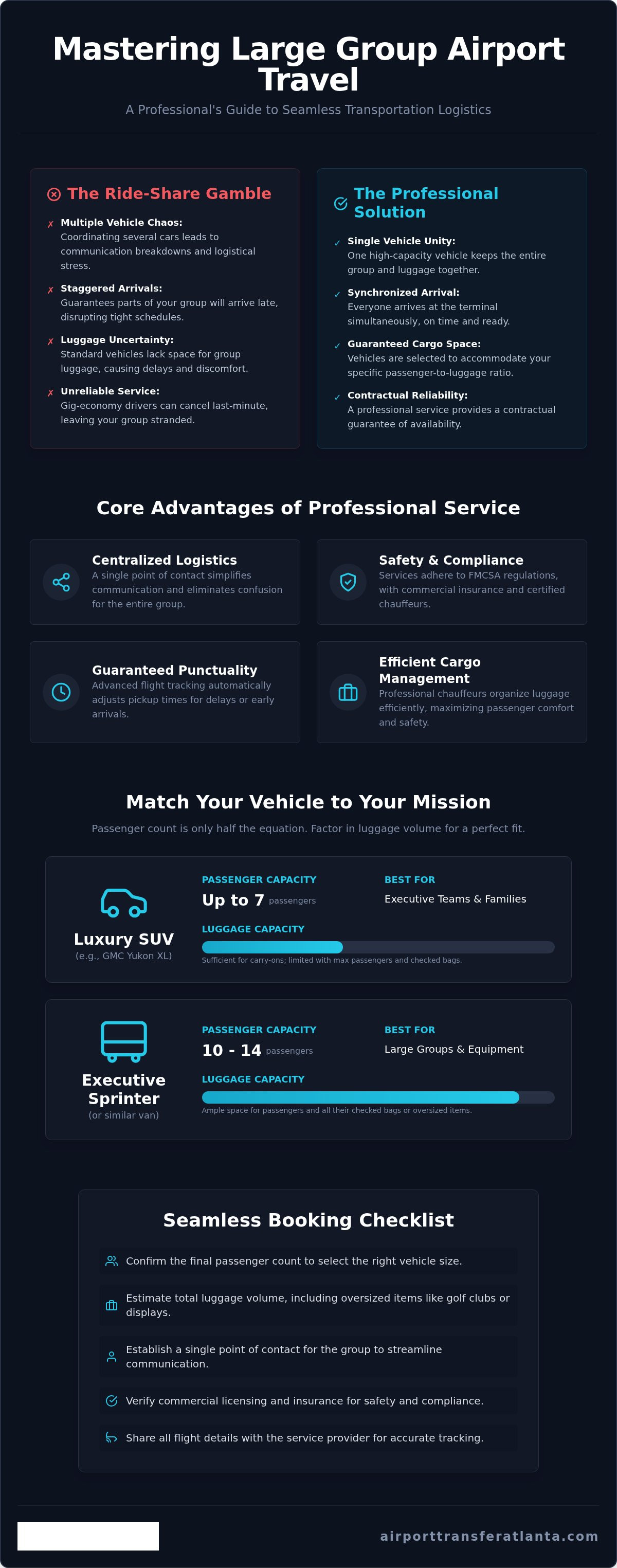
Managing travel for ten or more people requires a shift from individual mobility to collective logistics. When you rely on multiple ride-share vehicles, you introduce variables that often disrupt tight schedules. One driver might miss a turn, while another gets stuck in a different terminal's traffic loop. A professional large group airport transportation service centralizes your party into high-capacity vehicles like the Mercedes Sprinter. This synchronization ensures that every passenger and piece of luggage reaches the terminal simultaneously. It eliminates the administrative burden of tracking four different apps or reconciling dozens of individual digital receipts after the trip.
Accountability distinguishes professional chauffeurs from independent contractors. Chauffeurs operate under strict corporate oversight and adhere to scheduled arrival windows that account for group loading times. Unlike gig-economy drivers who may cancel a pickup if a better fare appears, a professional service provides a contractual guarantee of availability. This reliability is backed by rigorous vehicle maintenance schedules. Large groups require heavy-duty performance; professional fleets undergo frequent inspections to prevent mechanical delays that could cause a missed flight. Safety isn't just a preference; it's a result of structured fleet management.
Efficiency in Group Coordination
A single point of contact simplifies travel for event planners and group leaders. Instead of managing a fleet of independent drivers, you communicate with one coordinator who oversees the entire manifest. This structure reduces wait times at the curb because the vehicle is staged and ready before the group exits the terminal. High-occupancy vehicles like the GMC Yukon XL or Mercedes Sprinter are designed for rapid loading. Chauffeurs manage the cargo space efficiently, ensuring that oversized bags and equipment don't compromise passenger legroom or comfort. This organized approach moves the group from the terminal to the vehicle in minutes, not hours.
Reliability and Professional Standards
Professional group transportation incorporates advanced flight tracking to manage arrival fluctuations. If your flight is delayed or arrives early, the chauffeur adjusts the pickup time automatically. This service standard often includes a "Meet and Greet," where the driver waits at a designated indoor location with clear signage. This is essential for large groups who may be unfamiliar with the airport layout. Beyond the service experience, professional providers maintain high insurance and compliance standards. They follow Federal Motor Carrier Safety Administration (FMCSA) regulations, which include driver medical certifications and random drug testing. These legal safeguards provide a level of security that standard ride-hailing platforms cannot match.
Evaluating High-Capacity Vehicles: SUV vs. Mercedes Sprinter
Selecting the right vehicle is a balance of volume and comfort. For a reliable large group airport transportation service, the decision usually falls between a premium SUV and a luxury van. Each vehicle class serves a specific group dynamic and luggage requirement. It's critical to understand that passenger capacity and luggage capacity are not always equal. If you max out the seating in any vehicle, you inevitably reduce the available room for cargo. Professional dispatchers look at the total manifest to ensure you don't end up with bags on passengers' laps.
The "Luggage vs. Passenger" trade-off is the most common point of failure in group travel planning. A vehicle might have seven seatbelts, but if seven passengers each bring a checked bag and a carry-on, the rear cargo area of a standard SUV won't suffice. You must calculate the total volume of gear before booking. If your group carries oversized equipment like golf clubs or trade show displays, the vehicle choice becomes even more restrictive. Professional fleets prioritize safety by ensuring all bags are secured in designated cargo areas rather than the passenger cabin.
When to Choose a Luxury SUV
The GMC Yukon XL and Cadillac Escalade are the industry standards for groups of up to 7 passengers. These vehicles are ideal for smaller executive teams or families who prioritize a discreet, high-end experience. Privacy is a key benefit; these SUVs blend into traffic more easily than high-roof vans while providing a smooth, quiet ride. While the "XL" designations indicate extended cargo space, seating 7 adults comfortably still leaves limited room for heavy luggage. If your group is at the maximum passenger count with full luggage, upgrading to a larger class is often the safer logistical choice.
The Mercedes Sprinter for Executive Groups
The Mercedes Sprinter is the gold standard for groups of 8 to 14 passengers. It offers a significant ergonomic advantage with its high ceiling, allowing passengers to stand upright while entering or exiting the vehicle. This ease of entry is essential for corporate groups moving quickly between terminals and meeting sites. Inside, you'll find executive seating configurations that often include leather captain's chairs rather than standard benches. Every row typically features dedicated climate control and USB charging ports to keep travelers productive. For those managing a larger manifest, booking a luxury Mercedes Sprinter van service ensures that everyone travels in a single, cohesive environment with ample room for both legs and luggage.
Service Models: Choosing Between Flat-Rate and Hourly Rentals
The financial structure of a large group airport transportation service typically follows one of two models: flat-rate or hourly. Selecting the wrong model leads to unnecessary expenses or logistical constraints. A flat-rate transfer is a point-to-point service with a fixed price established at the time of booking. Hourly rentals provide a dedicated vehicle and chauffeur for a specific block of time. The decision depends entirely on the stability of your group's schedule and the number of stops required during the trip.
Hourly minimums are a standard industry practice for high-capacity vehicles like the Mercedes Sprinter or GMC Yukon XL. Most professional providers require a minimum booking of three to four hours for hourly charters. This ensures the vehicle's availability is dedicated exclusively to your group. Mileage allowances are also a factor in these agreements. While most hourly hires include a generous distance limit, exceeding a certain radius from the primary pickup point may trigger additional surcharges. Transparency regarding these limits is the hallmark of a professional chauffeur agreement.
Flat-Rate Point-to-Point Transfers
Fixed pricing offers the highest level of predictability for standard airport-to-hotel or hotel-to-airport routes. This model protects your budget from the surge pricing or traffic-based fare increases common with ride-hailing apps. When your group's only requirement is a direct transfer, the flat-rate model is the most cost-effective choice. It allows travel managers to account for ground transportation costs with absolute certainty before the trip begins. For a deeper look at how these services integrate into corporate travel, consult our Professional Airport Limo Service guide.
Hourly Charters for Complex Schedules
Complex itineraries involving corporate site visits, multi-terminal pickups, or dinner transfers require the flexibility of an hourly charter. This service model places a chauffeur on standby for the group, allowing for immediate departures without the need to book new vehicles for each leg of the journey. If your team needs to move between several locations before heading to the airport, having a dedicated vehicle waiting at the curb is a significant efficiency gain. You can review the technical details of these arrangements in our Hourly Limo Rental Guide. This model ensures your group remains together and on schedule, regardless of how many stops the day requires.
Safety and Quality Standards for Group Transportation
Commercial licensing is the foundation of a professional large group airport transportation service. Operators must comply with Federal Motor Carrier Safety Administration (FMCSA) regulations, which include specific medical examiner certificates for drivers and rigorous vehicle inspection cycles. When you evaluate a provider, verify their DOT number. This transparency ensures the company operates within legal safety frameworks rather than as an unmonitored private entity. Specialized insurance is equally critical. Professional policies for high-capacity vehicles provide multi-million dollar liability coverage, protecting every passenger in the event of an incident.
Vehicle age and maintenance history are indicators of service quality. Don't hesitate to ask a provider about their fleet rotation policy. High-mileage vehicles are more prone to mechanical failure, which is a risk no travel manager should accept. A professional firm maintains detailed maintenance logs for every SUV and Mercedes Sprinter in its fleet. These logs should prove that the vehicle has undergone scheduled inspections of braking systems, tire integrity, and engine performance. This data-driven approach to safety eliminates the uncertainty often found with independent contractors.
Chauffeur Training and Conduct
Professional chauffeurs undergo vetting that exceeds standard criminal background checks. They receive specialized training in group dynamics and terminal logistics. A chauffeur should be a facilitator, not just a driver. This includes managing curbside loading zones and navigating complex airport layouts to find the most efficient pickup points. You can learn more about identifying high-standard providers in our Limo Companies Selection Guide. Chauffeurs are also expected to maintain professional attire and provide active assistance with group luggage to ensure a seamless transition from the terminal.
Fleet Maintenance Protocols
Mechanical reliability is a product of structured maintenance protocols. High-mileage airport fleets require daily inspections of all safety-critical components. Sanitization is also a priority; every vehicle should undergo a deep cleaning between group transfers to maintain professional hygiene standards. This process includes disinfecting high-touch surfaces and ensuring climate control systems are functioning at peak efficiency. Duty of Care is the legal and ethical obligation of a transportation provider to ensure the safety and well-being of passengers throughout the entire duration of the service.
To experience a service that prioritizes these rigorous safety protocols, book your professional group transfer today.
Booking Checklist: Preparing Your Group for a Seamless Transfer
A successful large group airport transportation service relies on meticulous pre-trip planning. You must finalize the passenger count and total luggage volume at least 48 hours before departure. This data determines the vehicle assignment and ensures that every traveler has a seat and every bag fits in the cargo area. If you've booked a GMC Yukon XL for seven people, but two additional guests join at the last minute, the vehicle will no longer be compliant or safe. Establishing a primary point of contact is equally vital. This individual acts as the liaison between the group and the chauffeur, preventing conflicting instructions that could delay the itinerary.
Use the following checklist to ensure all logistical details are addressed before the vehicle arrives:
- Finalize the exact passenger count and luggage volume 48 hours prior.
- Designate one person as the primary contact for the chauffeur.
- Account for extra time needed for group check-in and security.
- Confirm the availability of requested amenities like car seats or Wi-Fi.
Scheduling pickup times requires a calculated approach. Don't just look at the flight time; consider the group size and current airport security requirements. Large parties take longer to unload, process through check-in, and navigate security checkpoints. You should also confirm any specific vehicle amenities in advance. If your group requires child safety seats or high-speed Wi-Fi for an executive meeting on the move, these must be requested during the booking process to ensure the vehicle is properly equipped.
Group Coordination Strategies
Clear communication is the best tool for avoiding travel friction. Distribute the chauffeur's contact information and the vehicle's license plate number to the entire group once it's provided by the dispatcher. This prevents individuals from wandering away from the designated pickup zone. We recommend setting a "ready time" exactly 15 minutes prior to the actual departure time. This buffer accounts for the inevitable delays of group travel, such as last-minute luggage adjustments or restroom breaks. For more details on preparing your team for travel, see our Mercedes Sprinter Buying Guide.
Managing Logistics on Arrival
When your group arrives at the airport, designate a specific meeting point at baggage claim. This centralizes the party before the chauffeur initiates the "Meet and Greet" service. Handling oversized equipment like golf clubs or trade show displays requires early notification. While a Mercedes Sprinter offers significant cargo space, extremely large items may require a specific configuration. If flight schedules change unexpectedly, contact the service provider immediately. Professional dispatchers track individual flights, but a group manifest with multiple arrival times needs manual coordination to ensure the vehicle is staged at the correct terminal at the right time.
Optimizing Your Group Logistics for 2026
Securing a high-capacity vehicle requires more than just a reservation; it's a strategic decision that balances passenger comfort with cargo requirements. You've learned how to evaluate the GMC Yukon XL for executive teams and why the Mercedes Sprinter remains the gold standard for parties of up to 14. By choosing between transparent flat-rate transfers and flexible hourly rentals, you can protect your travel budget while maintaining a strict itinerary. Reliability in group travel is the result of choosing providers who prioritize commercial licensing, rigorous fleet maintenance, and professional chauffeur accountability.
A centralized large group airport transportation service ensures your entire party arrives at the terminal simultaneously and stress-free. Our luxury fleet and seasoned chauffeurs provide the structured, predictable experience your group deserves. Experience the peace of mind that comes from professional logistics and clear pricing. Reserve Your Large Group Transportation Service Today and ensure your next journey is defined by punctuality and professional standards. We look forward to facilitating your group's safe and efficient arrival.
Frequently Asked Questions
What is the maximum passenger capacity for a large group airport transportation service?
The maximum passenger capacity for a large group airport transportation service depends on the specific vehicle class you select for your itinerary. A luxury Mercedes Sprinter van typically accommodates between 12 and 14 passengers comfortably with their luggage. For smaller groups of up to 7, a GMC Yukon XL or Cadillac Escalade is the industry standard. If your party exceeds 14 individuals, you'll need to coordinate multiple vehicles to maintain safety and compliance with vehicle weight limits.
Do high-capacity vehicles like the Mercedes Sprinter have enough room for luggage?
High-capacity vehicles like the Mercedes Sprinter are engineered with dedicated rear cargo areas to house full luggage sets for every passenger. However, the total volume of space varies based on the seating configuration and the number of travelers. If your group of 14 carries multiple checked bags per person, cargo space can become a constraint. We recommend providing a precise bag count during the booking process to ensure the chauffeur can secure all items without obstructing the cabin.
How far in advance should I book transportation for a group of 10 or more?
You should book transportation for a group of 10 or more at least two to four weeks in advance. Large-capacity vehicles like the Mercedes Sprinter are in high demand for corporate events and seasonal travel, meaning last-minute availability is often limited. Early booking ensures you secure a single-vehicle solution rather than being forced to split your party into multiple cars. This lead time also allows the dispatcher to assign a chauffeur who is specifically experienced in group logistics.
Is it cheaper to book one large van or two luxury SUVs?
Booking a single luxury Mercedes Sprinter is generally more cost-effective than hiring two luxury SUVs for the same route. A single-vehicle solution reduces labor costs by requiring only one professional chauffeur and simplifies logistics with a single flat-rate fee. Managing one vehicle also eliminates the risk of your group becoming separated in traffic. While two SUVs offer more privacy, the operational efficiency and lower total cost of a high-capacity van make it the preferred choice for professional travel managers.
Can we make multiple stops during a large group airport transfer?
You can make multiple stops during a large group airport transfer by selecting an hourly rental service model. While one-way transfers are designed for point-to-point travel, the hourly hire option provides the flexibility to collect passengers from different locations or make stops at corporate offices before reaching the terminal. This model ensures the chauffeur remains on standby for your group, allowing you to adjust the itinerary in real time without the need for several separate, uncoordinated bookings.
What happens if our group’s flight is delayed or arrives at different times?
Professional chauffeurs utilize advanced flight tracking software to monitor your arrival status and adjust pickup times for delays automatically. If members of your group arrive on different flights at varying times, we recommend designating a primary arrival window for the vehicle. The chauffeur will wait at a centralized meeting point as the party assembles. For significant gaps between arrivals, you may need to transition to an hourly service model to ensure the vehicle remains staged at the correct terminal.
Are child safety seats available for large group vehicles?
Child safety seats are available for large group vehicles but must be requested at the time of your initial booking. Professional transportation providers can equip SUVs and Mercedes Sprinter vans with age-appropriate seats, including boosters and rear-facing options, to ensure compliance with local safety regulations. Because these items require specific installation and take up cargo space when not in use, providing the exact age and weight of the children ensures the vehicle arrives correctly configured for your party.
What is the difference between a private van service and a shared shuttle?
The primary difference between a private van service and a shared shuttle is exclusivity and efficiency. A private large group airport transportation service provides a dedicated vehicle for your party only, moving directly to your destination without additional stops for other passengers. Shared shuttles involve multiple parties and a sequence of drop-offs that can significantly increase travel time. Private services also offer professional chauffeurs and luxury vehicle standards, whereas shared shuttles prioritize high-volume transit over individual comfort and punctuality.


