

What if the simplest way to coordinate corporate event transportation is to plan each journey separately instead of treating every trip the same? Managing ground transportation for corporate events means coordinating arrivals, departures, venue transfers, passenger groups, luggage, and schedule changes. When several movements share one timeline, pickup details can quickly become unclear.
A clear plan gives each journey an owner, a defined schedule, and a service model suited to its purpose. This article explains how to match fixed airport or venue trips with point-to-point transfers, and when hourly service may suit multiple stops or changing timings. It also covers how to account for group size and luggage when choosing among sedans, SUVs, and Mercedes Sprinter vans, and how to keep guests informed if plans change. With those details organized, you can reduce last-minute coordination and help guests know where to go, when to be ready, and what to expect.
Key Takeaways
- Start with an event brief and passenger manifest that records names, group sizes, pickup points, destinations, and time windows.
- For managing ground transportation for corporate events, map each trip before choosing vehicles or booking formats.
- Use point-to-point transfers for fixed journeys and hourly chauffeur-driven rentals when the itinerary includes multiple stops or shifting timings.
- Match sedan, SUV, or Mercedes Sprinter service to each group’s passenger and luggage needs.
- Plan responses to flight delays, late guests, schedule changes, and pickup-location confusion so coordination stays manageable.
Managing Ground Transportation for Corporate Events Starts With the Guest Journey
Organize transportation by journey before selecting vehicles or booking formats. Managing ground transportation for corporate events starts with mapping where each guest needs to travel, when they need to arrive, and whether the trip is a fixed group movement or an individual itinerary. This makes it easier to spot gaps before they cause event-day confusion.
Event ground transportation is the planned movement of guests between the locations that matter to an event, including arrival points, hotels, venues, off-site functions, and departure points. A journey-led plan connects each movement to a time, passenger group, pickup location, and destination. Coordinators can then see how trips fit together instead of treating every ride as a separate booking.
Transportation belongs in the broader event plan, not as a final detail. Event management often includes coordinating transportation and parking. Add guest movements to the event timeline alongside sessions, meals, and venue access so the transport plan reflects the full program.
Which event journeys belong in the transportation plan?
List every relevant leg, even when some guests arrange their own travel. Include airport-to-hotel arrivals, hotel-to-venue transfers, trips to off-site dinners or meetings, and post-event departures. Separate fixed-time group movements, such as a team traveling together to a venue, from individual itineraries shaped by different arrival or departure times.
Organize passenger groups by travel requirements, not just job title. VIPs, speakers, executives, clients, and employee teams may have different pickup points, time windows, luggage needs, or expectations for direct travel. For example, a speaker carrying presentation materials may need a different arrangement from a group traveling together from a hotel. Record these distinctions before choosing a vehicle or service format.
- Fixed-time movements: Record the shared pickup time, meeting point, destination, and group.
- Individual itineraries: Track each traveler’s arrival or departure details and the locations involved.
- Multi-stop plans: List every stop in order and flag any timing that may shift with the event schedule.
Why does journey planning affect the guest experience?
Guests need clear instructions to move confidently between locations. If a pickup point is vague, two groups may wait in different places, or a guest may not know which vehicle to approach. Make the essentials easy to communicate: where to meet, when to be ready, where the trip ends, and who can provide updates.
That clarity supports the event schedule and shapes a professional first impression. A well-organized arrival gives guests a straightforward transition from travel to the event. A defined departure helps them leave without searching for instructions at the last moment. Disruptions can still happen, but assigning each journey an owner and recording its details reduces avoidable coordination gaps. Start with the guest’s route, then build the transportation plan around it.
How to Build a Corporate Event Transportation Plan Step by Step
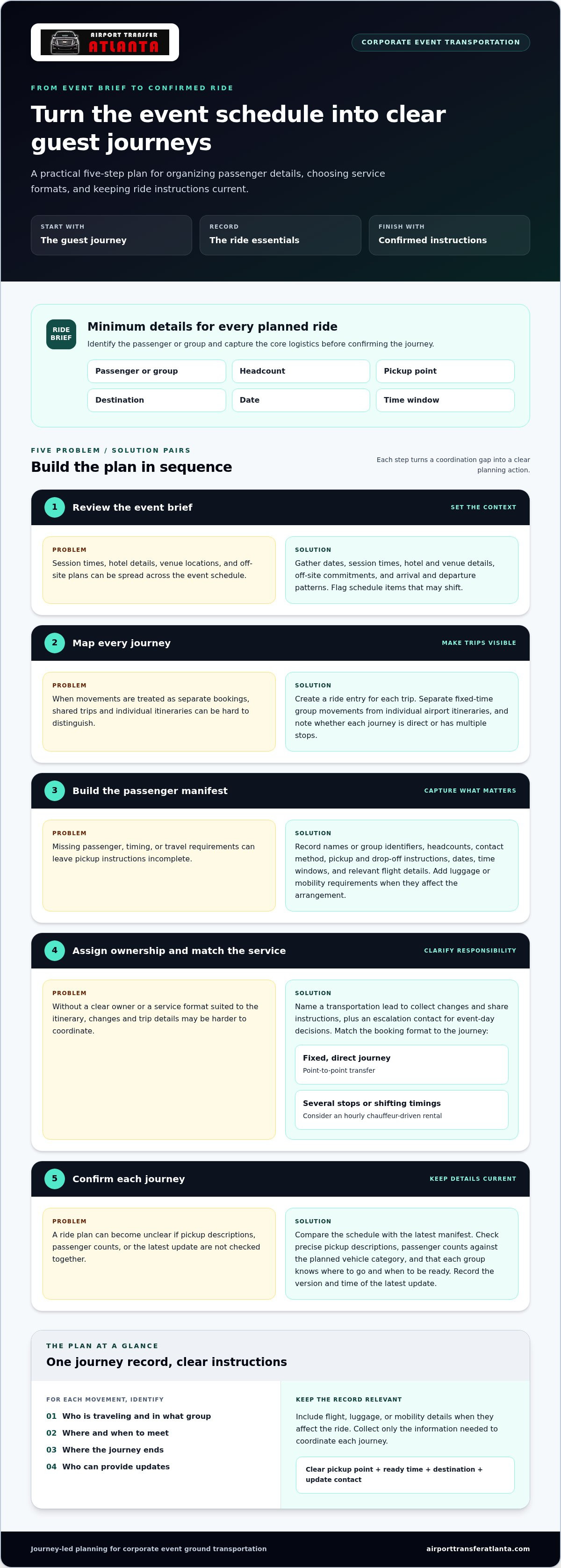
A practical plan turns the event schedule into confirmed passenger journeys, with one person responsible for keeping the details current. For managing ground transportation for corporate events, use this sequence from the initial brief through the final ride review.
Minimum ride details: Every planned ride needs an identified passenger or group, headcount, pickup point, destination, date, and time window.
- Review the event brief. Gather dates, session times, venue locations, hotel details, off-site commitments, and expected arrival and departure patterns. Flag schedule items that may shift, such as a reception ending time, so they can be considered during planning.
- Map the journeys. Convert the schedule into individual ride entries. Separate shared, fixed-time movements from individual airport itineraries, and note whether each trip is direct or includes multiple stops. This gives the transportation lead a working view of the full itinerary.
- Build the passenger manifest. Record names or group identifiers, headcounts, preferred contact method, pickup and drop-off instructions, dates, time windows, and relevant flight details. Add luggage or mobility requirements when they affect the arrangement. Collect only the information needed to coordinate each journey.
- Assign ownership and choose service formats. Name a transportation lead to collect changes and share instructions, along with an escalation contact for event-day decisions. Match fixed, direct journeys to point-to-point service, and consider hourly chauffeur-driven rentals for itineraries with several stops or changing timings.
- Confirm each journey. Compare the schedule with the latest manifest. Check that pickup descriptions are precise, passenger counts align with the planned vehicle category, and each group knows where to go and when to be ready. Record the version and time of the latest update.
What belongs in a passenger manifest?
Keep the manifest useful and controlled. For each passenger or group, include an identification method, headcount, contact channel, journey date, pickup and drop-off details, and the relevant time window. Add flight information for airport trips, plus luggage or mobility notes that affect the ride. Avoid unrelated personal details. A concise record makes missing instructions easier to spot and changes easier to communicate.
How should organizers coordinate updates?
Use one current working document instead of separate lists circulating among teams. When details change, the transportation lead should update the document, tell affected guests what changed, and direct event-day issues to the named escalation contact. Keep messages short: identify the passenger or group, pickup point, revised timing, and update channel. The U.S. Department of Transportation provides guidance on transportation planning and safety.
For a fixed airport leg, a chauffeur-driven one-way airport transfer can be recorded as a distinct journey in the plan. Make every ride traceable from the event brief through its final confirmation.
Choosing Event Transportation: Match the Service Model to Each Itinerary
Choose the booking format based on how each trip is scheduled. A direct airport arrival with a defined destination has different requirements from a series of venue, hotel, and off-site stops. For managing ground transportation for corporate events, compare the journey’s timing and stop pattern first, then select a vehicle suited to the passengers and their luggage.
| Planning factor | Point-to-point transfer | Hourly chauffeur-driven rental |
|---|---|---|
| Schedule structure | A defined pickup and drop-off, with a set journey. | A reserved time window for a planned itinerary. |
| Number of stops | Best suited to a direct trip between specified locations. | Useful when the itinerary includes multiple stops. |
| Flexibility | Works well when locations and timing are established. | Allows more flexibility within the planned rental period. |
Choose a vehicle category based on passenger and luggage requirements, rather than guessing at capacity. A Lincoln MKT or Cadillac XTS sedan may suit an individual traveler or smaller party. A GMC Yukon XL or Cadillac Escalade SUV may work for a group with different space needs, while a Mercedes Sprinter van may suit a larger group traveling together. The National Highway Traffic Safety Administration (NHTSA) sets safety standards for vehicles.
When does point-to-point transportation fit an event?
Use point-to-point service when a journey has a clear origin and destination, such as an airport-to-hotel arrival or a hotel-to-venue transfer. One-way bookings can suit single legs, while round-trip arrangements can cover a defined outbound and return journey. This model ties the booking to a specific transfer instead of reserving a vehicle during gaps in the schedule. See the professional airport limo service guide for more context on planning airport journeys.
When is hourly chauffeur service a practical fit?
Hourly service can suit a program with several planned stops or timings that may shift during a reserved window. It provides continuity across an itinerary instead of treating each leg as a separate point-to-point booking. Hourly rentals include a defined mileage allowance, and additional charges may apply if the allowance is exceeded. Review the hourly limo rental reference guide when planning this format.
A single event can use both models. Arrange point-to-point transfers for scheduled airport arrivals, then use hourly service for a group moving between several event locations. Match each journey to its own needs to keep the overall plan clear without forcing every trip into the same format.
Prevent Event-Day Transportation Problems With Clear Contingency Planning
A detailed transportation plan reduces uncertainty, but it cannot prevent every flight delay, late arrival, schedule revision, or pickup mix-up. Decide in advance who assesses each change, who approves a response, and how affected guests will receive updated instructions. That structure helps prevent a disruption from turning into conflicting messages or unanswered questions.
A usable contingency plan names the likely disruption, the person responsible, the next decision, the guest update channel, and the fallback instruction. Keep these details with the event schedule so assigned staff can act without searching through scattered messages.
How should plans account for delays and schedule changes?
Flag journeys that depend on an incoming flight, a session ending, or another event milestone. For a delayed flight, the transportation lead should receive the update, assess which pickup is affected, and communicate revised instructions to the traveler and relevant staff. If a session runs late, identify who can authorize a timing adjustment and how that change affects later trips. Build reasonable flexibility into the schedule, but do not promise disruption-free travel.
Set a simple escalation path before event day: the person monitoring updates reports the issue to the transportation lead, who decides whether to revise the timing, pickup details, or guest instructions. If the change affects a larger group or the event schedule, notify the designated event decision-maker as well. This prevents multiple people from issuing conflicting directions.
How can organizers make pickups easier to execute?
Write pickup instructions for someone unfamiliar with the venue. Use a specific entrance, meeting point, or clearly identified landmark instead of a general direction such as “outside the hotel.” If a pickup location changes, send one concise update stating the new location, when it takes effect, and which group is affected. Use the same event-day communication channel for routine changes and urgent coordination.
Make the current contact list and fallback steps accessible to assigned staff. If a guest cannot find the pickup point, the instructions should say whom to contact and what information to provide. If a vehicle or timing changes, staff should know who can approve the revised arrangement and who needs to be notified. Keep these directions in the working schedule, not only in one person’s inbox.
- Flight delay: Identify who receives the update and who sends revised pickup instructions.
- Late guest: Set a contact and a decision path for handling the missed meeting time.
- Revised event timing: Name the approver and notify each journey affected by the change.
- Pickup confusion: Provide a precise meeting point and a direct contact for assistance.
Before the event, review these scenarios with the people responsible for transportation and guest communication. Keep changes in one current schedule and make sure staff know which version to follow. For planned airport arrivals, arrange a one-way airport transfer as part of the journey plan, with clear pickup details ready to share.
Put the Corporate Event Transportation Plan Into Action
With the journey list and service model selected, turn the plan into confirmed bookings and clear event-day instructions. Managing ground transportation for corporate events is easier when the organizer closes each open detail in sequence: verify the itinerary, match trips to service formats, finalize vehicle categories, and share the current schedule with the people responsible for each movement.
What should the organizer finalize before booking?
Review the event dates, each planned journey, estimated group sizes, pickup and drop-off points, and timing windows. Flag any movement that depends on a changing schedule. Then assign a booking structure to each trip: use point-to-point service for defined one-way or round-trip transfers, and hourly chauffeur-driven service for a reserved period with multiple stops or a flexible itinerary.
Select the vehicle category based on passenger and luggage needs. Lincoln MKT and Cadillac XTS sedans, GMC Yukon XL and Cadillac Escalade SUVs, and Mercedes Sprinter vans provide options for individual travelers, smaller parties, or groups traveling together. For more context on group vehicle planning, consult the Mercedes Sprinter rental with driver guide.
- Before booking: Align the journey list with the latest event schedule and passenger information.
- At confirmation: Record the service format, vehicle category, pickup details, destination, and timing for each trip.
- Before event day: Share the final instructions with guests and assigned event staff, and identify who will communicate any changes.
How can a chauffeur service fit into the event plan?
A chauffeur-driven service can support a defined airport transfer, a round-trip journey, or an hourly itinerary, depending on how the trip is structured. Clear pickup instructions and service timing help guests understand where to meet and how their ride fits the event schedule. For example, an individual arrival may be planned as a one-way airport transfer, while a group with several scheduled stops may fit an hourly rental.
Keep the booking details consistent with the itinerary shared with guests. If the pickup point or timing changes, update the transportation lead and send revised instructions through the event’s designated communication channel. This keeps the service plan connected to the schedule without requiring every journey to use the same format.
Once dates, routes, group needs, and booking structures are ready, plan corporate event transportation around your itinerary and vehicle needs.
Set Your Event Transportation Plan in Motion
A transportation plan works best when it stays connected to the event as details develop. Before the schedule is finalized, review the journey list alongside the latest program and make sure every change has a clear owner. This helps prevent outdated instructions from reaching guests and gives your team a practical reference on event day.
Managing ground transportation for corporate events does not require every detail to be fixed far in advance. It does require a clear process for turning confirmed dates, passenger needs, and itinerary changes into coordinated journeys. Start with the next event on your calendar, identify the movements that need dedicated planning, and build the transportation arrangements around them.
Airport Transfer Atlanta offers point-to-point one-way and round-trip service, hourly chauffeur-driven rentals with a defined mileage allowance, and sedan, SUV, and Mercedes Sprinter vehicle categories for different itineraries. Plan your corporate event transportation around your schedule and vehicle needs, then put a clear plan into action.
Frequently Asked Questions
How far in advance should you plan ground transportation for a corporate event?
Start planning as soon as the event date and main locations are established. Early planning gives organizers time to refine the itinerary, estimate group needs, and coordinate bookings before event-day details become urgent. For managing ground transportation for corporate events, set a planning deadline alongside other key event milestones.
What information should an event transportation manifest include?
Include enough information to identify each journey and communicate with the relevant traveler or group. Record names or group identifiers, headcount, contact method, pickup and drop-off details, date, time window, and relevant flight information. Add luggage or mobility notes when they affect the arrangement. Limit access to staff who need the document, and mark its latest revision so outdated copies are not mistaken for current instructions.
Is hourly chauffeur service suitable for a corporate event?
Yes, hourly chauffeur service can suit an itinerary with several scheduled destinations or a reserved period during which timings may shift. For example, an executive group traveling between a hotel, meeting venue, and dinner location may benefit from one planned service window. Hourly rentals include a defined mileage allowance, so estimate the route as you build the schedule and account for any additional mileage charges that may apply.
Can one event use different types of transportation?
Yes. Different journeys within one event can use different booking formats and vehicle categories. For instance, individual airport arrivals may be planned separately from a group’s scheduled travel between event locations. A sedan, SUV, or Mercedes Sprinter van can be matched to the group’s passenger and luggage needs. Organize the journeys independently, then review them together to spot conflicting pickup times or overlapping responsibilities.
How should event organizers plan for flight delays?
Identify which pickups depend on flight arrivals and assign one person to receive travel updates and coordinate revised instructions. If a flight is delayed, that lead can assess the affected journey, update the relevant contact, and notify staff responsible for the pickup. Share one clear update channel with travelers before departure. Avoid asking guests to report the same change to multiple people, which can create conflicting information.
What is the difference between point-to-point and hourly event transportation?
Point-to-point transportation is arranged for travel between specified locations, either one way or as a round trip. Hourly service reserves a chauffeur-driven vehicle for a defined period and includes a mileage allowance. The first model suits a journey with known endpoints; the second can fit an itinerary involving several stops. Compare the schedule, route, and expected changes to decide which structure suits each trip.
How can organizers make event pickup instructions clear?
Give guests a precise meeting location, not just a venue name or a direction such as “outside.” Identify the relevant entrance or pickup area, state the expected meeting time, and include the destination and a contact method for questions. Keep each message focused on one journey, especially when groups depart from different locations. Send revised directions through the same channel if the pickup point or timing changes.


