

What if the lowest airport transfer quote isn’t the lowest fare you’ll pay? Comparing prices can be difficult when one quote uses a flat rate and another charges by the hour, especially if mileage allowances or extra-charge terms aren’t clear. Airport transfer price transparency starts with understanding how each fare is calculated and which parts of your trip it covers.
It’s reasonable to want a clear picture of the fare before you book. A direct airport journey and an itinerary with multiple stops may suit different pricing formats, so comparing headline figures alone can hide important differences.
This guide explains how to compare like-for-like quotes, review details that may affect the fare, and decide whether a flat-rate transfer or hourly booking better fits your schedule. You’ll also see how vehicle type, distance, duration, and mileage allowance factor into the comparison. With those details in view, you can choose a private transfer format that matches your route and travel needs before confirming your booking.
Key Takeaways
- Use airport transfer price transparency to assess whether a quote clearly states its pricing method, trip scope, vehicle category, and mileage terms.
- Compare flat-rate and hourly options by matching the pricing basis to your itinerary, not just the quoted total.
- Check that each quote reflects the same route, travel date, direction, passenger needs, and vehicle category.
- For hourly rentals, compare the booked duration and mileage allowance alongside the rate.
- See how private point-to-point transfers and hourly rentals structure pricing around different trip needs.
What Does Airport Transfer Price Transparency Mean?
Airport transfer price transparency means clearly stating how a fare is calculated, what trip it covers, which vehicle category is quoted, and any mileage terms or additional-charge conditions that apply. This gives travelers a consistent basis for understanding a quote before booking, rather than relying on the headline figure alone.
A displayed starting fare and a trip-specific quote serve different purposes. A starting fare indicates an entry point under stated conditions; a trip-specific quote reflects details such as the route, service format, and selected vehicle. Neither is automatically better. The key is knowing what each figure represents and whether it matches the journey you need.
The word “transfer” can refer to transportation from one place to another, as outlined in Transfer (travel). For quote comparison, the practical question is how that journey is defined. Airport transfer price transparency depends on being able to compare the same route, passenger requirements, and service format across quotes.
What should a clear airport transfer quote show?
Start with the pricing basis. Is the quote a flat rate for a defined point-to-point trip, or does it depend on booked hours? It should also identify the vehicle category and trip details used to calculate the fare. For hourly pricing, note the duration and mileage allowance. Review any stated extra-charge conditions so you understand what could affect the amount you pay.
Why can two airport transfer quotes look different?
Quotes can reflect different journeys or different ways of charging. One may cover a longer route, a different vehicle category, or a round trip instead of a one-way transfer. An hourly quote may cover a set duration and mileage allowance, while a flat-rate quote applies to a defined trip.
Separate these differences before judging the figures. For example, compare two one-way quotes for the same airport-to-destination route and vehicle category, rather than comparing one with an hourly booking. If the service format or itinerary differs, the quotes aren’t like-for-like. First align the trip scope and passenger needs, then compare the pricing structure and its terms.
Which Details Shape an Airport Transfer Quote?
A quote reflects the journey and vehicle requested, not just the distance shown on a map. For a flat-rate point-to-point transfer, vehicle type and route distance inform the fare. For an hourly rental, booked time and the stated mileage allowance define a different pricing basis. Compare matching trip details before weighing the headline amounts. That’s a practical step toward airport transfer price transparency.
Flat-rate pricing for a defined airport transfer
A flat rate applies to a specified point-to-point trip and vehicle category. The route endpoints matter: changing the destination can change the distance used to prepare the quote. So does trip direction. A one-way transfer and a round-trip booking have different scopes, even if they use the same vehicle.
For a useful comparison, line up the details: airport pickup and destination, one-way or round-trip service, and vehicle category, such as a sedan, SUV, or Sprinter van. A quote should make the relevant trip conditions clear before booking. If two quotes describe different routes or service scopes, their totals aren’t directly comparable.
Hourly pricing, duration, and mileage allowance
Hourly rental pricing is based on booked time and has a minimum booking duration. Include the mileage allowance in your comparison too: two hourly quotes with different included mileage don’t describe the same usage, even if their booked hours match.
Estimate how long the itinerary is likely to take and how much driving it involves. A vehicle reserved for a direct journey has a different use pattern from one scheduled for several stops or standby time. If planned mileage exceeds the allowance, additional charges may apply under the stated terms. Read those terms alongside the hourly rate to understand the basis of the quote.
Use a simple comparison before deciding:
- Route: Match pickup and destination points.
- Scope: Compare one-way with one-way, or round trip with round trip.
- Vehicle: Keep the category consistent with passenger and luggage needs.
- Pricing basis: Separate a defined-trip flat rate from an hourly booking.
- Terms: For hourly service, note the minimum duration and mileage allowance, along with any stated charges if terms are exceeded.
For a clearer view of the available trip formats, explore private airport transfer options and compare the itinerary details that shape each quote.
Flat-Rate or Hourly Airport Transfer: How to Compare the Options
The right pricing format depends on how your itinerary is structured. A flat-rate transfer is based on a defined point-to-point trip. An hourly booking is based on reserving a vehicle for a period of time, with a mileage allowance to consider. Airport transfer price transparency means comparing each option against the journey you actually plan, rather than treating one format as universally better.
| Comparison | Flat-rate transfer | Hourly booking |
|---|---|---|
| Trip structure | Defined origin and destination | Vehicle booked for a stated period |
| Pricing basis | Vehicle category and trip distance | Booked duration and mileage allowance |
| Useful itinerary fit | A direct airport-to-destination journey | Multiple stops or a schedule requiring flexible use over time |
When does a flat-rate transfer make the fare easier to understand?
A fixed origin and destination provide a clear scope for a point-to-point quote. For example, an airport pickup to one specified destination gives you a defined trip to compare. Keep the direction consistent: compare one-way requests with one-way requests, and round-trip requests with round-trip requests. Then match the vehicle category, since a quote for a sedan and one for an SUV or van don’t describe the same service. These details make the fare basis easier to assess. For more on executive ground transportation, see this professional airport limo service guide.
When is an hourly booking easier to evaluate?
An hourly booking may suit an itinerary that needs a vehicle for a defined period, such as a schedule with several stops or changes in timing. Compare the booked duration and mileage allowance alongside the quoted amount. If the itinerary may exceed the stated mileage allowance, review the applicable terms to understand how additional mileage is handled. That gives you a more useful comparison than looking at the hourly figure alone. The hourly limo rental guide explains this time-based format in more detail.
Use the itinerary as your decision point. A direct trip with defined endpoints can be compared on a flat-rate basis; a schedule built around time, stops, or vehicle availability is better assessed against hourly terms. Align the trip scope and vehicle first, then compare the pricing basis and conditions.
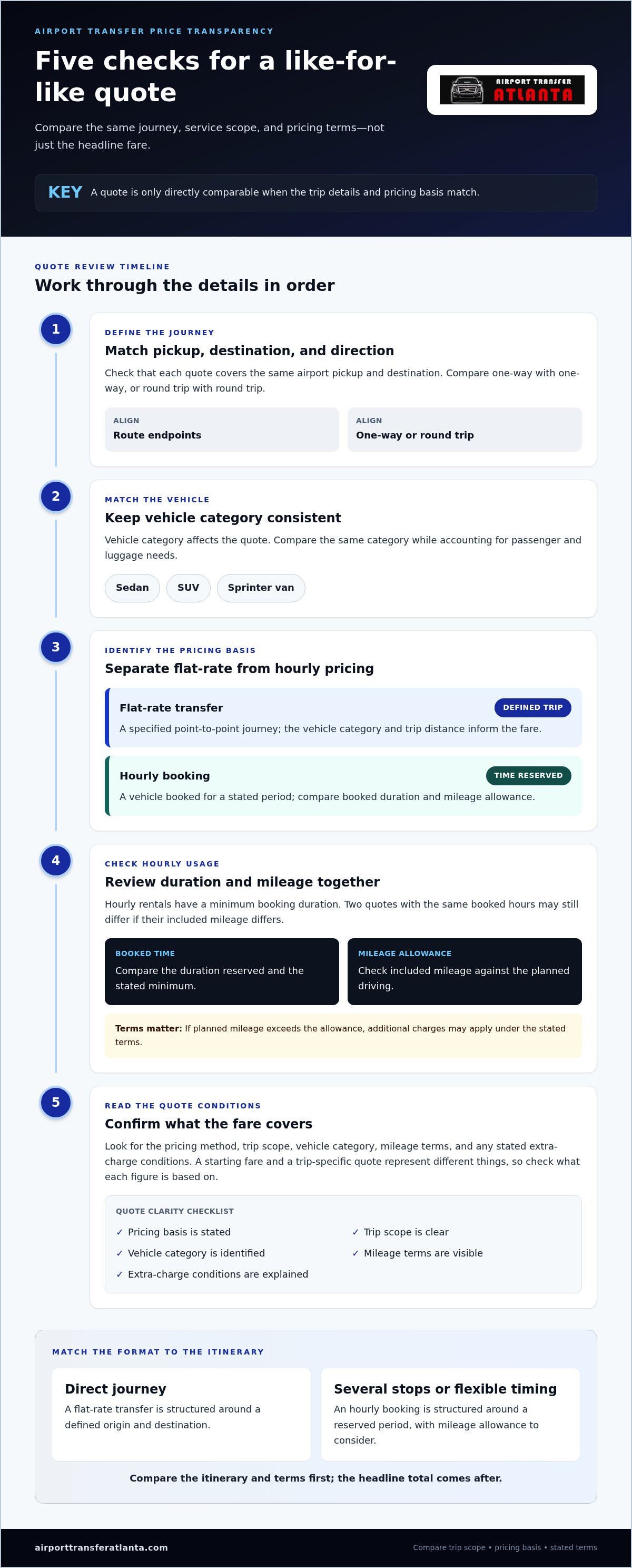
How to Review an Airport Transfer Quote Before Booking
Use the same checklist for every quote. Consistent details make it easier to see whether a difference comes from the trip itself, the pricing format, or a fare condition. That’s the practical basis of airport transfer price transparency.
Check that each quote covers the same trip
Start with the itinerary. A quote for a different pickup point, destination, or travel date won’t provide a direct comparison. Make sure the schedule, direction, passenger requirements, and vehicle category match your request. A point-to-point transfer and a vehicle reserved by the hour also have different scopes.
Read fare conditions and mileage terms carefully
For time-based rentals, include the minimum booking duration and mileage allowance in your review. Look for stated terms explaining how mileage beyond the allowance is handled, along with any other extra-charge conditions. Broader service considerations are covered in this guide to professional limo companies.
Work through these checks before comparing totals:
- Match the route and date. Record the pickup and destination details, travel date, and requested schedule for each quote.
- Match the trip direction. Compare one-way with one-way, or round-trip with round-trip. Don’t treat a return journey as equivalent to a single transfer.
- Check passenger and luggage needs. Compare vehicle categories that suit the same group and luggage requirements.
- Identify the service format. Note whether the quote is for a defined point-to-point trip or a time-based booking.
- Review the pricing basis. For a flat rate, check the trip scope and vehicle category. For an hourly quote, record the booked duration and minimum booking term.
- Read the stated conditions. Note the mileage allowance and any disclosed terms for mileage beyond it or other extra charges before assessing the total.
Keep the details together in a simple comparison note or table. If one quote covers a different vehicle, schedule, or trip scope, mark that difference instead of ranking it by total alone. This helps you compare equivalent services and understand what each figure represents before booking.
For a private airport journey, review airport transfer options and assess the quote against your route, schedule, and vehicle needs.
How Airport Transfer Atlanta Structures Private Transfer Pricing
Airport Transfer Atlanta uses two pricing formats for private transportation. Point-to-point airport transfers have a flat rate based on vehicle type and distance. Hourly rentals are structured around booked time, a minimum booking duration, and a mileage allowance. Understanding which format fits your itinerary helps you assess the quote before booking.
Choose between a one-way transfer and hourly service
A one-way point-to-point transfer is designed for a defined route, such as travel from an airport to a specific destination. Its flat-rate structure is based on the distance and selected vehicle category. Round-trip point-to-point options are also available, with the requested direction and trip scope informing the quote.
Hourly limo rental suits a schedule planned around having a vehicle for a period of time. The booking uses a minimum duration and mileage allowance, so compare both terms with your itinerary. If your plan involves multiple stops or timing that calls for time-based use, assess the hourly format against those requirements. Choose the service type that matches the trip structure.
Prepare the details needed for a clear booking
Provide the details that define the journey: pickup and destination, travel timing, and whether the request is one-way or round trip. Then select a vehicle category based on your passenger and luggage needs. Sedan, SUV, and Mercedes Sprinter options give you categories to consider without comparing quotes for unlike vehicles.
Before booking, review the pricing basis shown for the selected format. For a point-to-point transfer, focus on the route and vehicle type. For an hourly rental, consider the booked duration and mileage allowance together. These details support airport transfer price transparency by making the quote’s structure clear and relevant to your itinerary.
Prepare your route and vehicle requirements, then review private airport transfer options to select the format that fits your travel plans.
Choose a Transfer Format That Fits Your Itinerary
Clear fare comparisons begin with matching the trip details: route, direction, vehicle category, and service format. A flat-rate point-to-point transfer is priced by vehicle type and distance, while an hourly rental is based on booked duration and a mileage allowance. Reviewing those terms side by side supports airport transfer price transparency and helps you understand what each quote covers.
Airport Transfer Atlanta offers sedan, SUV, and Mercedes Sprinter service options to suit different passenger and luggage needs. Select a vehicle category that fits your group, then choose the flat-rate or hourly format that aligns with your schedule. Before booking, review the trip scope and applicable mileage terms so your decision is based on the journey you plan.
Review private airport transfer options and take the next step toward a clearly structured ride that fits your travel plans.
Frequently Asked Questions
What does price transparency mean for an airport transfer?
Price transparency means you can understand how the fare is calculated and what trip it covers before booking. A clear quote identifies the pricing format, route scope, vehicle category, and relevant terms, such as an hourly minimum or mileage allowance. Airport transfer price transparency helps you distinguish a trip-specific quote from a displayed starting fare and compare equivalent services with greater confidence.
Is a flat-rate airport transfer cheaper than an hourly car service?
Not necessarily. The more suitable format depends on the itinerary, so compare the quoted amount against the service each fare covers. A flat rate is based on a defined point-to-point trip, vehicle type, and distance. An hourly service is based on booked time, a minimum duration, and a mileage allowance. A direct trip and a schedule with multiple stops may not be comparable on price alone.
What should an airport transfer quote include?
An airport transfer quote should make the trip and fare basis understandable. Review the pickup and destination, travel timing, one-way or round-trip direction, and vehicle category. Check whether pricing is flat-rate for a defined route or hourly, and note the booked duration and mileage allowance for hourly service. Read any stated extra-charge conditions and terms so you know what the quoted amount applies to.
Can an hourly airport transfer have extra mileage charges?
Yes. Hourly rentals have a mileage allowance, and exceeding it may lead to additional costs under the applicable terms. Before comparing quotes, note both the booked duration and the allowance, then consider whether they fit your planned route and stops. The hourly amount alone doesn’t show how the quote relates to your expected mileage, so review the mileage terms as part of the fare structure.
How do I compare airport transfer quotes fairly?
Compare quotes that describe the same trip. Match the pickup and destination, travel date and schedule, one-way or round-trip scope, passenger and luggage needs, and vehicle category. Then compare the pricing basis: a flat rate for a defined trip or an hourly booking with a minimum duration and mileage allowance. Review stated extra-charge conditions before comparing totals, since different trip details can produce different quotes.
What is the difference between a flat-rate transfer and an hourly rental?
A flat-rate transfer covers a defined point-to-point journey, with pricing based on vehicle type and distance. An hourly rental reserves a chauffeur-driven vehicle for a booked period and uses a minimum duration and mileage allowance. The first format is structured around a route; the second is structured around time and mileage. Compare the one that matches your itinerary, rather than assuming either format is always preferable.
Does the vehicle type affect an airport transfer quote?
Yes. Vehicle type is one factor used to set flat-rate point-to-point pricing, alongside trip distance. Airport Transfer Atlanta offers sedan, SUV, and Mercedes Sprinter service options. Choose a category that suits your passenger and luggage needs, then compare quotes using the same vehicle type and trip details. A quote for a different vehicle category may represent a different service, even if the route is identical.


