

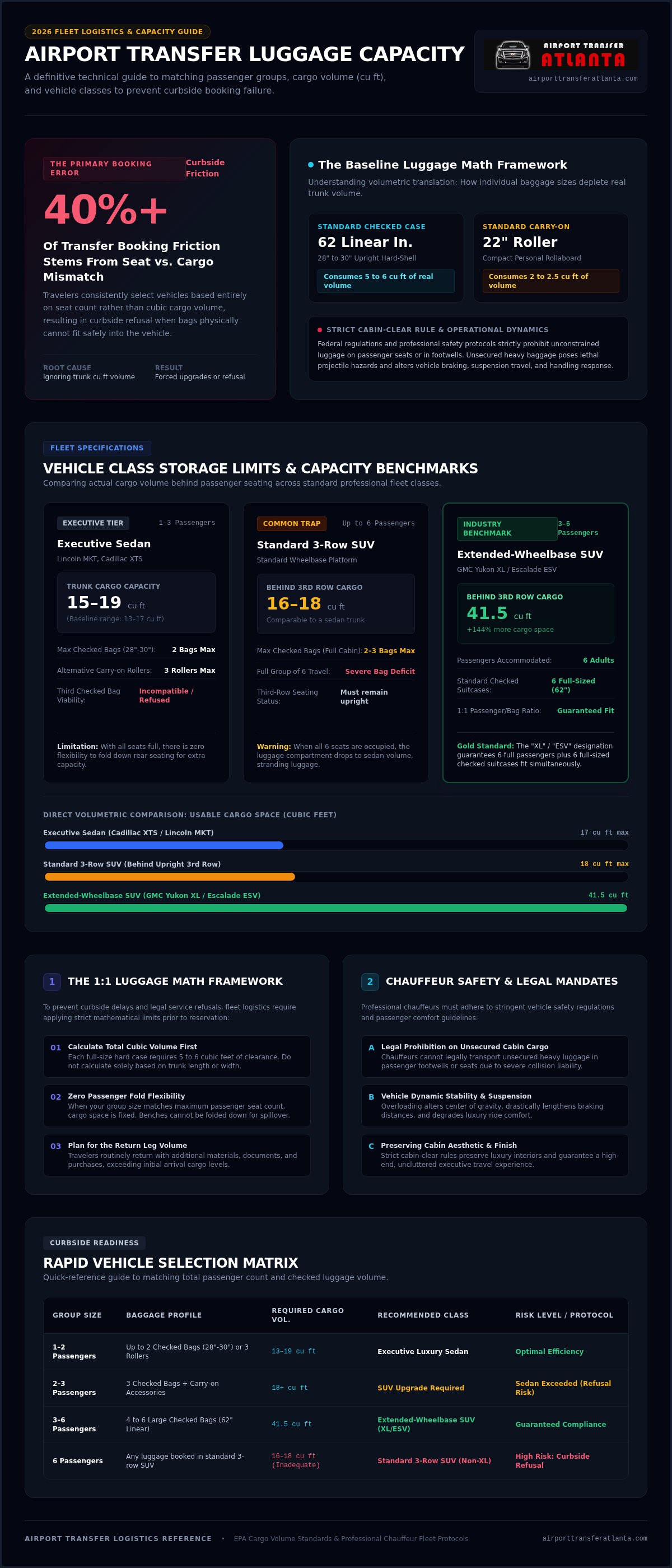
Over 40% of airport transfer booking friction occurs because travelers select a vehicle based on seat count rather than actual cargo volume. It's a common mistake that leads to significant curbside anxiety when a sedan arrives for a group carrying four large suitcases. You shouldn't have to worry about a chauffeur refusing service because your bags won't safely fit in the trunk. Understanding airport transfer luggage capacity is the most critical step in ensuring your transition from the terminal to your destination is seamless and professional.
We agree that a high-end travel experience requires absolute predictability and transparency. This 2026 buying guide provides the technical data you need to calculate the perfect vehicle size for your specific passenger and bag count. You'll learn how to distinguish between standard and extended-wheelbase SUVs, why vehicle electrification affects trunk depth, and which fleet options guarantee the space you require. This guide gives you the confidence to book the right vehicle class the first time, helping you avoid the hidden costs and delays of an inadequate fleet choice.
Key Takeaways
- Learn to calculate the airport transfer luggage capacity of your fleet choice to avoid the common mistake of booking based on seat count alone.
- Understand the technical cargo differences between executive sedans and extended-wheelbase SUVs like the GMC Yukon XL to ensure all bags fit safely.
- Apply the 1:1 luggage math framework to account for the physical volume of hard-shell suitcases and professional gear.
- Recognize the safety protocols and legal restrictions that prevent chauffeurs from transporting unsecured luggage within the passenger cabin.
- Use our final checklist to match your group size and baggage volume with the correct vehicle class for a stress-free arrival.
The Critical Importance of Airport Transfer Luggage Capacity
A successful airport transfer depends on the precise alignment of vehicle volume and passenger needs. Many travelers focus solely on the number of seats, but this is a secondary metric for professional logistics. If the trunk cannot accommodate every bag, the transfer fails before it begins. Professional chauffeurs prioritize safety and comfort, which means keeping the passenger cabin free of loose items. This standard ensures that your travel experience remains high-end and predictable from the moment you exit the terminal.
The Hidden Logistics of Professional Travel
Luggage weight significantly impacts vehicle dynamics. An overloaded trunk changes how a car handles, affecting braking response and suspension travel. Professional standards require that vehicles operate within their designed limits to ensure a smooth, stable ride. Clear communication during the booking process is the only way to avoid logistical breakdowns at the curb. You must provide an accurate count of both checked bags and carry-ons to receive a vehicle that matches your needs. Within the framework of standard vehicle size classifications, luggage capacity is defined as the intersection of cubic volume and passenger count.
Passenger Count vs. Trunk Space: The Essential Trade-off
The passenger capacity listed for most vehicles is often a misleading figure for airport arrivals. While a sedan may technically seat four people, its 13 to 17 cubic feet of trunk space usually only accommodates two large suitcases. When every seat is occupied, there is zero flexibility to fold down a rear bench for extra room. This trade-off is why over 40% of booking friction stems from a mismatch between seat count and cargo volume. If you don't account for this, you risk a service refusal or a forced upgrade when the driver arrives.
High-end services adhere to a strict cabin-clear rule. This protocol ensures that no luggage is placed on seats or in footwells. Keeping the cabin clear protects the vehicle's interior, maintains the luxury aesthetic, and prevents bags from becoming dangerous projectiles during transit. You should also account for the return leg of your journey. Many travelers return with additional materials, documents, or souvenirs that require more airport transfer luggage capacity than the initial arrival. Planning for the maximum possible volume ensures a stress-free experience for everyone in your group.
Decoding Vehicle Classes and Their Standard Storage Limits
Professional fleets adhere to federal vehicle interior and cargo volume standards to ensure both safety and passenger comfort. These regulations define the thresholds for each vehicle class, providing a baseline for what a trunk can legally and physically hold. Matching your baggage count to these specific tiers is the only way to guarantee a smooth transition from the terminal. If you under-book, you risk a curbside service refusal. Chauffeurs cannot legally transport unsecured heavy luggage in the passenger cabin, making vehicle selection a critical logistical decision.
Luxury Sedans: Compact Efficiency for Individuals
The Lincoln MKT and Cadillac XTS represent the standard for executive travel. These vehicles typically offer between 15 and 19 cubic feet of trunk space. This volume limits storage to a maximum of two standard checked bags (28 to 30 inches) or three carry-on rollers. If your group has a third large suitcase, the sedan is no longer a viable option. For solo travelers or couples with minimal gear, our Luxury Sedan Service provides the most efficient logistics without sacrificing professional standards.
Luxury SUVs: The Gold Standard for Families and Heavy Gear
For groups of three to six, the GMC Yukon XL and Cadillac Escalade ESV are the industry benchmarks. The "XL" or "ESV" designation is vital for airport transfer luggage capacity. While a standard three-row SUV provides only 16 to 18 cubic feet behind the upright third row, extended-wheelbase models offer 41.5 cubic feet. This allows for six passengers and six full-sized checked suitcases to fit comfortably. Industry ratings use a standard checked bag size of 62 linear inches as the baseline. A single hard-shell case consumes roughly five to six cubic feet of real-world volume. Review the specifications of our Luxury SUV Service to see how these dimensions support high-volume travel.
Mercedes Sprinter Vans: Maximum Capacity for Groups
When passenger counts exceed six or when specialized gear is involved, the Mercedes Sprinter is the only logical choice. These vans feature a dedicated rear luggage area that handles ten or more standard checked bags. Corporate teams with heavy equipment or families with strollers and golf bags benefit from the high roof and modular seating. If you're coordinating a large team, a Mercedes Sprinter Rental with Driver ensures everyone arrives together with their equipment safely stowed. You can view our full fleet specifications to confirm which vehicle meets your specific requirements.
The Luggage Math Framework: Calculating Your Vehicle Needs
Accurate airport transfer luggage capacity planning begins with the 1:1 Rule. This standard assumes each passenger travels with one large checked bag and one carry-on. While travelers often overlook the carry-on, these items consume roughly 2.5 to 3 cubic feet of space each. In a full vehicle, these smaller bags quickly saturate the remaining trunk volume. You must calculate the total footprint of every item to ensure your selected vehicle class can accommodate the load without encroaching on passenger legroom.
Check-in Bags vs. Carry-ons: Volume Calculations
International and domestic flights frequently involve large checked luggage measuring 28 to 32 inches. These cases are often rigid hard-shells that don't compress. According to U.S. Department of Transportation baggage guidance, understanding your total baggage footprint is essential for a trouble-free arrival. A single large hard-shell bag occupies about 6 cubic feet of real-world trunk space. In contrast, soft-sided duffels allow for more flexible packing. Chauffeurs use a tetris-style configuration to maximize every inch, but rigid cases create fixed boundaries that can't be bypassed. You should always round up your volume estimates to account for the irregular shapes of wheel wells and trunk hinges.
Specialized Equipment: Golf Clubs, Skis, and Oversized Items
Standard volume calculations fail when specialized gear is involved. A single golf travel bag typically equates to the volume of two large suitcases. If your group includes golf clubs, you'll need to upsize your vehicle class regardless of the passenger count. Skis and snowboards present a different challenge due to their length. While some SUVs accommodate internal storage by folding a portion of the third row, this action reduces your passenger capacity. For corporate travelers, trade show displays and presentation materials often require the high-capacity cargo area of a Mercedes Sprinter. These items are typically non-compressible and require a flat load floor to prevent damage during transit.
Visualizing trunk space helps prevent curbside delays. A GMC Yukon XL handles six large bags easily, but adding two sets of golf clubs will likely require moving to a larger vehicle class or reducing the passenger count. Medium-sized bags (24-26 inches) are often deceptive; while they look smaller, three of them occupy the same footprint as two large cases. Always account for the most rigid and largest items first when calculating your needs. This methodical approach ensures your chauffeur can load the vehicle quickly and maintain the professional standards you expect.
Avoiding Booking Errors: Practical Guidance for High-Volume Travel
Booking the wrong vehicle class creates an immediate logistical bottleneck at the terminal curb. If your group arrives with more gear than the trunk can hold, you face the risk of a "forced upgrade." This scenario often requires waiting for a second vehicle to be dispatched from a central depot, leading to missed appointments and significant stress. Professional airport transfer luggage capacity standards exist to prevent these delays. By selecting a vehicle that matches your actual baggage volume, you ensure a predictable and efficient transition from the airport to your final destination.
Safety regulations are a primary driver of these capacity limits. Commercial vehicle operators are legally prohibited from transporting unsecured baggage in the passenger cabin. Chauffeurs will refuse to load suitcases onto seats or into footwells because these items become dangerous projectiles during sudden braking or a collision. Maintaining a cabin-clear policy is not merely about aesthetics; it is a fundamental requirement for passenger protection and insurance compliance. If luggage is not properly stowed in the designated cargo area, the vehicle is not fit for service.
The Risks of Over-Capacity Bookings
Over-capacity bookings jeopardize the executive experience by compromising passenger comfort. A cramped cabin reduces legroom and limits the effectiveness of the vehicle's climate control system. There are also significant liability concerns. Insurance providers may void coverage if a vehicle is operated beyond its gross weight rating or with unsecured cabin loads. Reliability relies on absolute transparency during the reservation phase. When you under-report your baggage count, you force the chauffeur into a difficult position that often results in a service refusal without a refund.
Communication Strategies with Your Chauffeur Service
Precision starts with the digital reservation process. You should always utilize the "Special Instructions" field to specify bag dimensions or the presence of rigid hard-shell cases. When evaluating professional Limo Companies, confirm the specific wheelbase of the SUV fleet. A standard GMC Yukon provides significantly less cargo space than a Yukon XL. Verifying the "XL" or "ESV" designation ensures you receive the 41.5 cubic feet of storage required for a full passenger load.
Chauffeurs act as logistics facilitators, not just drivers. They are trained to maximize trunk space using strategic loading patterns that protect your gear from shifting during transit. If your itinerary involves multiple stops where additional items may be collected, communicate this volume increase in advance. To maintain high-end standards and ensure your arrival is handled with professional precision, verify your baggage count before you book your airport transfer.
Selecting Your Professional Transfer with Confidence
Finalizing your booking requires a methodical review of your group's specific requirements. You've already established that airport transfer luggage capacity is a calculation of volume rather than a guess based on seat count. To ensure a seamless transition from the terminal to your vehicle, you must match your baggage footprint to the correct fleet class. This final step eliminates the risk of curbside delays and ensures your arrival is handled with the professional standards you expect from a high-end service provider.
Matching Fleet Capabilities to Your Itinerary
Your choice of vehicle should reflect both your passenger count and the nature of your trip. Use this checklist to verify your selection before confirming the reservation:
- Lincoln MKT / Cadillac XTS Sedan Service: Best for 1-2 passengers. This class handles a maximum of two large checked suitcases. It is the efficient choice for solo executive travel.
- GMC Yukon XL / Cadillac Escalade SUV Service: The standard for families or groups of 3-6. The "XL" wheelbase is mandatory if you have more than two large bags. It accommodates 4-6 checked suitcases without compromising legroom.
- Luxury Mercedes Sprinter Van Service: The primary solution for corporate teams and groups of 7 or more. This vehicle handles 10+ bags and specialized equipment easily.
Flat-rate pricing for a One Way Airport Transfer provides financial predictability for direct trips. However, if your itinerary involves multiple stops or if your luggage volume might increase during your stay, an Hourly Limo Rental offer superior flexibility. Hourly service allows your chauffeur to remain on standby as your logistical needs evolve.
Streamlined Booking for Reliable Logistics
Reliability depends on the accuracy of the information provided during the booking phase. You should finalize all luggage details at least 24 hours before your scheduled pickup. This lead time allows the dispatch team to verify that the assigned vehicle meets your specific cubic volume requirements. Clear communication regarding oversized items, such as golf clubs or trade show displays, prevents the need for secondary vehicle dispatches at the terminal.
Professional fleet management provides the peace of mind that comes from structured, predictable service. When you provide precise bag counts and dimensions, you enable your chauffeur to plan the loading configuration in advance. This preparation ensures that your transition from the airport is fast-paced and efficient. For a deeper understanding of how these standards are maintained across various vehicle tiers, consult our Professional Airport Limo Service guide. Taking these final steps ensures that your ground transportation is the most reliable segment of your travel itinerary.
Securing Your Seamless Arrival
Ensuring a successful airport transfer requires moving beyond seat counts to calculate the physical footprint of your gear. By applying the luggage math framework, you can select a vehicle class that guarantees both passenger comfort and legal safety compliance. Whether you require a sedan for solo travel or an extended-wheelbase SUV for a family group, matching your needs to the correct airport transfer luggage capacity prevents curbside delays and forced upgrades. Professional logistics provide the peace of mind necessary for high-end travel.
Our service offers a luxury fleet including Cadillac Escalades and Mercedes Sprinter vans, all operated by chauffeurs trained in logistical efficiency. You'll benefit from flat-rate pricing with no hidden luggage fees and seamless terminal transitions. Book your high-capacity airport transfer with confidence today and enjoy a transition that is as efficient as it is comfortable. We look forward to facilitating your next arrival with absolute precision and reliability.
Frequently Asked Questions
How many suitcases fit in a luxury SUV like a GMC Yukon XL?
A GMC Yukon XL accommodates approximately six standard checked suitcases alongside six passengers. This high-capacity vehicle features an extended wheelbase that provides 41.5 cubic feet of cargo space behind the third row. It's the gold standard for families with heavy international bags. If you have soft-sided duffels, the flexible packing might allow for additional smaller items, but six large hard-shell cases are the reliable limit for this vehicle class.
Can a luxury sedan accommodate three passengers with three large bags?
No, a luxury sedan like the Lincoln MKT or Cadillac XTS cannot accommodate three passengers with three large suitcases. While the cabin seats multiple people, the trunk volume is limited to 13 to 17 cubic feet. This space typically fits only two standard checked bags or three carry-on rollers. Attempting to fit a third large bag would require placing it in the passenger cabin, which violates professional safety standards and insurance regulations.
What should I do if my group has oversized items like golf clubs or skis?
You should book a GMC Yukon XL or a Mercedes Sprinter to accommodate oversized equipment. A single golf travel bag occupies the volume of two standard suitcases, while skis require significant length that often necessitates folding down rear seats. Always specify these items in the special instructions field during your booking. This ensures the dispatch team assigns a vehicle with the appropriate airport transfer luggage capacity for your specialized gear.
Do carry-on bags count toward the vehicle's total luggage capacity?
Yes, carry-on bags must be factored into the total cargo volume calculation. Each carry-on roller occupies approximately 2.5 to 3 cubic feet of space. In smaller vehicles like the Cadillac XTS, these items quickly consume the remaining trunk volume after large checked bags are loaded. To maintain a cabin-clear executive experience, you should account for every piece of luggage, including personal items that don't fit under a passenger seat.
What happens if my luggage exceeds the capacity of the vehicle I booked?
If your baggage exceeds the vehicle's capacity, the chauffeur may be forced to refuse service at the curb. Chauffeurs cannot legally transport unsecured items in the passenger compartment due to safety regulations. In these cases, you may need to wait for a second vehicle to be dispatched, which often results in additional fees and significant delays. Accurate reporting of your bag count during the reservation process is essential to avoid these logistical failures.
Is it safe to store luggage in the passenger cabin of a limo?
Storing luggage in the passenger cabin is not safe and is prohibited by professional transportation providers. Unsecured bags become dangerous projectiles during sudden braking or collisions. Additionally, heavy items can damage the high-end interior of vehicles like the Cadillac Escalade. Professional standards require all gear to be stowed in the designated trunk or cargo area to ensure passenger protection and maintain the luxury aesthetic of the transfer.
How do I book a Mercedes Sprinter for a large group with heavy gear?
You can select the Luxury Mercedes Sprinter Van Service option through our digital booking platform for groups of seven or more. This vehicle class is the preferred choice for corporate teams or multi-generational families with heavy equipment. It features a dedicated rear luggage area designed to hold ten or more standard checked bags. Finalizing your booking at least 24 hours in advance ensures the vehicle is prepared for your specific airport transfer luggage capacity requirements.
Are there extra fees for heavy or oversized luggage in a private transfer?
Our service utilizes flat-rate pricing for a One Way Airport Transfer, which typically includes standard luggage handling without hidden fees. However, the requirement for a larger vehicle class to accommodate oversized items like trade show displays or ski equipment will affect the base rate of the transfer. It's more efficient to book the correct vehicle class initially than to face the costs and logistical complications of a curbside service refusal or secondary vehicle dispatch.


