

Choosing the lowest base fare for a single trip often leads to the highest total expenditure by the end of a business day. Inconsistent arrival times and fluctuating surge rates frequently disrupt carefully planned executive schedules. You've likely dealt with the logistical friction of waiting for a new driver between back-to-back meetings or managing the lack of professional reliability in standard car services. Determining if an hourly limo rental is cost effective requires looking beyond the base rate to understand the value of continuous availability and predictable accounting.
This 2026 analysis provides the mathematical and logistical frameworks you need to make an informed booking decision. We'll examine the specific tipping points where dedicated chauffeur services outperform on-demand apps in both time management and total value. You'll discover how to maximize daily productivity using vehicle options like the Mercedes Sprinter or executive SUVs as mobile command centers. We also outline a clear decision-making framework to help you eliminate hidden fees and ensure your transportation remains a seamless, predictable extension of your professional day.
Key Takeaways
- Contrast hourly "as-directed" service with fixed point-to-point transfers to identify which model aligns with your specific logistical requirements.
- Apply the "3-Stop Rule" to determine if hourly limo rental is cost effective when compared to the cumulative fees of multiple individual bookings.
- Evaluate how utilizing an executive vehicle as a mobile command center recaptures productive labor time and mitigates the risks of travel delays.
- Map itinerary dwell times and peak-hour demand to avoid the hidden costs of wait-time penalties and rideshare surge pricing.
- Select the optimal fleet option for your group size, ranging from Cadillac XTS sedans for solo travel to Mercedes Sprinter vans for professional group transport.
The Economics of Hourly Limo Rental vs. Point-to-Point
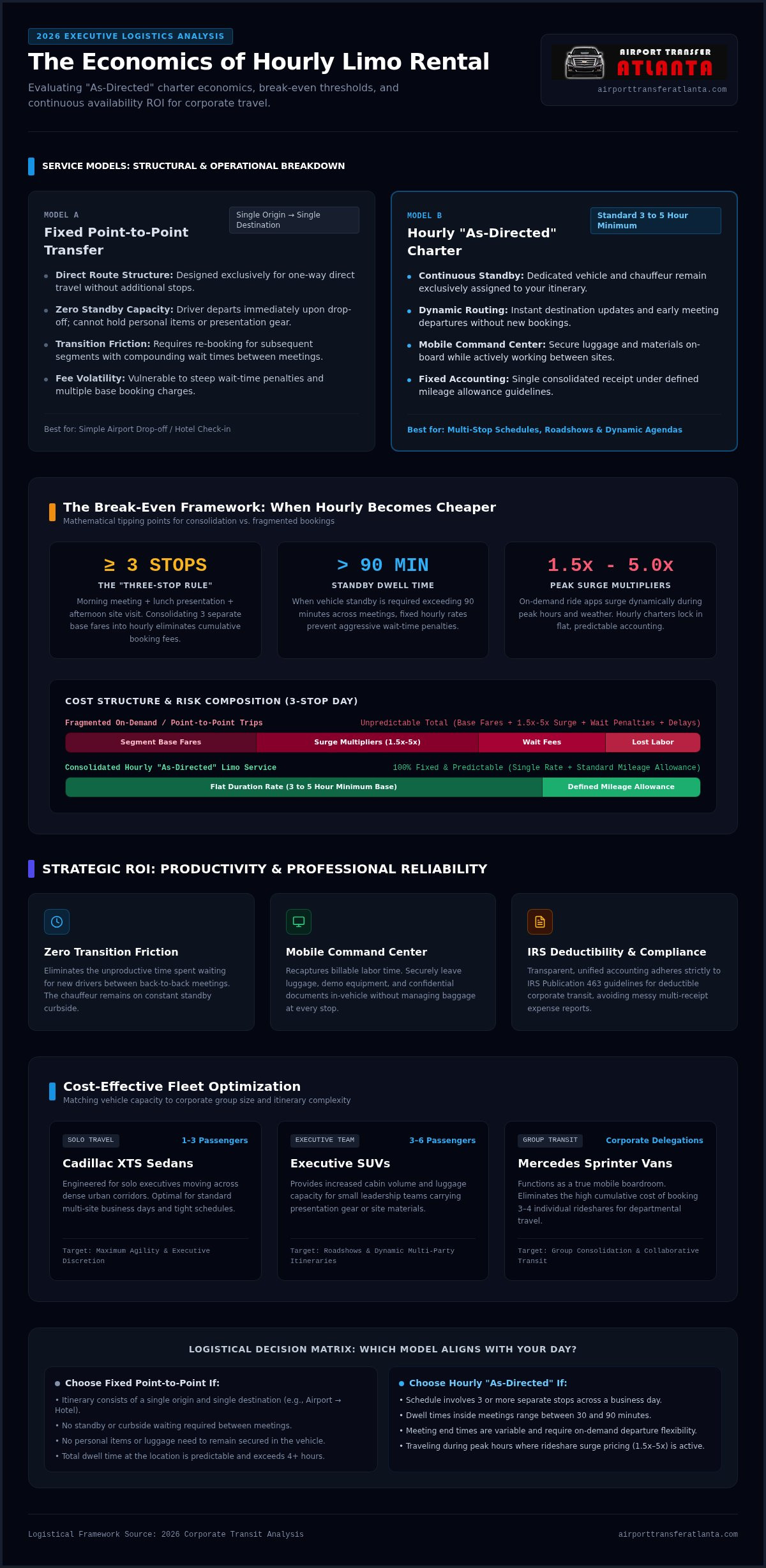
The primary question for many corporate travelers is hourly limo rental cost effective when compared to standard transfers. Point-to-point service is designed for direct, one-way travel from a specific origin to a single destination. It's efficient for airport arrivals or hotel check-ins where no additional stops are required. In contrast, an hourly limo rental operates on an "as-directed" basis. This provides a dedicated vehicle and professional driver for a set duration, allowing for multiple stops and route changes without the need for separate bookings.
In 2026, the industry standard for hourly charters typically involves a 3 to 5 hour minimum booking. This structure ensures the vehicle and chauffeur remain exclusively assigned to your itinerary for the duration of the contract. The core economic driver here is the trade-off between the cost of availability and the cost of individual segments. While point-to-point transfers carry lower base prices for single trips, they lack the standby capacity required for complex or volatile schedules.
When Availability Becomes a Tangible Asset
Determining if is hourly limo rental cost effective requires an analysis of transition friction. This term describes the unproductive time spent waiting for new vehicles between meetings or events. Relying on on-demand apps often exposes travelers to the risk of having no cars available during peak hours or inclement weather. A chauffeured limousine service removes this uncertainty by keeping the driver on constant standby. Additionally, the vehicle serves as a secure storage space. You can leave personal items, presentation materials, or luggage in the car while attending meetings, which is a logistical impossibility with point-to-point transfers.
Defining the 'As-Directed' Service Model
The as-directed model offers total flexibility for dynamic schedules. If a meeting concludes early or a destination changes unexpectedly, you don't need to re-book or wait for a new driver to arrive. Your chauffeur acts as an on-site logistical coordinator who monitors traffic patterns and adjusts routes in real time. This is the gold standard for executive roadshows and multi-site visits. It ensures you maintain a professional image while moving between locations without the administrative burden of managing multiple separate receipts or dealing with steep wait-time penalties associated with fixed-route services.
Comparative Cost Analysis: The Break-Even Point
Calculating whether is hourly limo rental cost effective requires a detailed look at the cumulative expenses of a multi-stop itinerary. Many travelers mistakenly compare a single hourly rate to a single one-way transfer. However, the true comparison lies in the total daily spend. If your schedule involves three or more stops or requires a vehicle to remain on standby for more than 90 minutes, the hourly model typically provides superior value. This consolidation eliminates the repeated booking fees and base charges associated with multiple point-to-point transfers.
Ride-sharing platforms often appear cheaper on the surface but carry significant hidden costs. Surge pricing multipliers frequently reach 1.5x to 5x base fares during peak business hours or adverse weather. Additionally, wait-time penalties on these apps accumulate quickly if a meeting runs late. Professional chauffeurs provide a fixed, transparent rate that remains unaffected by local demand spikes. This predictability is vital for corporate accounting and aligns with IRS business travel and transportation expense guidelines regarding deductible professional transit costs.
The Three-Stop Rule for Hourly Efficiency
The "Three-Stop Rule" serves as a primary benchmark for logistical efficiency. When you book individual transfers for a morning meeting, a lunch presentation, and an afternoon site visit, you pay three separate base rates. Each segment also carries the risk of a late arrival or a driver cancellation. An hourly rental covers the entire duration, including the "dwell time" while you are inside your meetings. This ensures the car is ready the moment you exit the building, effectively recapturing lost productivity. For those managing complex schedules, reviewing Hourly Limo Rental options often reveals a more streamlined budget than fragmented bookings.
Mileage Allowances and Overages
Hourly contracts typically include a defined mileage allowance per hour. This is sufficient for most urban business itineraries where travel is concentrated within a specific metropolitan area. If your route involves long-distance travel between distant hubs, it's important to identify potential overage charges early in the planning process. Transparent providers outline these limits clearly to prevent unexpected costs on the final invoice. Group size also influences these economics. Utilizing a high-capacity vehicle like the Mercedes Sprinter for a team of eight can reduce the per-passenger cost to a fraction of multiple individual rideshare cars while keeping the group together for collaborative work.
The ROI of Productivity and Professional Reliability
The true measure of whether is hourly limo rental cost effective often lies in the recovery of billable time. For a traveling executive, a 45 minute transit between meetings isn't just travel; it's a gap in the productive workday. Standard ride-sharing environments are rarely conducive to deep work or confidential calls. By converting the vehicle into a mobile command center, you can maintain a continuous workflow. This "Mobile Office" effect transforms transportation from a sunk cost into a productive asset that supports your bottom line.
Reliability serves as a critical risk-mitigation strategy for high-stakes business meetings. In professional environments, even a short delay can derail a negotiation or lead to a missed presentation. Dedicated services offer significantly higher on-time performance rates than on-demand platforms. This predictability fosters a sense of calm efficiency, allowing you to focus on your professional objectives rather than logistical hurdles. Understanding the Efficiency of Professional Airport Chauffeur Services helps illustrate how these high standards apply to broader corporate travel needs.
Security and Confidentiality for Executives
Professional chauffeurs undergo rigorous background checks and adhere to strict duty-of-care standards. This differs sharply from the gig-economy model, where driver vetting is often automated. According to the Bureau of Labor Statistics occupational overview for professional chauffeurs, dedicated livery drivers are held to specific operational and safety scopes that on-demand drivers are not. The sound-insulated cabins of executive vehicles provide a secure environment for discussing sensitive corporate data or proprietary information. This privacy is a non-negotiable requirement for many financial roadshows and legal proceedings.
Physical Amenities That Support Work
The infrastructure of a luxury fleet is specifically engineered to support professional activity. Vehicles like the Lincoln MKT or Cadillac XTS are equipped with high-speed Wi-Fi, multiple charging ports, and individual climate controls. These features ensure that devices remain powered and the environment remains comfortable for long-duration travel.
- Ergonomic Seating: Premium leather seating reduces physical fatigue during multi-stop itineraries.
- Stable Connectivity: Dedicated Wi-Fi hotspots provide reliable connections for video conferencing.
- Secluded Workspace: Privacy partitions and tinted windows ensure a workspace free from external distractions.
- Task Lighting: Adjustable lighting allows for reading or laptop use regardless of the time of day.
In 2026, vehicle standards prioritize passenger productivity over simple transit. When you factor in the value of an executive's hourly labor rate, the decision to book a dedicated service becomes a logical financial choice. The ability to work without interruption while moving between locations is a primary factor in determining why is hourly limo rental cost effective for high-level organizations.
Itinerary Assessment: Is Hourly Right for Your Trip?
To determine if is hourly limo rental cost effective, you must audit your itinerary against four specific logistical variables. This assessment moves beyond simple mileage to evaluate the standby value required for your schedule. Follow these steps to calculate the most efficient booking model for your needs.
- Step 1: Map total stops and dwell times. If you spend more than 60 minutes at a location or have three or more segments, the standby rate often competes with the combined cost of separate transfers and wait-time penalties.
- Step 2: Estimate peak-hour demand. High-traffic periods increase the risk of driver cancellations and surge pricing on standard platforms. Hourly rates remain fixed regardless of local demand spikes.
- Step 3: Evaluate the need for immediate departure. If your meeting end times are variable, having a chauffeur on-site eliminates the transition friction of waiting for a new vehicle to arrive.
- Step 4: Determine luggage requirements. Hourly service allows you to use the vehicle as a secure mobile locker for personal items, presentation materials, or luggage between stops.
Scenario A: The Corporate Roadshow
Financial roadshows and executive site visits require absolute punctuality and a consistent professional image. Hourly service is the only logical choice for back-to-back meetings because it guarantees a single point of contact and a dedicated vehicle throughout the day. This continuity ensures you don't waste time re-orienting new drivers or managing multiple receipts. For a deeper look at managing these complex schedules, consult our Hourly Limo Rental: The Professional Reference Guide.
Scenario B: Large Group Event Logistics
Managing transportation for a team summit or client hospitality event often involves moving between multiple venues. Using a single Mercedes Sprinter for group transport is frequently more economical than booking multiple executive SUVs. The cost-per-head efficiency of a high-capacity hourly rental simplifies accounting and ensures the entire team arrives together, ready to work. This model eliminates the logistical nightmare of tracking multiple independent vehicles. For detailed fleet specifications and capacity charts, view the Mercedes Sprinter Rental with Driver: 2026 Guide.
Perform a thorough audit of your planned stops to ensure your budget is optimized for both time and reliability. If your itinerary involves more than three segments or requires a vehicle to stay on-site, Book an Hourly Limo Rental to secure your dedicated vehicle and chauffeur today.
Selecting the Cost-Effective Fleet for Your Schedule
Matching vehicle capacity to your specific group size is the final step in determining if is hourly limo rental cost effective. Over-booking a high-capacity vehicle for a solo traveler leads to wasted expenditure, while under-estimating luggage needs can cause significant logistical friction. For solo executives or pairs, luxury sedans like the Lincoln MKT or Cadillac XTS provide a streamlined professional profile. These vehicles offer the most accessible hourly entry point while maintaining the high standards required for executive transit.
Vehicle choice directly impacts the hourly base rate and the overall value of the "as-directed" model. Large-scale SUVs provide a more robust presence for site visits, while executive vans offer the highest per-passenger savings for corporate teams. Selecting the correct fleet category ensures you only pay for the capacity you actually require.
The SUV Advantage for Multi-Stop Group Travel
The GMC Yukon XL or Cadillac Escalade represents the best balance of interior volume and professional utility for groups of three to six passengers. These vehicles are particularly effective for itineraries involving multiple stops where travelers need to enter and exit the vehicle frequently. Choosing a single executive SUV is often more cost effective than booking two separate sedans. This consolidation reduces the total hourly minimums you must satisfy and simplifies the management of mileage allowances. For a deeper analysis of these vehicle standards, consult our Ultimate Guide to Luxury SUV Service.
High-Capacity Savings with Sprinter Service
When group size exceeds six travelers, the Mercedes Sprinter Van becomes the ultimate choice for high-capacity efficiency. Booking one 12-seater Sprinter is significantly more economical than managing three separate SUVs. This model keeps the entire team together, allowing for group briefings or collaborative work between locations. The luxury features of a Sprinter, such as stand-up headroom and mobile conference seating, justify the hourly investment by maximizing the productivity of every passenger on board.
Finalize your logistics by ensuring your chosen Limo Company provides a transparent breakdown of their fleet capabilities and hourly requirements. A professional provider will help you map your passenger count and luggage volume to the most efficient vehicle class, ensuring your transportation remains a high-value asset rather than a logistical burden.
Optimizing Your Professional Ground Logistics
Determining if is hourly limo rental cost effective requires a holistic view of your itinerary and the value of your billable time. As analyzed, the "Three-Stop Rule" serves as a definitive mathematical tipping point where continuous availability outperforms fragmented bookings. By converting transit time into a productive mobile office and eliminating the transition friction of on-demand services, you secure a significant return on your logistical investment.
Airport Transfer Atlanta provides the structured, predictable service necessary for high-stakes business travel. Our transparent pricing models and late-model luxury fleet, featuring Cadillac and Mercedes-Benz vehicles, ensure your transportation is a seamless extension of your professional standards. Every itinerary is managed by vetted, professional chauffeurs who prioritize your schedule and security above all else. Transition from unpredictable transit to a managed mobility solution that respects your time and intelligence.
Book Your Professional Hourly Limo Rental Today and experience the peace of mind that comes with expert logistical coordination. We look forward to facilitating your next successful itinerary.
Frequently Asked Questions
Is there a minimum number of hours required for an hourly limo rental?
Yes, a minimum booking duration is standard across the luxury transportation industry. Most professional providers require a commitment of at least three to four hours for a dedicated chauffeur and vehicle. This requirement ensures that the vehicle remains exclusively assigned to your itinerary. It prevents the logistical conflicts that arise from trying to schedule short, fragmented segments throughout a busy business day.
Does the hourly rate include the chauffeur's gratuity and fuel surcharges?
The base hourly rate typically excludes ancillary fees such as mandatory gratuities, fuel surcharges, and administrative fees. In the 2026 market, these additions often represent an increase of 25% to 30% over the advertised base quote. You should request an all-in quote before booking to ensure a transparent understanding of the total expenditure for your professional travel needs.
Can I change my itinerary mid-trip during an hourly rental?
One of the primary reasons is hourly limo rental cost effective is the total flexibility of the "as-directed" service model. You can change destinations, add stops, or adjust your departure times on the fly without needing to re-book. Your chauffeur acts as a logistical coordinator, managing route changes in real time to accommodate the evolving needs of your professional schedule.
Is it cheaper to book a round-trip airport transfer or an hourly service?
The decision depends entirely on your "dwell time" between trips. A round-trip transfer is more efficient for direct travel with predictable departure times. However, if your chauffeur must wait at a venue for more than 90 minutes, or if you have multiple stops, the hourly model becomes the superior financial choice. It eliminates the steep wait-time penalties associated with fixed-route transfers.
What happens if I exceed the mileage allowance during my hourly hire?
Most hourly contracts include a specific mileage allowance per hour, which is sufficient for travel within a metropolitan area. If your itinerary involves long-distance travel that exceeds these limits, additional per-mile charges will apply. Professional providers outline these overage rates in the service agreement to maintain transparency and prevent unexpected costs on your final corporate invoice after the trip is completed.
Are there specific peak-hour surcharges for hourly rentals in 2026?
Industry standards in 2026 often include surcharges for high-demand periods, such as major conventions, holiday weekends, or late-night service. These fees reflect the increased operational costs during peak times. Unlike the volatile surge pricing found on ride-sharing apps, these professional surcharges are typically disclosed at the time of booking, providing a predictable and stable framework for your corporate travel budget.
Can I leave my luggage in the limo between my scheduled stops?
Yes, your dedicated vehicle serves as a secure mobile locker throughout the duration of your hourly rental. You can leave presentation materials, personal items, or luggage in the car while attending meetings or events. This feature provides a significant logistical advantage over point-to-point transfers, where you would be responsible for managing your belongings and finding storage between every individual ride.
Is a Mercedes Sprinter more cost-effective than two luxury SUVs for group travel?
A single Mercedes Sprinter is almost always more cost-effective than booking two separate executive SUVs for groups of seven to twelve passengers. Consolidating your team into one vehicle reduces the total number of hourly minimums and mileage allowances you must cover. It also ensures the entire group arrives together, facilitating team collaboration and simplifying the administrative task of managing multiple receipts.


