

For FBO private jet ground transportation, a vehicle can reach the aircraft only when airport rules and security procedures permit it. Planeside pickup is not guaranteed. If ramp access is restricted, passengers typically meet the chauffeur in the FBO lobby or another approved pickup area. The exact meeting point depends on the facility’s access procedures.
That distinction matters when planning a private jet arrival. A vehicle at the aircraft may shorten the handoff, while a lobby pickup provides a clear meeting point when ramp access is unavailable. The pickup plan should match the FBO’s procedures and the arrival details.
This guide covers the information to provide when arranging car service, coordinating transportation for multiple jet arrivals, and choosing between planeside and lobby pickup. It also explains how passenger count, luggage, timing, and vehicle capacity shape the transfer, so you can plan around the itinerary without assuming ramp access will be available.
Key Takeaways
- Coordinate each arrival around its FBO, estimated block-in time, passenger count, and luggage so vehicles are assigned to the right flights.
- Share the aircraft tail number and facility details when arranging pickup to help align the car service with the arrival.
- Choose the pickup point around facility access procedures; the arrival plan should account for both aircraft-side and lobby handoffs.
- Match the vehicle and service type to the group’s passenger and luggage needs, then plan the onward transfer around the itinerary.
How do I Coordinate Chauffeur Service for Multiple Jet Arrivals?
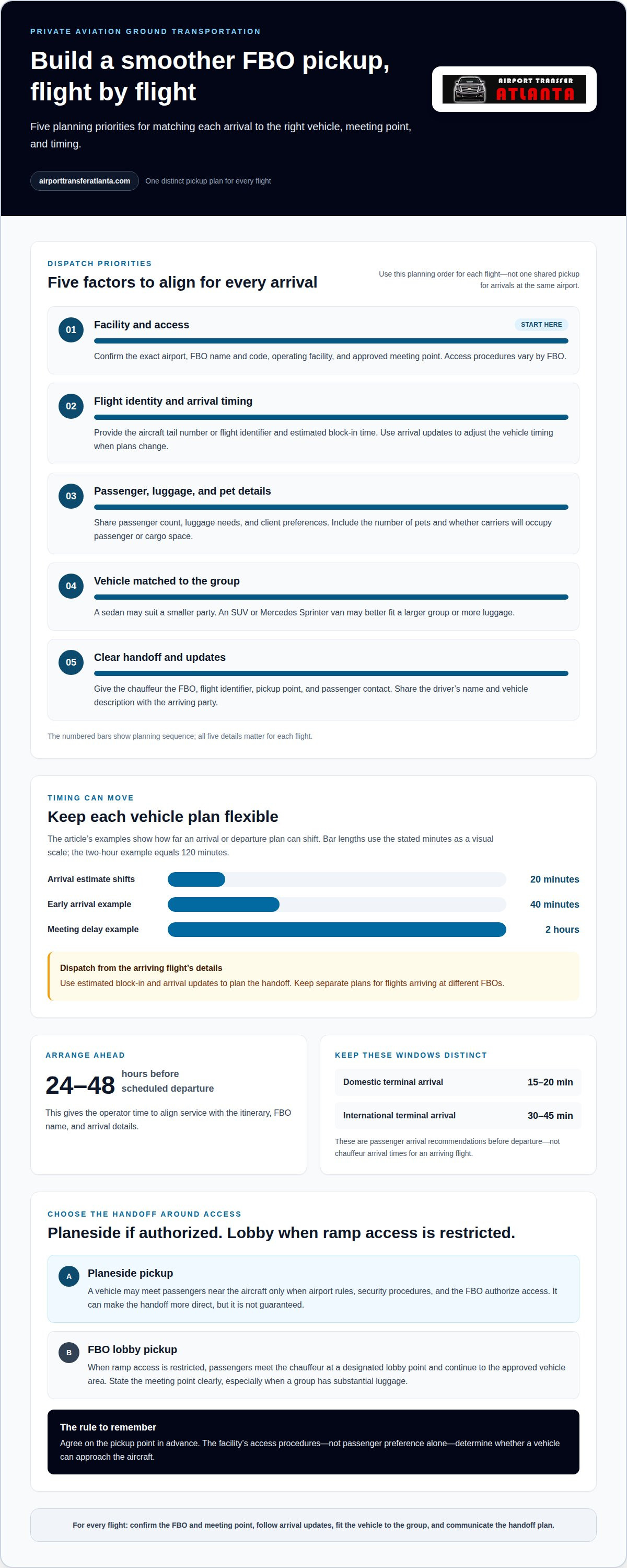
For multiple private aviation arrivals, match each flight with a vehicle using passenger count, timing, luggage, and client preferences. Start with the exact FBO name and code, then provide each aircraft’s estimated block-in time. A concierge or trip coordinator can keep those details grouped by flight, rather than treating arrivals at the same airport as one pickup. If an FBO provides arrival updates directly, the transportation provider can use them to adjust vehicle timing.
Build flexibility into the schedule. Air traffic control sequencing can shift a Gulfstream’s estimated arrival by twenty minutes, while a tailwind can bring a private jet in forty minutes early. A principal’s meeting may also delay departure by two hours. These changes can affect vehicles differently, especially when flights arrive at separate FBOs. Keep each flight’s pickup plan distinct and update the relevant chauffeur when its timing changes.
Separate terminal arrival guidance from car dispatch timing. For domestic private jet flights, the recommended terminal arrival is 15-20 minutes before departure; for international flights, it is 30-45 minutes. Those windows describe when passengers arrive before departure, not how early a chauffeur should reach an FBO for an arriving flight. For pickups, use estimated block-in and updates to plan the handoff.
Include pets in the passenger and luggage details. For example, note the number of animals and whether carriers will occupy passenger or cargo space. Share the FBO, flight identifier, pickup point, and passenger contact with the chauffeur, then provide the driver’s name and vehicle description to the arriving party. A sedan may suit a smaller party, while an SUV or Mercedes Sprinter van may better fit a larger group or more luggage. This information gives each chauffeur a clear assignment and supports a smooth arrival sequence.
How Do You Schedule Car Service for a Private Jet Arrival?
FBO pickups use private aviation facilities, while commercial airport pickups follow terminal curb and passenger flows. Start the transportation plan with the airport, FBO, flight details, and destination.
FBO Transfers and Commercial Airport Pickups
An FBO transfer collects passengers at a fixed-base operator rather than a commercial terminal. FBOs have controlled access and no common baggage carousels or public taxi ranks, so the pickup needs a defined meeting point. Commercial terminal pickups can take 30 to 60 minutes from touchdown until passengers are moving. Standard rideshare apps may be permitted at some private aviation facilities, but a prearranged car offers more predictable coordination than relying on a taxi or rental-car counter. Share the aircraft tail number or enable real-time flight tracking when arranging service.
Airport Locations and FBO Availability
Airport location and the operating FBO determine where the chauffeur meets the arriving party and how the onward route works. The United States has over 5,000 FBOs, but access procedures and operating hours vary by facility and operator. At Miami Opa-locka Executive Airport, ramp access policies vary by operator, making advance coordination useful. Aircraft limits also matter when selecting an airport: a light jet might need a 3,200 ft runway. Henderson Executive Airport is an option for travelers heading to the Las Vegas Strip. Match the airport and FBO to the aircraft and final destination.
Booking Ground Transportation in Advance
Arrange private aviation car service 24 to 48 hours before the scheduled departure. This gives the operator time to align the pickup with the flight itinerary, FBO name, and arrival details. How does it compare with rideshare, taxis, and rental cars? Prearranged service provides a planned pickup and timing coordination, while rideshare access varies by facility and taxis or rental cars may not meet passengers at the FBO. For domestic and international arrivals, provide the airport, FBO, tail number, passenger count, and luggage details. These details help the chauffeur plan the meeting point and route to the destination.
Planeside versus FBO lobby pickup
Planeside pickup places the vehicle near the aircraft; lobby pickup brings passengers to a designated FBO meeting point. The right choice depends on the facility’s access rules and whether the vehicle is cleared to approach the aircraft or an approved curb area.
Ramp access is not guaranteed. Airport rules and security procedures determine whether a chauffeur can drive onto the tarmac, and vehicles need clearance for ramp or curb approaches. Agree on the pickup point in advance as part of the flight plan. If a facility permits planeside access, passengers may be able to move directly from aircraft to vehicle. That convenience depends on authorization, not simply passenger preference.
When ramp access is restricted, the FBO lobby is the standard alternative. Passengers meet the chauffeur inside the private terminal, then proceed to the approved vehicle area. This creates a defined handoff without relying on a car reaching the aircraft. For a group with substantial luggage, specify the meeting point clearly so passengers and bags can move together rather than splitting between the lobby and curb.
FBO vehicle pickups use controlled access, unlike the open pickup arrangements common at commercial terminals. The facility’s procedures determine which identification or security steps apply. Vehicles need clearance for the relevant ramp or curb approach, and access procedures vary by FBO. Provide the chauffeur’s name and vehicle description to the arriving party so they can identify the assigned car at the agreed pickup point.
Choose planeside service only when the airport and FBO authorize that approach. Otherwise, set the lobby as the meeting point and communicate it before departure. For example, passengers arriving at an FBO with restricted ramp access should meet inside, while a cleared vehicle can use the authorized approach. Confirming the pickup location in advance helps the chauffeur, passengers, and luggage follow the same handoff plan. It also avoids treating an FBO like a commercial terminal, where public curbside conventions may not apply.
Private jet and FBO ground transfers
A private-jet transfer connects an FBO arrival with a ground destination through a separately arranged vehicle. The handoff matters because flight plans, passenger needs, and road travel must align. For executives flying into Teterboro Airport, the drive to Manhattan typically takes 20 to 35 minutes, depending on the time of day. That road segment is part of the transfer plan, not the flight itself.
Choose a vehicle based on passenger count and luggage. Airport Transfer Atlanta offers a Lincoln MKT for three passengers and three bags, a GMC Yukon XL for six passengers and six bags, and a Luxury Mercedes Sprinter for fourteen passengers and fourteen bags. Share any unusual luggage needs in advance, since they affect how passengers and bags fit within the vehicle’s capacity.
For a direct trip, a one-way transfer connects the FBO with your chosen destination. Hourly transportation can suit an itinerary with several stops or a schedule that requires the vehicle to remain available. In either case, consider the route, passenger count, luggage, and schedule when choosing the arrangement. The aim is a smooth connection without treating the FBO like a commercial terminal.
How much does private jet ground transportation cost in the United States? The price depends on the case and is given after a quote request. Route distance, service duration, vehicle type, passenger and luggage needs, and one-way or hourly arrangements affect the quote; ground transportation may also be itemized separately from charter costs.
Do FBOs offer chauffeurs, limousines, SUVs, and group transportation? FBOs provide aviation services and may coordinate ground transportation, but chauffeur service and vehicle arrangements are typically handled separately. Choose a vehicle based on passenger count and luggage. Airport Transfer Atlanta offers a Lincoln MKT for three passengers and three bags, a GMC Yukon XL for six passengers and six bags, and a Luxury Mercedes Sprinter for fourteen passengers and fourteen bags. Plan for the road journey after flying, not just the aircraft’s arrival.
Airport Transfer Atlanta
Airport Transfer Atlanta helps travelers plan the road journey between an airport and their destination. After arranging the FBO pickup point, choose a One Way Airport Transfer for a direct trip or Hourly Limo Rental when the itinerary includes multiple stops. Vehicle options include Lincoln MKT / Cadillac XTS Sedan Service and GMC Yukon XL / Cadillac Escalade SUV Service. Match the vehicle to your passenger group and luggage, then align the transfer with your arrival schedule and destination. This is a practical next step when your private flight plan is set and you need ground transportation arranged for the journey ahead. Contact Airport Transfer Atlanta to discuss your airport transfer needs.
Plan the Next Leg of Your Journey
Use the final stage of trip planning to connect flight timing with the road itinerary. A useful transfer brief brings together the destination, passenger priorities, luggage needs, and agreed pickup point. Sharing these details helps keep decisions aligned if plans change, whether you’re arranging travel for yourself, family, or business executives.
For FBO private jet ground transportation, turn the flight details into a clear transportation request. Consider how the ground journey fits the day’s schedule, including appointments, hotel arrival, or an onward connection. When the transportation plan reflects the purpose of the trip, it can support a coordinated transition from the aircraft to the next destination.
Airport Transfer Atlanta provides airport transportation for travelers planning that connection. To discuss the road portion of your itinerary, contact Airport Transfer Atlanta. A clear plan for the next leg helps you move forward with confidence.
Frequently Asked Questions
Can the Car Really Drive Up to the Aircraft?
Not always. A vehicle can approach the aircraft only if the airport and FBO authorize ramp access; otherwise, passengers meet the chauffeur in the FBO lobby or an approved curb area. For a charter with several passengers, agree on one pickup point before landing and share it with everyone traveling. This helps ensure no one waits at a different location.
How Does the Chauffeur Know When a Private Jet Actually Arrives?
The aircraft tail number or real-time flight tracking can tie vehicle dispatch to the correct flight rather than a fixed clock time. The chauffeur’s plan should also identify the FBO and agreed meeting point. Pass along changes to the arrival estimate so the driver’s timing aligns with passengers reaching the pickup location.
Should Ground Transport Be Booked Through the Jet Operator or Directly?
Either approach can work. Booking directly with a car service provider keeps the vehicle, destination, passenger count, and luggage details in one transportation request. Arranging transportation through the jet operator can keep the ground leg alongside the flight itinerary. What matters is that updates and pickup instructions are communicated clearly among the flight team, FBO, passengers, and chauffeur.
What Are Some Key Features to Look For in a Car Service for Private Jet Travelers?
Prioritize flight coordination, a defined pickup location, a vehicle suited to the passenger and luggage count, and a clear way to communicate arrival changes. A party carrying bulky golf clubs has different luggage needs from a solo traveler with a briefcase. Also decide whether the arrangement suits a direct transfer or an itinerary with several stops.
What Happens if the Jet Is Early or Late?
Vehicle dispatch should follow updated arrival information, not just the original estimate. Provide the flight identifier and passenger contact when arranging the transfer, then pass along itinerary changes. If the trip includes a time-sensitive meeting, share the destination and onward schedule so the ground journey can be planned around the revised arrival.
What Is an FBO and How Does Ground Transportation Work for Private Jet Passengers?
An FBO, or fixed-base operator, is a private aviation facility serving aircraft and passengers. Its services can include fueling, maintenance, hangar space, and passenger amenities. Ground transportation connects the FBO with the traveler’s next destination. Arrange the handoff around the specific facility and its access procedures, rather than expecting a public taxi rank or shared baggage carousel.


