

Peace of mind airport travel starts with a flexible plan: organize essential documents, prepare for common disruptions, and leave room to adjust your schedule. 80% of travelers rank peace of mind and relaxation as their primary goal when going abroad, so preparation deserves a place alongside the itinerary.
It’s reasonable to want a smooth trip, but delays, misplaced essentials, or changes in plans can add pressure. A few practical steps can make these challenges easier to manage without planning for every possibility.
This guide explains how to prepare for unexpected challenges, keep essential information close at hand, and move through the airport with flexibility. It also shows how to make peace of mind a priority, from preparing at home to arranging the ride to or from the airport.
Key Takeaways
- Keep travel documents and essential items organized and accessible so you can respond more easily to disruptions.
- Build flexibility into your itinerary and identify which plans can change if delays affect your schedule.
- Review airport details ahead of time and keep your travel information available offline for easier navigation.
- Prioritize practical steps that reduce uncertainty, including planning your airport transportation before travel day.
- Choose transportation that fits your itinerary, whether you need a one-way airport transfer or hourly service.
1. Preparing for unexpected challenges
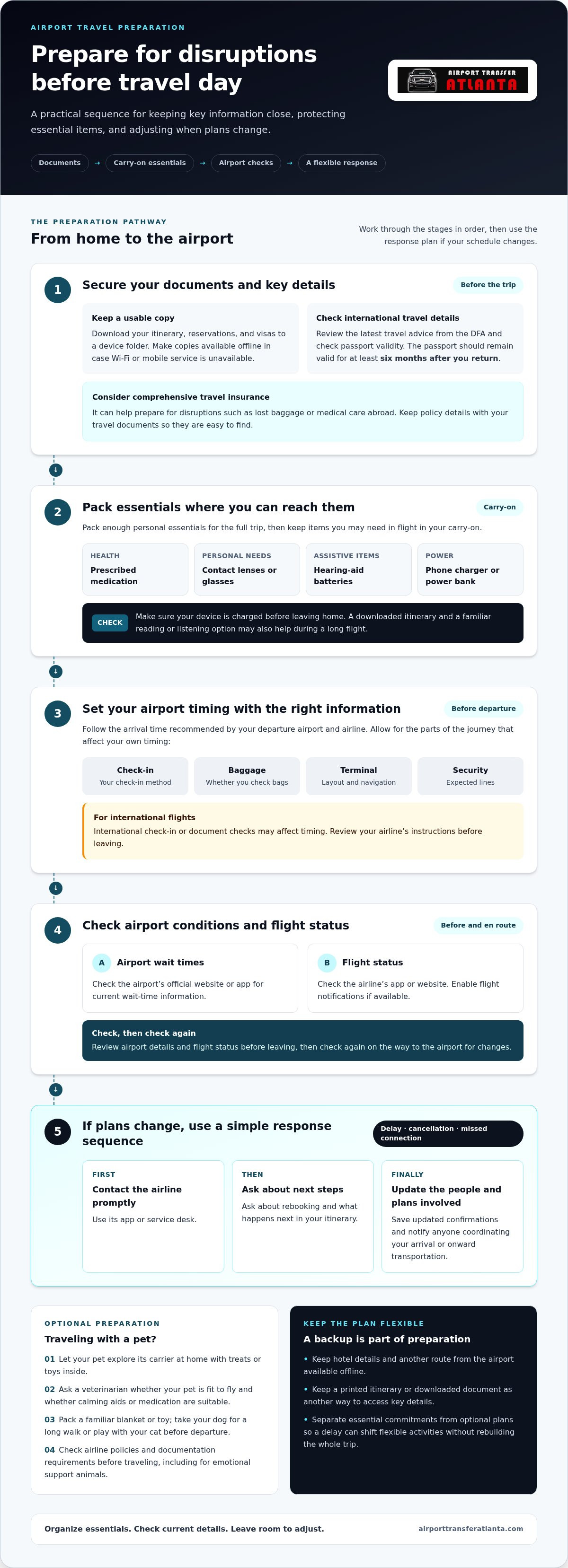
Build your plan around your documents, essential items, and options if your flight changes. Download your itinerary, reservations, and visas to a folder on your device, and keep copies available offline in case airport Wi-Fi or mobile service is unavailable. Pack enough personal essentials, such as contact lenses or hearing-aid batteries, for the full trip.
Before an international trip, check the latest travel advice from the DFA and review your passport’s validity. It should remain valid for at least six months after you return. Consider comprehensive travel insurance for disruptions such as lost baggage or medical care abroad. Keep the policy details with your travel documents so you can find them without searching your email.
Choose compact items for an in-flight comfort kit that meet your needs. Pack prescribed medication, contact lenses or glasses, and hearing-aid batteries in your carry-on. Add a phone charger or power bank, and make sure the device is charged before you leave home. A downloaded itinerary and a familiar reading or listening option can also help manage anxiety during a long flight.
How early should you arrive at the airport for domestic and international flights? Follow the arrival time recommended by the departure airport and airline, then allow for your check-in method, checked baggage, terminal layout, and expected security lines. International check-in or document checks may affect your timing, so review your airline’s instructions before leaving.
How can you check airport wait times and flight status before traveling? Check the airport’s official website or app for current wait-time information, and your airline’s app or website for flight status. Review both before leaving, enable flight notifications if available, and check again for changes on the way to the airport.
If your flight is delayed or canceled, or you miss a connection, contact the airline promptly through its app or service desk. Ask about rebooking and the next steps for your itinerary. Save updated confirmations and notify anyone coordinating your arrival or onward transportation when your schedule changes.
Traveling with a pet takes additional preparation. Let your pet explore its carrier at home with treats or toys inside, and ask a veterinarian whether the animal is fit to fly and whether calming aids are suitable. Before departure, take your dog for a long walk or play with your cat. Pack a familiar blanket or toy, and follow the airline’s policies and documentation requirements for emotional support animals.
Comprehensive travel insurance can also help prepare for emergencies, including lost baggage or in-country medical care. For pets, follow the airline’s policies and required documentation, checking them before departure. Check airline policies and documentation requirements before traveling with an emotional support animal.
A veterinarian can advise whether your pet is fit to fly and whether calming aids or medication are recommended. Before flying, take your dog for a long walk or play with your cat. A familiar toy or blanket, or a calming pheromone spray in the carrier, may also help.
2. Confidence and flexible travel
Separate fixed commitments from flexible plans in your itinerary. Mark your flight, hotel check-in, and time-sensitive appointments as essential, while keeping restaurant reservations, sightseeing, and shopping flexible. If a delay shifts your arrival, you can adjust optional plans without rebuilding the entire trip. This distinction gives each travel day structure while leaving room to adapt.
Choose a practical backup for important transitions. Save your hotel address offline and note another route from the airport. Keep your airline’s app available for schedule changes, but avoid relying on a single device for every decision. A printed itinerary or downloaded document offers another way to access key details if your battery runs low.
Try a brief breathing exercise when anxiety rises during a long wait or flight. Box breathing has four steps: inhale, hold, exhale, and hold again, for four seconds each. Repeat the cycle while seated, focusing on each stage. It gives your mind a specific task during a tense moment, rather than leaving your attention fixed on uncertainty.
A grounding exercise can also focus your attention on the immediate surroundings. The 5-4-3-2-1 technique involves naming five things you see, four you can touch, three you hear, two you smell, and one you taste. You can do this quietly at a gate or during a flight. At 30,000 feet, familiar sensory details can make the moment feel more manageable.
Build some movement into your trip when your schedule allows. Hiking or cycling at your destination can support mood and stress reduction, while physical activity can release endorphins associated with happiness and mental clarity. You don’t need to plan an intensive workout. A walk outdoors between scheduled activities adds movement without making your itinerary rigid.
A 2021 U.S. Travel Association study found that 84% of American travelers said vacations positively affected their mental health. The Global Wellness Institute has also found significant growth in wellness tourism, including yoga, meditation retreats, and outdoor travel. Use those ideas selectively: choose an activity that fits your energy and schedule, rather than adding more commitments.
For a more flexible trip, leave open space between arrival and your first planned activity. Keep airport pickup timing and destination details together in your itinerary, and include airport transportation planning in that schedule. A clear plan for the ground-transport portion can make it easier to adjust the rest of the day when your flight itinerary changes.
3. Navigating airports
Before entering the terminal, open your airline’s app and confirm your departure terminal and gate. Follow airport signs to check-in, security, and your gate, and note nearby landmarks such as a numbered entrance or information desk. If your gate changes, check the airport display and airline app again. A terminal map can help you plan your route before walking with bags.
Allow time to find the services you’ll use, including restrooms, elevators, seating, and food outlets. At a large airport, getting between terminals may involve a train, shuttle, or marked walkway. Read the airport map before setting off, and follow signs to your destination rather than assuming every gate is in the same building. If directions are unclear, ask airport staff at an information desk.
What airport assistance is available for seniors, children, and travelers with disabilities? Travelers can request help such as wheelchair assistance, an escort through the terminal, or support during boarding. Contact the airline or airport before traveling with details about the traveler’s needs. Confirm where assistance begins and where your party should meet.
Keep luggage in sight in queues and seating areas. Store passports, phones, medication, and other valuables in a secure, accessible personal bag rather than an outer pocket. Use a distinctive luggage tag, and check the tag and bag before leaving a counter or gate. When traveling as a family, agree on which adult will keep the travel documents.
Your phone can simplify terminal navigation, but prepare for weak connectivity. A lack of reliable internet for maps, local transport schedules, or translation tools in an unfamiliar city concerns 54.1% of travelers. Download airport maps and relevant travel documents for offline access. Save the airport’s name and your destination’s address in a note you can open without a connection.
Smartphones are the primary travel tool for 91% of global travelers, so keep yours charged and easy to reach. Before joining a line, check the flight display for gate or departure updates. If the app and airport screen show different details, ask airline staff to clarify before leaving your current area. A power bank can help maintain access to maps and boarding details while moving.
For children, choose a simple meeting point, such as a staffed information desk, in case your group gets separated. Keep each child’s boarding information with the accompanying adult, and explain the next steps in plain terms: check-in, security, then gate. A familiar meeting point can reduce confusion without adding complicated instructions.
Noise, crowds, and unfamiliar signs can feel stressful, especially during a tight connection. Pause at a clear landmark, review your route, and take the next marked step instead of rushing toward an uncertain turn. For peace of mind airport travel, a map, a charged phone, and a clear meeting point make airport decisions easier to manage.
4. Peace of mind as a travel priority
For 80% of travelers, peace of mind and relaxation are the primary goals when traveling abroad. Treat those goals as itinerary criteria, not benefits to hope for after arrival. Before booking, consider how easily you can reach your accommodation, find meals, and manage planned activities. A destination with clear transport options and familiar services may feel easier to manage than an isolated location.
Approximately 15% of international travelers routinely report significant stress and anxiety during their journeys. A practical routine can reduce avoidable decisions: review the next day’s plans each evening, set out essential items, and identify the first step after waking. For example, knowing how you’ll get from your accommodation to a morning appointment removes one choice from a busy start.
Choose a well-visited destination if predictable services and straightforward routes matter to you. That doesn’t mean avoiding every less-traveled area. Consider whether your plans fit your comfort with unfamiliar transport, limited facilities, or changes in routine. Before committing to an outing, note the route back and a nearby place to pause, such as a hotel lobby or staffed visitor center.
Travel insurance can give you peace of mind about accessing medical treatment abroad. Review the policy’s coverage and procedures before departure, and keep its assistance details with your itinerary. Think through what you would do if you needed care: who to contact, how to describe your location, and where your policy information is saved. A prepared sequence can be easier to follow during an unexpected health issue.
Connectivity also affects how manageable a trip feels. A lack of mobile signal or a usable network upon arrival at a border concerns 43.4% of travelers, while unexpected roaming charges concern 43.6%. Before leaving, check your mobile plan’s international coverage and save maps, addresses, and travel documents for offline use. If you rely on a phone for navigation, keep a power bank ready and write down key addresses as a backup.
For corporate travelers, dependable mobile connectivity is important for personal safety and keeping to a schedule. Build a simple communication routine: tell a colleague when your itinerary changes, keep meeting details in one accessible place, and allow time to reconnect after landing. These steps help clarify work commitments without requiring constant phone checks throughout the trip.
Choose experiences that matter to you while preserving routines that help you feel comfortable. Leave space between major plans, select activities that suit your energy, and identify which commitments can move. A flexible schedule lets you respond to changes without treating every adjustment as a disruption. That’s how peace of mind becomes a practical priority throughout the journey.
5. What airport services help travelers feel less stressed and more secure?
Airport information desks can help you find the correct terminal, ground-transport area, or baggage service counter. Before leaving the desk, repeat the directions and note a nearby sign or landmark. For example, record the name of the pickup zone instead of relying on “outside arrivals.” Clear location details make it easier to coordinate your next step.
Airline staff are the right contact for flight-specific needs, including seating requests, boarding questions, and itinerary changes. Keep your booking details accessible, then explain the issue in one sentence. If your plans change, ask what happens next and save the updated itinerary. A clear sequence can reduce confusion at a busy counter.
Travelers who need mobility or other disability-related assistance can arrange support through their airline or airport. Explain what assistance is needed and where it should begin, such as at check-in or the terminal entrance. For a senior traveler, child, or person with limited mobility, agree on a meeting point before entering a crowded area.
Families can make better use of airport services by planning around children’s immediate needs. After reaching the terminal, locate the nearest restroom, seating area, and food options. If a child needs help, ask uniformed airport or airline staff at a service counter. Set a specific meeting point, such as the information desk, in case your group gets separated.
If you have a baggage problem, go to the airline’s baggage service counter with your bag tag and travel documents ready. Describe the bag clearly, including its color, size, and any distinctive tag. Before leaving the counter, save the report details and instructions. Keep essential medication and valuables in your personal bag, not checked luggage.
Ground transportation can make the transition from terminal to destination more structured. Identify the pickup location, vehicle type, and passenger count before choosing an option. If you’re meeting family, share the pickup point and agree on how you’ll recognize one another. For peace of mind airport travel, specific meeting details are more useful than a general “I’ll see you outside.”
Choose assistance based on the part of the journey causing the most uncertainty: terminal access, baggage, mobility, or the ride after arrival. Write down the service point and the next action, such as “baggage counter, then pickup area.” To arrange a more organized airport ride, plan your airport transportation before departure.
Pet preparation can be included in a calmer travel routine. Travelers can help pets become familiar with a carrier by letting them explore it at home with treats and toys inside. Treats and toys give the pet something to encounter as it explores the carrier, while the home setting lets this introduction happen before the airport journey. This preparation keeps attention on one manageable step involving the pet and its carrier.
You can also make room for activities that support your mood. Outdoor activities such as hiking and cycling can lower stress and boost mood. If they fit your plans, consider them alongside carrier preparation as another way to support a less stressful journey. Both ideas focus on preparation and well-being before travel, alongside the practical help available at the airport.
Airport Transfer Atlanta: One Way Airport Transfer
Airport Transfer Atlanta offers One Way Airport Transfer for travelers who want a planned ride to or from the airport. It provides a direct transportation option for an arrival, departure, or change of destination, without requiring a round trip booking. Choose a sedan service, such as a Lincoln MKT or Cadillac XTS, or an SUV service, such as a GMC Yukon XL or Cadillac Escalade.
For airport travel with stops or a changing schedule, Hourly Limo Rental may suit the itinerary. A vehicle choice can be based on your passenger group and luggage needs. Keep your pickup and flight details organized so the transportation plan fits your travel schedule.
For a one-way airport ride, contact Airport Transfer Atlanta to discuss your transportation plans.
Make your next trip easier to manage
Make peace of mind airport travel part of your planning from the start. Decide how you want your arrival or departure to feel, then choose arrangements that support that goal. A clear ground transportation plan can reduce last-minute decisions and give you a defined next step when you leave the terminal.
Before travel day, keep your pickup details and flight itinerary together. Share relevant information with anyone meeting you, and leave room in your schedule to handle changes. These small decisions make the transition between the airport and your destination easier to organize.
If arranging your airport ride is the next step, Airport Transfer Atlanta offers One Way Airport Transfer and Hourly Limo Rental, including Lincoln MKT and Cadillac XTS sedan service. Contact Airport Transfer Atlanta to discuss your transportation plans. With the ground portion planned, you can focus on the purpose of your trip and move forward with greater confidence.
Frequently Asked Questions
What are the safest and most reliable ways to get to and from the airport?
A prearranged ride with a licensed, insured transportation provider offers a structured airport travel option. Airport Transfer Atlanta is fully licensed and fully insured, and its chauffeurs are well-trained, well-groomed, licensed, and regulated. Before traveling, make sure your pickup location, destination, and flight details are accurate. Specify the terminal or agreed meeting point so the driver can coordinate the pickup clearly.


