

A corporate account works best when booking rules, traveler details, billing contacts, and vehicle needs are organized before the first trip. Define who can book, what each reservation must include, and how airport pickups and schedule changes will be handled. Then assess whether an executive car service for corporate clients can meet those requirements, with clear trip details and all-inclusive rates.
Reliable transportation matters when employees, executives, and guests need to arrive on schedule, and a clear booking process helps keep each trip organized. This guide explains what information to prepare for a corporate account, how to arrange airport and hourly bookings, and which chauffeur and vehicle standards to consider. It also compares executive sedans, SUVs, Escalades, and Sprinter vans so you can match the ride to each business travel need.
Key Takeaways
- Set up clear corporate booking procedures, including who can reserve rides and what trip details to provide.
- Assess chauffeur professionalism, insurance, and vehicle inspection practices as part of your transportation standards.
- Match the ride plan to the traveler’s itinerary, airport pickup needs, and business schedule.
- Choose a sedan, SUV, Escalade, or Sprinter based on passenger group and travel requirements.
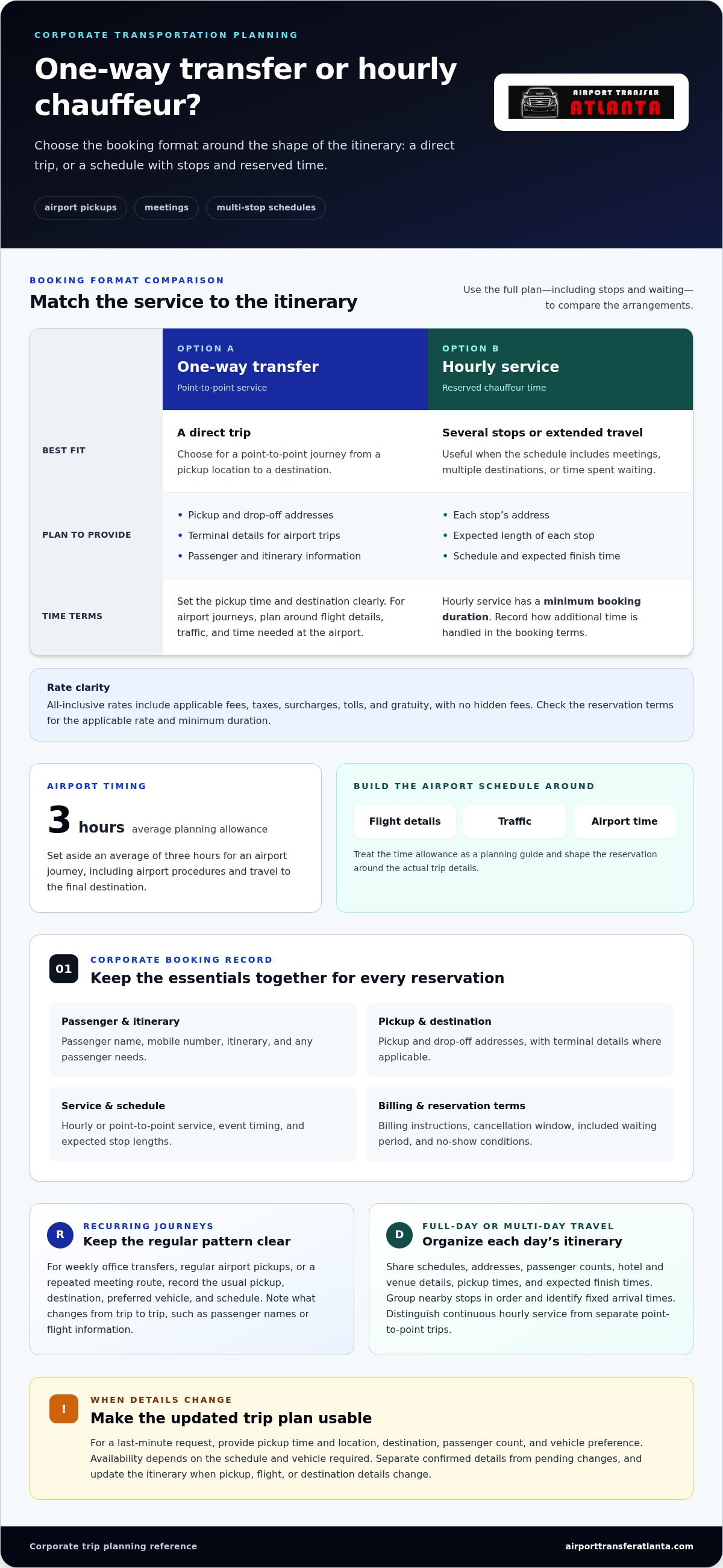
- Use one-way airport transfers for direct trips and hourly service when the schedule calls for multiple stops or extended travel.
Booking process and advance booking recommendations
Build each booking around the passenger, pickup, destination, schedule, and vehicle requirement. Cancellation, waiting-time, and no-show policies are set by the reservation terms, so record the applicable cancellation window, included waiting period, and no-show conditions before confirming.
Use a consistent booking record for corporate transportation:
- Enter the passenger’s name, mobile number, and itinerary.
- Provide pickup and drop-off addresses, including terminal details.
- Choose hourly service or a point-to-point trip.
- List event timing, passenger needs, and billing instructions.
Airport trips need careful timing. Set aside an average of three hours for an airport journey, including airport procedures and travel to the final destination. Build the schedule around flight details, traffic, and the time needed at the airport.
Hourly Rates and Minimum Booking Duration
Hourly chauffeur service is based on reserved time, with a minimum booking duration. All-inclusive rates include applicable fees, taxes, surcharges, tolls, and gratuity, with no hidden fees. Compare the reserved hours with the full plan, including stops and waiting, rather than judging the arrangement by time alone.
For a meeting with several stops, list each address and expected stop length. A sedan or SUV can suit executive travel, while a Sprinter can accommodate a group. Include the minimum duration and how additional time is handled in the booking terms.
Recurring Executive and Personal-Driver Bookings
Recurring bookings work for predictable journeys, such as weekly office transfers, regular airport pickups, or a repeated meeting route. Record the usual pickup location, destination, preferred vehicle, and schedule in one itinerary. Note which details change from trip to trip, such as passenger names or flight information.
For a personal-driver arrangement, distinguish a standing schedule from individual reservations. Set out recurring dates, service hours, and the process for changing a trip. This gives coordinators a consistent basis for each reservation without treating every journey as identical.
Full-Day and Multi-Day Corporate Bookings
Full-day bookings suit itineraries with several appointments, corporate events, or changing destinations. Share the day's schedule, addresses, passenger count, and expected finish time. Group nearby stops in order, then identify fixed arrival times that should shape the route.
For multi-day business travel, organize each day separately. Include hotel and venue details, pickup times, and changes in passenger or vehicle needs. A clear schedule helps distinguish continuous hourly service from separate point-to-point trips, and makes adjustments easier to record when meetings move.
Advance Bookings and Last-Minute Requests
Reserve transportation as soon as the itinerary and passenger needs are clear, especially for events or airport travel. A 3am pickup illustrates why precise timing matters: include the date, pickup address, flight details, and destination in the reservation. Update the itinerary when any of those details change.
Last-minute requests need the same information, provided in a concise order: pickup time and location, destination, passenger count, and vehicle preference. Availability depends on the schedule and vehicle required. Separate confirmed details from pending itinerary changes so the chauffeur receives a usable trip plan.
Chauffeur vetting, insurance, and vehicle inspections
Corporate transportation standards should cover the chauffeur, vehicle, insurance documentation, and dispatch process. Review these elements before assigning rides to executives or visiting guests. A professional ground transportation plan also defines how pickup details reach chauffeurs and how schedule changes are communicated.
Use a consistent review process for each transportation provider:
- Chauffeur screening: Ask how identity, driving history, background checks, and professional conduct are assessed.
- Insurance: Review current commercial auto coverage documents and understand which vehicles and services they cover.
- Vehicle condition: Look for documented maintenance and pre-trip checks of tires, lights, seat belts, and climate controls.
- Dispatch: Clarify how the assigned chauffeur receives the itinerary and updates from the travel coordinator.
Keep insurance information with the corporate travel records. Airport Transfer Atlanta is fully licensed and fully insured. For each reservation, record the vehicle and trip details together so the coordinator has a clear reference for airport transfers, meetings, or event transportation.
Assess the passenger experience, not just the vehicle's appearance. Check that the cabin is clean, seat belts work, doors operate properly, and climate controls respond. A pre-trip inspection should also identify visible damage or warning indicators. These practical checks can catch issues before a passenger enters the vehicle.
Chauffeur service differs from a taxi or rideshare mainly through its reservation and coordination model. A prearranged trip uses a planned itinerary, a designated pickup point, and dispatch communication tied to the booking. Taxi and rideshare trips are commonly requested closer to departure. Each option serves different needs, but scheduled meetings and airport arrivals benefit from having trip details organized beforehand.
For executive travel, the chauffeur's role includes following pickup instructions, assisting passengers as they enter and exit, and maintaining a discreet, businesslike manner. These details matter when a passenger needs to prepare for a meeting or travel directly from an airport. Corporate coordinators should also establish how itinerary changes and passenger privacy are handled.
Visiting and international executives may be unfamiliar with pickup areas or meeting locations. Include clear arrival instructions, the passenger's preferred name, and a working contact method in the itinerary. For example, a conference guest can receive a defined airport pickup point and a direct route to the hotel or venue. Clear coordination reduces uncertainty without distracting the traveler.
Are your drivers trained for corporate travel?
Corporate transportation can include airport transfers, point-to-point trips, hourly chauffeur service, and rides for business meetings or events. An executive car service for corporate clients should align the trip plan with passenger needs, including whether the traveler needs a direct transfer or transportation between several scheduled stops.
Assess chauffeur service against clear standards, not a job title alone. For an executive pickup, the chauffeur should follow the itinerary, communicate professionally, respect passenger privacy, and handle luggage appropriately. A coordinator can also establish how chauffeurs receive trip updates and respond when a meeting runs late.
Relevant preparation includes route planning, safe vehicle operation, passenger assistance, and courteous conduct. For example, a driver taking a visitor from an airport to a downtown meeting needs accurate pickup instructions, the destination, and the passenger’s preferred name. Clear dispatch notes help prevent confusion at the curb.
Executive sedans suit individual travelers who need a private ride between an airport, hotel, and office. A Lincoln MKT or Cadillac XTS sedan can be considered for that itinerary. A sedan also works for an executive traveling alone to a client meeting, where a smaller passenger arrangement may fit better than a larger vehicle.
Executive assistants often arrange travel for someone else. To make the reservation useful, provide the traveler's name, pickup details, destination, meeting schedule, and a contact method. If an assistant books an airport transfer, share arrival information with both the traveler and transportation coordinator. This gives everyone a consistent itinerary to follow.
For recurring business travel, record the usual route and preferences, then update the details for each trip. A weekly office transfer may keep the same pickup location while the passenger or meeting destination changes. The chauffeur needs the current itinerary, not an older reservation. Organize travel records by traveler and trip date.
Visiting executives and international guests may be unfamiliar with pickup procedures. Give them a clear meeting point, vehicle description, and contact process through the travel coordinator. For a conference arrival, this information connects the airport pickup with the hotel transfer and event schedule. An executive car service for corporate clients can support that coordination when the itinerary is shared clearly.
Use a defined coordination process to track changes. A travel manager can monitor flight status, share delays with dispatch, and update pickup instructions. This helps when an arrival changes before a scheduled airport transfer. Updated notes keep the chauffeur's instructions aligned with the latest itinerary.
Before assigning a chauffeur, corporate travel teams can review service expectations, communication steps, and trip details together. That preparation helps match transportation to the traveler's needs, whether the plan involves one airport ride, a sedan for meetings, or a recurring schedule.
Do you provide airport transportation for business travelers?
Business airport transportation is arranged as point-to-point transfers, hourly chauffeur bookings, or group travel in suitable vehicles. Services operate in major U.S. cities and at airports nationwide, with the right choice determined by the route, schedule, and passenger requirements.
Executive Vehicle Capacity
Choose a vehicle by counting passengers and luggage, then comparing those needs with its seating and cargo space. A sedan can suit an executive traveling alone with work bags; a group with larger cases may need an SUV or van. Confirm the vehicle class and luggage plan together, especially for special equipment or conference materials.
Route details also affect the choice. A typical commercial airport transfer may span 12 miles from a major downtown hotel block, or connect a medical district about 10 miles from the terminal. For any transfer, match vehicle capacity to the passenger group and belongings, not simply the distance.
Vehicle Options and Hourly Rates
Executive sedans, SUVs, and passenger vans serve different business travel needs. A sedan suits a direct airport pickup or downtown meeting; an SUV offers a different passenger and luggage arrangement, while a van can accommodate a larger traveling group. Compare the planned stops and service period before selecting hourly transportation.
Hourly pricing covers reserved chauffeur time, and the total depends on the itinerary, vehicle, duration, and route. The price depends on the case and is provided after a quote request. Share the schedule, pickup locations, and expected stops so the quote reflects the actual travel plan.
Fixed Rates and Confirmed Vehicles
A point-to-point transfer is suited to a direct journey, while hourly service suits a schedule with several stops or extended travel. Compare the planned itinerary with the service type before booking. For example, an airport-to-office trip differs from a schedule that includes a hotel, meeting venue, and return journey.
Include the vehicle category in the reservation record. A written confirmation naming the Lincoln MKT, GMC Yukon XL, or Luxury Mercedes Sprinter makes the assignment easier to coordinate. Keep the pickup point, destination, passenger count, and luggage details together, then share any itinerary changes with the booking coordinator.
Luxury Fleet and Airport Availability
Airport Transfer Atlanta delivers professional logistics where luxury transportation can include executive sedans, SUVs, and vans, with vehicle selection guided by passenger count, luggage, and trip purpose. Airport pickups may lead to a downtown hotel, office, medical center, or event venue. For a business traveler, a clear destination and pickup instruction help connect each leg of the itinerary.
Airport services in major U.S. cities vary by operator and service area. Before planning a special event transfer or professional trip, define the airport, destination, passenger needs, and timing. An average of three hours should be set aside for an airport journey, including airport procedures and travel to the final destination.
Executive sedan, SUV, Escalade, and Sprinter options
Choose a vehicle by matching passenger count, luggage, schedule, and trip purpose. For a solo flight arrival, a sedan can provide direct transportation to an office or hotel. Groups traveling together may prefer an SUV or Sprinter, especially when the itinerary includes visits to several locations.
Executive sedans, including the Lincoln MKT and Cadillac XTS, suit individual travelers or small parties with limited luggage. They work well for airport pickups, client meetings, and point-to-point travel. Consider the passenger’s work materials and bags before selecting a sedan. A vehicle that fits the traveler and belongings avoids splitting a group across separate rides.
An SUV such as the GMC Yukon XL or Cadillac Escalade can suit travelers carrying more luggage or traveling together. A Mercedes Sprinter is another option for group transportation. Don’t select by vehicle name alone. Compare the actual passenger count and luggage requirements with the available seating and cargo space before confirming the reservation.
- Sedan: Choose for an individual executive, airport transfer, or direct meeting trip.
- SUV: Consider for a small group, additional luggage, or a multi-stop schedule.
- Sprinter: Use for group travel when keeping passengers together is a priority.
Hourly service suits a day with several scheduled visits, changing destinations, or meetings that may run long. Point-to-point service fits a traveler who needs one pickup and one destination. For example, an executive traveling from an airport to a hotel may need a different arrangement from a team attending meetings at several locations.
Before booking, provide flight details, pickup location, destination, passenger count, and luggage needs. Then identify whether the trip is a single transfer or hourly travel. If a group has separate arrivals, coordinate the pickup plan around each traveler's arrival time. Clear details help match the vehicle to the itinerary.
For a corporate travel plan, record the preferred vehicle category alongside the trip purpose. A sedan may be the practical choice for a one-person client visit, while a Sprinter can keep colleagues together between an airport and an event. Review those needs for each reservation instead of applying one vehicle choice to every journey.
Match the vehicle to your next airport transfer, meeting schedule, or group visit by planning your executive transportation.
Airport Transfer Atlanta: One Way Airport Transfer
Airport Transfer Atlanta provides One Way Airport Transfer for business travelers going to or from an Atlanta airport. Choose a direct transfer for an airport-to-office trip, or Hourly Limo Rental when the itinerary includes multiple stops or extended travel.
Match the vehicle to the traveler and itinerary. Lincoln MKT / Cadillac XTS Sedan Service suits individual executive travel, while GMC Yukon XL / Cadillac Escalade SUV Service can fit a different passenger or luggage plan. Share the pickup point, destination, flight details, and any scheduled stops when arranging transportation.
For a corporate trip with several meetings, choose the service type according to whether the traveler needs a direct ride or transportation over a period of time. Contact Airport Transfer Atlanta to arrange a one-way transfer or hourly charter that fits your business travel itinerary.
Put Your Corporate Travel Plan Into Practice
The next step is to turn transportation preferences into a repeatable travel standard. Give assistants and coordinators one process for submitting itineraries, noting passenger requirements, and recording vehicle preferences. A consistent format helps each traveler receive instructions that match the booking, rather than relying on informal handoffs. Use early reservations to refine the process, then apply the same recordkeeping approach to future business trips.
An executive car service for corporate clients should fit the way your organization travels. Set clear expectations for who books, who receives itinerary updates, and how changes are documented. That structure supports a smooth handoff between the traveler, assistant, and transportation team without adding unnecessary steps.
For Atlanta airport travel, choose an arrangement that matches the schedule and passenger needs. Plan your corporate airport transportation with Airport Transfer Atlanta and give your next itinerary a clear, practical starting point.
Frequently Asked Questions
How can I open a corporate account?
Prepare the company's billing contact, authorized bookers, traveler details, and preferred reservation process. Define whether employees submit requests directly or an assistant coordinates each trip. Include the organization name and billing instructions with reservations, then keep a shared record of trip dates and itineraries. For example, an assistant arranging an airport pickup can enter the traveler's flight information and destination in the same booking record.
Why Choose a Corporate Car Service?
A corporate car service gives travel coordinators a planned transportation option for airport arrivals, client visits, and scheduled events. It keeps trip details, pickup instructions, and vehicle preferences organized in the reservation process. For an executive traveling between a hotel and a meeting, a prearranged ride means the itinerary is set before the workday. Choose the service to match the trip and passenger requirements.
How much does corporate executive car service cost in the United States?
Airport Transfer Atlanta's All-inclusive rates include applicable fees, taxes, surcharges, tolls, and gratuity, with no hidden fees. The selected service and trip itinerary determine the rate. Provide the pickup and destination, service type, and schedule when arranging transportation so the reservation reflects the actual journey.
How are executive car service rates calculated: hourly, flat rate, or by mile?
All-inclusive rates have no hidden fees. A one-way airport transfer is a point-to-point reservation, while hourly service is based on reserved time. The service type and itinerary determine the rate. For example, a direct airport pickup differs from a reservation covering several meetings. Share the complete schedule when arranging transportation so the service fits the travel plan.
Which executive car services offer corporate accounts and centralized billing?
Corporate accounts combine authorized booking access with a designated billing process. Centralized billing means the company organizes transportation charges through its chosen account arrangement rather than handling each traveler’s trip separately. Set clear rules for bookers, traveler identification, and invoice routing. For individual trips, One Way Airport Transfer and Hourly Limo Rental are available booking types; corporate account terms are separate from those ride options.
What vehicle types are available for corporate car services?
Available vehicle types include executive sedans, SUVs, and passenger vans. The Lincoln MKT accommodates 3 passengers and 3 bags; the GMC Yukon XL accommodates 6 passengers and 6 bags. Choose the vehicle based on the group size and luggage requirements. Choose based on the group size and luggage. Cadillac XTS Sedan Service and Cadillac Escalade SUV Service are also available, but capacity should not be inferred from another model.
How do executive car services compare with rideshare and traditional taxis for business travel?
Executive transportation is arranged around a reservation and itinerary, while rideshare and taxi trips may be requested closer to departure. A prearranged booking suits a traveler with a set airport pickup, meeting destination, or planned sequence of stops. Compare options by the trip's coordination needs: consider whether the passenger needs a direct ride, a scheduled vehicle, or transportation organized around an event agenda.
What safety, licensing, insurance, and driver-vetting standards should companies check?
Review licensing and insurance documentation, vehicle condition, and the chauffeur standards stated for the service. This company is fully licensed and fully insured; its chauffeurs are well-trained, well-groomed, licensed, and regulated. A corporate travel file can record these details alongside the reservation process. For a specific trip, keep the vehicle assignment and passenger itinerary together so coordinators can manage transportation records consistently.


