

A chauffeur-driven ride doesn’t require stiff formality. Clear, courteous communication matters more. If you’re unsure whether to make conversation, how to share a timing change, or when to discuss luggage, chauffeur etiquette for passengers comes down to a few practical habits. You can be professional without making the journey feel awkward.
It’s normal to wonder what’s expected when someone else is driving. A brief greeting, a clear statement of your preferences, and respect for the chauffeur’s role set a comfortable tone. You don’t need to keep up conversation if you’d rather work or relax.
This guide explains how to communicate pickup details, schedule changes, luggage needs, and special requests with confidence. It also covers conversation, vehicle courtesy, and tipping. All-inclusive rates include applicable fees, taxes, surcharges, tolls, and gratuity, so you don’t need to guess whether an additional tip is expected. For family travel, complimentary car seats and boosters are provided for infants and toddlers.
Key Takeaways
- Chauffeur etiquette for passengers is about considerate behavior, not rigid formality. A polite, direct approach keeps the ride professional and comfortable.
- Share your passenger count, luggage needs, and relevant travel requirements before pickup to help prepare for the journey.
- State your preference for conversation or quiet clearly, and treat the vehicle as a shared professional space.
- For children, luggage, stops, or schedule changes, communicate details early and keep requests clear.
- Use a brief checklist before pickup and at drop-off to make each part of a private transfer or hourly charter more orderly.
What Does Chauffeur Etiquette for Passengers Actually Mean?
Chauffeur etiquette for passengers is the considerate behavior that helps a professional journey remain calm, clear, and efficient. It means communicating your needs directly, respecting the chauffeur’s role, and treating the vehicle as a shared professional space. It doesn’t require formal rituals or constant conversation. A courteous greeting and a clear request are usually enough to set a respectful tone.
The chauffeur is responsible for providing professional transportation; the passenger helps by making relevant information easy to understand. Etiquette isn’t a performance based on status or luxury. It’s a practical way for both people to coordinate the ride. Concise instructions can prevent confusion and help the chauffeur focus on the journey.
How passenger etiquette differs from chauffeur etiquette
Chauffeur etiquette concerns how the chauffeur conducts the professional service. Passenger etiquette concerns how the rider communicates and behaves during it. The Chauffeur Wikipedia article offers background on the role. For passengers, the practical takeaway is to treat the chauffeur as a professional, not as a social host who must keep the conversation going.
No elaborate greeting, special title, or formal exchange is required. Say, “Good morning,” then share what you need: “Please take me to the main entrance,” or “I’d prefer a quiet ride, thank you.” If you’re unsure whether to speak or relax in silence, a short, polite preference is enough. Natural communication is respectful when it’s clear and considerate.
Why small courtesies make a ride smoother
Punctuality and precise instructions give the pickup a clearer starting point. Be ready at the agreed time, use the specific meeting point arranged for the ride, and mention a change as soon as you know about it. “I’m at the east entrance” is more useful than “I’m outside” when a location has several doors or pickup areas.
Small courtesies also reduce avoidable uncertainty. Greet the chauffeur, listen to instructions relevant to the pickup, and make requests calmly and directly. If a preference changes, explain what you need rather than assuming it’s obvious.
Keep the standard simple: be considerate, communicate early, and allow the chauffeur to manage the professional service. You can ask for what makes the ride comfortable without being demanding, and you can be courteous without feeling overly formal. That balance is the foundation of good passenger etiquette.
Before Pickup: Communicate Clearly and Be Ready on Time
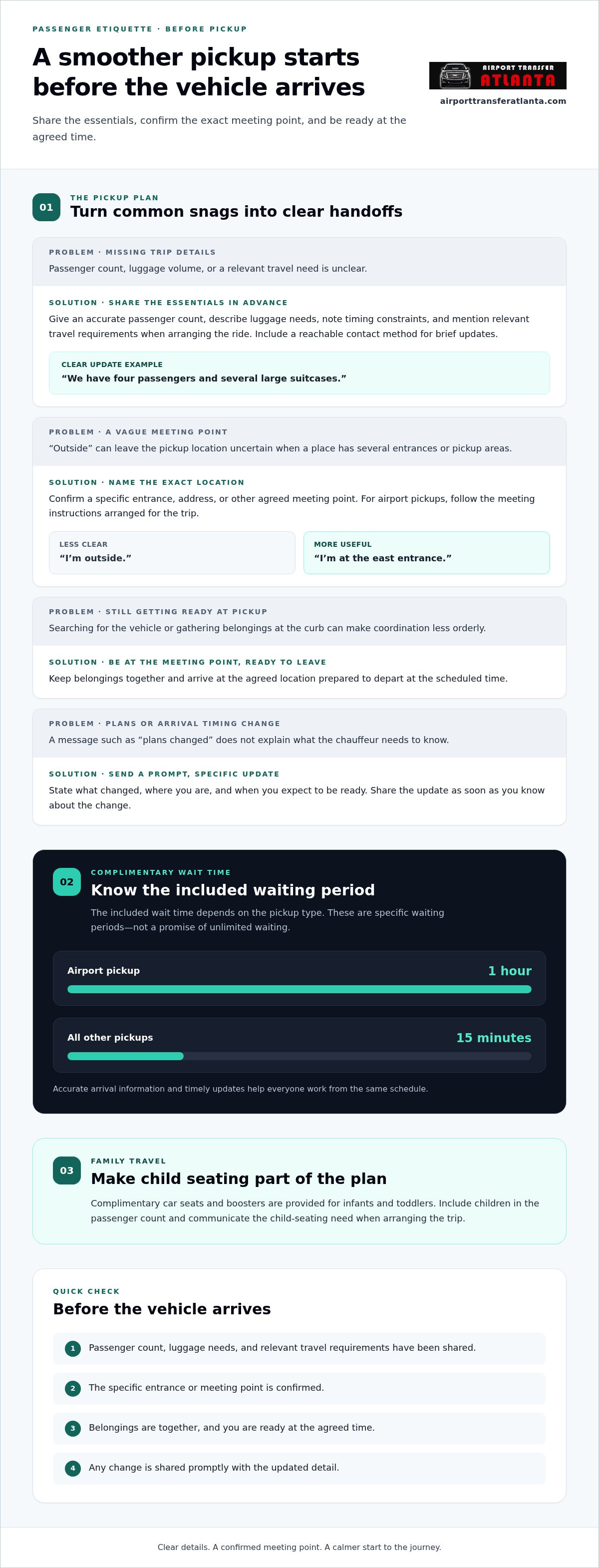
Good preparation begins before the vehicle arrives. Share essential details, confirm the pickup point, then be ready to depart at the agreed time. This gives the chauffeur useful information in advance and helps you avoid sorting out basic logistics at the curb. Clear preparation is one of the most practical parts of chauffeur etiquette for passengers.
- Share the essentials. Provide the correct passenger count, pickup details, luggage needs, and relevant travel requirements. Include a reachable contact method so you can receive a brief update.
- Confirm the meeting point. Use a specific entrance, address, or other agreed location rather than a vague description such as “outside.”
- Be ready at pickup. Keep your belongings together and arrive at the meeting point prepared to leave.
What information should passengers communicate?
Give an accurate picture of the trip. Passenger count and luggage volume help with vehicle planning, while timing constraints clarify when you need to arrive. If you have a relevant travel need, mention it when arranging the ride instead of waiting until pickup.
Keep updates concise and specific. “We have four passengers and several large suitcases” gives more useful context than “We have bags.” If a detail changes, send a clear update as soon as possible. A message that only says “plans changed” leaves important questions unanswered. State what changed and provide the revised detail.
For families traveling with infants or toddlers, complimentary car seats and boosters are provided. Include the children in your passenger count and communicate the need for child seating when arranging the trip. This gives the pickup plan a clearer starting point.
How to handle timing and pickup coordination
Plan to be at the agreed pickup point, not still getting ready or searching for the vehicle. For an airport pickup, follow the meeting instructions arranged for your trip. At other locations, identify the correct entrance or curb in advance. If you’re delayed, communicate promptly and state where you are and when you’ll be ready.
Keep the complimentary wait times in mind. Airport pickups include one hour of complimentary wait time; all other pickups include 15 minutes. These are specific waiting periods, not a promise of unlimited waiting. Sharing accurate arrival information and sending timely updates helps everyone work from the same schedule.
For a private airport transfer, prepare your passenger, luggage, and meeting-point details before pickup. Private airport transportation is easier to coordinate when those details are clear from the start.
During the Ride: Conversation, Privacy, and Reasonable Requests
The cabin is a professional shared space. You can settle in, work, rest, or speak with your travel companions while remaining mindful that the chauffeur is focused on driving. Good chauffeur etiquette for passengers means communicating preferences clearly, respecting that focus, and allowing reasonable time for a response.
Discretion means handling conversation and personal space with restraint, without drawing unnecessary attention to the people or discussions in the vehicle. It describes a considerate approach, not a promise about confidentiality terms. Passengers can support a respectful environment by keeping sensitive conversations at an appropriate volume and treating the chauffeur courteously.
Should passengers make conversation with a chauffeur?
A brief greeting is courteous, but conversation isn’t obligatory. Some passengers enjoy a short exchange; others prefer a quiet ride to work or relax. You can say, “Good morning,” and let the conversation develop naturally, or set a preference directly: “I’m going to take a call and work quietly, thank you.” There’s no need to fill every silence or expect the chauffeur to initiate or sustain conversation.
Follow the cues of the moment. If the chauffeur responds briefly, let the exchange end without pressing for more. If you’d like to ask a practical question, do so politely and keep it relevant to the trip. A clear preference helps avoid guesswork and lets everyone settle into a comfortable rhythm.
How to make requests without disrupting the journey
Make requests calmly and concisely. State what you need and give the chauffeur time to respond. For example, “Could we stop at the next safe place?” is clearer than a vague hint. A request involving a route or stop may affect the itinerary, so share the details plainly rather than assuming the change is understood.
Consider the timing. Mention a comfort or itinerary preference when the vehicle is stopped if it can wait. While the vehicle is moving, avoid sudden demands or repeated instructions that could distract the chauffeur. If something needs immediate attention, speak clearly and briefly; don’t reach toward the driver or interfere with vehicle controls.
- For a conversation preference: “I’d prefer a quiet ride, please.”
- For a practical question: Ask briefly, then allow the chauffeur to answer when appropriate.
- For a route or stop request: Explain the change clearly and allow the chauffeur to handle it safely.
Courtesy doesn’t mean every request can be acted on at once. The chauffeur must give priority to safe driving and the journey. Clear language, sensible timing, and patience keep communication professional without making the ride feel overly formal.
Common Passenger Etiquette Questions About Luggage, Children, and Changes
Practical details are easiest to manage when passengers communicate them clearly. Share luggage and family needs before pickup, and give prompt updates if plans change. These small steps make chauffeur etiquette for passengers useful in everyday situations, not just a matter of formal manners.
| Situation | Considerate passenger action | Communication cue |
|---|---|---|
| Luggage | Describe the number and general size of bags before pickup. Keep important belongings organized and check the vehicle before leaving. | “We’ll have two suitcases and a folded stroller.” |
| Traveling with infants or toddlers | Share the child’s seating needs when arranging transportation. Complimentary car seats and boosters are provided for infants and toddlers. | “We’re traveling with a toddler and need a booster.” |
| Requested stop | Explain the stop and its purpose clearly. Allow the chauffeur to respond and account for the itinerary. | “Could we include a stop at this address?” |
| Pickup plan changes | Send a prompt, specific update with the new location or timing. Don’t assume a delay means the vehicle can wait indefinitely. | “Our pickup point has changed to the north entrance.” |
How should passengers handle luggage and personal belongings?
Give a useful description of your bags before pickup, especially if you’re traveling with unusually large, bulky, or numerous items. “Several bags” can mean different things to different travelers; a simple count and description gives a clearer picture. Keep passports, medication, electronics, and other essentials together so they’re easy to manage during boarding and departure.
Match your passenger and bag count to the vehicle’s listed capacity when arranging the ride: the Lincoln MKT carries 3 passengers and 3 bags, the GMC Yukon XL carries 6 passengers and 6 bags, and the Luxury Mercedes Sprinter carries 14 passengers and 14 bags. If you need help with a bag, ask politely rather than assuming assistance is automatic. Before leaving the vehicle, check the seating area and collect your belongings.
What should families and groups communicate?
Families should mention infant or toddler seating needs when arranging transportation. Complimentary car seats and boosters are provided for infants and toddlers, so include the child’s seating requirement in the trip details. Groups should provide an accurate passenger count and a realistic luggage description. That information helps match the ride to the people and belongings traveling.
For a stop or revised pickup plan, be specific: provide the requested location and explain what needs to change. A chauffeur may need to consider the itinerary and safe driving before responding, so avoid treating a request as an instruction that must be carried out immediately. Clear, timely updates support coordination without creating pressure or confusion.
Traveling with family or extra luggage? Arrange your private transfer with passenger and baggage details ready.
A Simple Chauffeur Etiquette Checklist for a Professional Journey
A professional ride is easier to coordinate when everyone understands the practical details. Use this checklist to prepare, communicate respectfully, and leave the vehicle without overlooking your belongings. Chauffeur etiquette for passengers isn’t about strict rules; it’s a straightforward way to support a considerate journey from pickup through drop-off.
The passenger checklist: before, during, and after the ride
- Before pickup: Share your passenger count, luggage needs, and relevant travel requirements. Confirm the agreed meeting point and be ready at the scheduled time.
- During the ride: Communicate requests politely and directly. Set a preference for conversation or quiet, respect personal space, and avoid distracting the chauffeur while the vehicle is moving.
- At drop-off: Collect your bags and personal items, check the seating area, and offer a brief acknowledgment before leaving.
Use the checklist as a quick sequence, not a formal script. A clear update is more useful than an extended explanation, and a reasonable request can be made without assuming it will be handled immediately. If a plan changes during the ride, state the specific change and allow the chauffeur to respond with the journey in mind.
What professional service details help passengers feel prepared?
Our service includes private airport transportation and hourly charters. Our chauffeurs are well-trained, well-groomed, licensed, and regulated, and our company is fully licensed and fully insured. Knowing the service details in advance can make it easier to prepare relevant questions and travel needs before pickup.
All-inclusive rates include applicable fees, taxes, surcharges, tolls, and gratuity, with no hidden fees. Complimentary car seats and boosters are provided for infants and toddlers. Complimentary wait time is one hour for airport pickups and 15 minutes for all other pickups. Keep those limits in mind when coordinating arrival and pickup plans. Standard bookings can be cancelled at no charge up to 1 hour before pickup; hourly charters can be cancelled at no charge up to 24 hours before pickup.
Before you travel, review the passenger count, bags, meeting point, and any family seating needs you’ve shared. At the destination, take a final moment to check your belongings. These simple habits make the professional exchange clear at both ends of the ride.
For a private transfer or hourly charter, explore chauffeur transportation options and prepare your trip details in advance.
Put Your Passenger Etiquette Into Practice
For your next ride, prepare a short travel note before pickup: the meeting point, passenger and luggage details, any timing constraints, and a preference that would make the journey more comfortable. Keep it accessible so you can share an update clearly if plans shift. A little preparation turns chauffeur etiquette for passengers into a practical habit, not something you have to improvise at the curb.
During the journey, let your needs guide your communication. A quiet ride, a brief question, or a reasonable request can all be expressed directly and respectfully. At drop-off, pause to gather your belongings and check the cabin. These small choices help make the experience comfortable for you and considerate of the professional providing the transportation.
When you’re ready to plan your next trip, review the private transportation and hourly charter options and choose the arrangement that fits your itinerary. Explore private transportation and hourly charter options, then prepare your trip details for a well-coordinated ride.
Frequently Asked Questions
Is it rude to talk to a chauffeur?
No. A brief greeting or polite conversation is appropriate, but you aren’t expected to keep talking throughout the ride. Follow the tone of the exchange, and say directly if you’d rather work, rest, or take a call. For example, “I’m going to focus on a few emails, thank you” sets a clear preference without sounding unfriendly. Respectful communication matters more than constant conversation or formal phrases.
Should you tip a chauffeur if gratuity is included?
All-inclusive rates include applicable fees, taxes, surcharges, tolls, and gratuity, so passengers shouldn’t plan an additional gratuity for this service. Treat the included gratuity as part of the stated rate.
How early should passengers be ready for a chauffeur pickup?
Be at the agreed pickup point, with your group and belongings ready, at the scheduled time. If a meeting runs late or you’re delayed getting to the vehicle, send a clear update as soon as possible. Airport pickups include one hour of complimentary wait time, and all other pickups include 15 minutes. These are defined wait periods, not unlimited waiting, so communicate promptly if timing changes.
Can passengers ask a chauffeur to change the route or make a stop?
Yes, you can make a reasonable request, but explain it clearly and early. For example, state the stop’s address and whether you’re asking to add it to the trip. Avoid giving sudden directions or distracting the chauffeur while the vehicle is moving. A request doesn’t automatically change the booked itinerary, so allow the chauffeur to respond with safety and the existing trip plan in mind.
What should passengers tell a chauffeur service when traveling with children?
Share the number of children and any relevant seating needs when arranging the ride, along with an accurate passenger and luggage count. Include the seating request in your trip details rather than raising it only at pickup. This gives the transportation plan a clear account of who is traveling and what child seating is needed.
Is it acceptable to work or take a phone call during a chauffeur ride?
Yes. You can work or take a call while keeping your voice at a considerate level and avoiding unnecessary interaction with the chauffeur. If you’ll be on a call, a brief heads-up can prevent an expectation of conversation. Keep work materials and devices secure, and save questions or non-urgent requests for a suitable moment. The main consideration is to respect the shared cabin and not distract the chauffeur.
What is the most important rule of chauffeur etiquette for passengers?
Communicate clearly and treat the chauffeur as a professional. Share relevant details, give straightforward instructions, and raise changes respectfully instead of relying on hints or assumptions. The phrase chauffeur etiquette for passengers may sound formal, but the practical standard is simple: be prepared, considerate, and direct. You don’t need elaborate rituals. A calm greeting, an accurate request, and attention to the agreed plan are enough to set a courteous tone.


