

A dependable airport transfer starts with clear terms, not assumptions. An airport transfer service level agreement should define what happens when a booking changes, a flight is delayed, a driver must wait, or service falls short. These details give everyone a practical standard to follow.
Reliable pickups depend on more than a vehicle and a scheduled time. Set a process for sharing itinerary updates, monitoring inbound flights, and explaining arrival and waiting arrangements. Agree on how to measure punctuality and respond to issues such as a no-show, an incorrect vehicle, or a significant delay.
This guide explains how to set those terms in a useful sequence. It covers booking and itinerary changes, flight monitoring and waiting policies, incident escalation and remedies, and on-time performance measurement. The result should be a straightforward agreement that clarifies responsibilities before travel begins.
Key Takeaways
- Set clear rules for booking changes, pickup details, and itinerary updates so everyone knows how changes are handled.
- Define how inbound flights are monitored, how driver timing adjusts, and when arrival waiting time ends.
- Specify escalation steps and remedies for service failures such as a no-show, wrong vehicle, or significant delay.
- Measure punctuality against a precise, agreed definition and review performance through a structured process.
Booking, pickup, and itinerary changes
- Define the booking record before setting pickup terms. Include the passenger’s name and contact method, flight number, airport, pickup location, destination, vehicle class, luggage needs, and requested time. State when a booking is confirmed and which channel records approved changes. If a terminal or destination changes, update the same trip record to avoid conflicting instructions. The agreement should also identify who can authorize changes and how dispatch receives them.
- Set a change process with clear cutoffs and responsibilities. Specify how passengers or coordinators submit cancellations, schedule revisions, added stops, and passenger-count changes. Explain how the provider acknowledges each update and how the actual itinerary is shared with dispatch and the driver. For programs with 200+ transfer legs per month, negotiated route terms can make volume and pricing expectations more predictable. Smaller programs may use a preferred-supplier arrangement without volume commitments.
- Distinguish service models by how each handles dispatch and pickup. Taxis generally serve immediate street or stand demand; private car services use prearranged trips and assigned vehicles. Shuttles may combine passengers on shared routes, while ride-hailing typically dispatches through an app-based platform. Write separate booking, pickup, and change procedures for each model rather than assuming one workflow fits all.
- Address United States requirements through clear contract terms. Specify applicable insurance evidence, licensing, vehicle and driver safety procedures, and accessibility arrangements for the contracted service and operating locations. Assign responsibility for maintaining requirements and reporting changes. Passenger-information clauses should limit data collection to trip needs, define authorized access, and set retention and secure-disposal procedures subject to applicable privacy rules.
- Negotiate operational terms before service begins, then document approval and exit procedures. Set objectives, define route coverage, and negotiate the top 10 routes where concentrated volume matters. Record change control, review dates, notice requirements, breach thresholds, remedies, and termination steps. Allow time to resolve disputes and transfer active bookings. A written notice process should identify the recipient, delivery method, effective date, and treatment of trips already confirmed.
Flight monitoring and arrival waiting policies
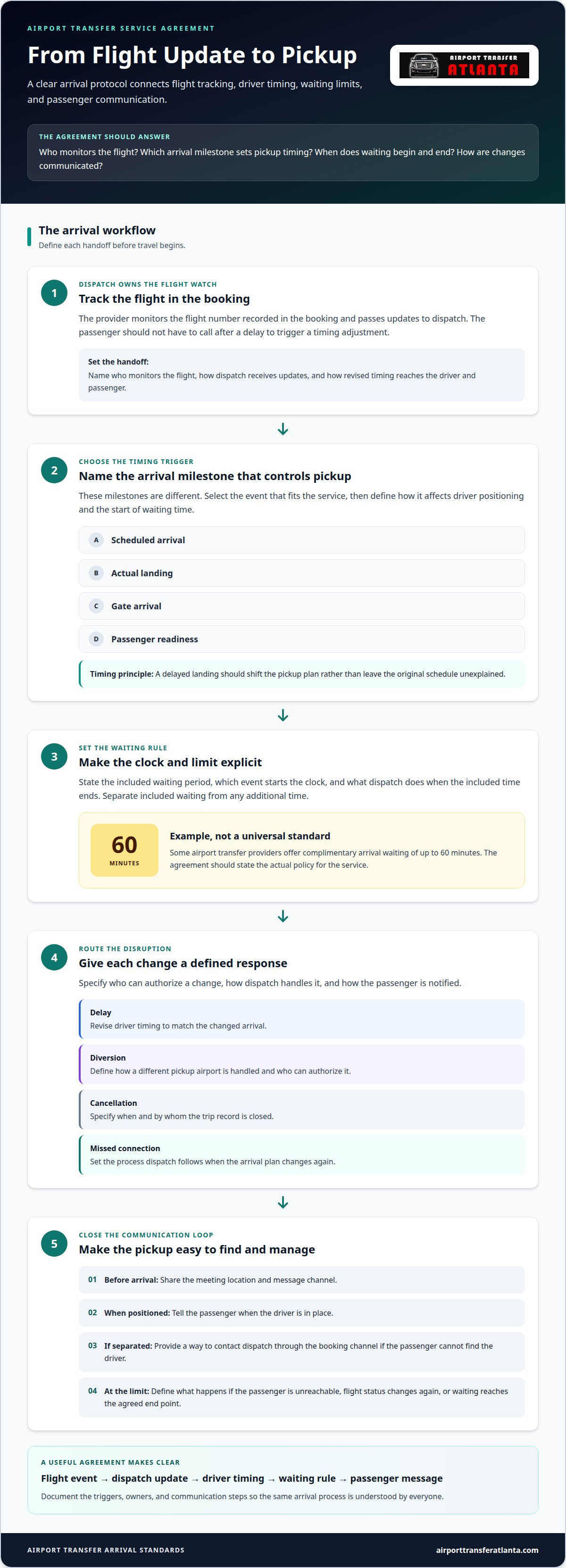
- Make inbound-flight tracking part of dispatch, not a passenger task. The provider should monitor the flight number in the booking and adjust driver timing when arrival changes, so the passenger does not have to call after a delay. State who monitors the flight, how dispatch receives updates, and how revised timing is communicated to the driver and passenger.
- Define which flight event controls pickup timing. Scheduled arrival, actual landing, gate arrival, and passenger readiness are different milestones. Choose the event that fits the service, then explain how it affects driver positioning and when waiting time begins. A delayed landing, for example, should shift the pickup plan rather than leave the original schedule unexplained.
- Set the waiting policy in advance. State the included waiting period, the event that starts the clock, and what happens when that period ends. Some airport transfer providers offer complimentary arrival waiting of up to 60 minutes. Treat that as an example, not a universal standard. The agreement should distinguish included waiting from any additional time and explain how dispatch handles it.
- Set separate procedures for delays, diversions, cancellations, and missed connections. A delay may require revised driver timing; a diversion may require a different pickup airport; a cancellation may mean closing the trip record. Identify who can authorize a revised destination and how the passenger is notified. This gives dispatch a defined response when arrival plans change.
- Specify the pickup communication sequence. Identify the meeting location, message channel, and information sent when the driver is in position. Include a way for passengers who cannot find the driver to contact dispatch through the booking channel. Clarify what happens if the passenger is unreachable, flight status changes again, or waiting reaches the agreed limit. Clear triggers make arrivals easier to manage.
Incident escalation and remedies
Tie remedies to specific failures and define how each incident moves from reporting to resolution. A written process also helps reduce disputes about evidence, responsibility, and service recovery.
-
Set Prices and Service Remedies
Define the transfer charge separately from service credits and penalties. Transfer price depends on route mileage, service time, and vehicle, and is provided after a quote request. In the agreement, specify whether a credit applies to a missed pickup, substantial delay, or incorrect vehicle, and explain how it is calculated and applied.
Avoid vague terms such as “reasonable compensation.” State the threshold, remedy, required documentation, and payment or credit process. For example, an incorrect vehicle may call for a replacement, while repeated failures may qualify for a credit or termination right. Keep remedies proportional to the failure and measurable against agreed standards.
-
Establish Incident Responses
Set an escalation path for a driver no-show, incorrect vehicle, or significant delay. Identify the initial reporting channel, who is responsible for dispatch action, and the next escalation contact if the issue remains unresolved. Require an incident record with trip details, reported time, action taken, and outcome. A clear agreement assigns ownership for each response.
Specify how the provider should adjust the service and notify the passenger or travel coordinator. A replacement vehicle may address an incorrect vehicle, while a delay may require a revised pickup estimate. Define when the incident is resolved and who documents that decision, so the agreement supports consistent follow-through.
- Address common disputes directly. Parties may disagree about arrival timing, passenger readiness, responsibility for a missed connection, or whether a failure crossed the agreed threshold. Link each issue to the trip record, timestamps, flight updates, and communication history. State which records take precedence when accounts differ.
- Review incident patterns systematically. Group reports by failure type, route, and service period, then compare them with agreed standards. Set corrective actions for recurring problems and record owners and completion status. Include failure thresholds that permit termination when performance repeatedly falls below the contract standard.
On-time performance definitions and measurement
Define punctuality through observable events, accurate timestamps, and a consistent review process. Clear terms make performance easier to assess across airport transfers.
-
Define Key SLA Terms
Specify the service scope, pickup point, expected passenger arrival, and what “on time” means. State whether the driver must be in position before the passenger’s expected arrival and define the allowed time difference. Identify each timestamp source and explain how delays affect measurement.
Include performance targets, reporting responsibilities, review procedures, and remedies for falling below standards. Avoid broad terms such as “prompt” or “reliable” without measurable definitions. Clear wording gives dispatch, coordinators, and passengers the same reference point when reviewing a trip.
-
Measure On-Time Performance
Choose a consistent method for comparing the agreed pickup time with the driver’s recorded position time. For example, track whether the driver was in position by the required point before the passenger’s expected arrival. Define which records count, how exceptions are classified, and how incomplete or inaccurate trip data is handled.
Use realistic measures that reflect safe, reliable operations. Review results against the agreed standard, not isolated impressions or marketing claims. A structured evaluation helps the agreement identify trends, explain exceptions, and assign corrective actions when performance falls short.
- Set a reporting schedule and name who supplies, reviews, and acts on performance data. Each report should use consistent definitions and show missed targets, exceptions, and follow-up actions. Regular reviews help distinguish recurring issues from a single trip affected by changed circumstances.
- Connect measurement to enforcement. Define when a result triggers a corrective plan, service remedy, or further escalation, then record the decision and owner. For dependable airport pickups, book a one-way airport transfer with clear trip details and pickup expectations. This keeps the airport transfer service level agreement tied to practical service outcomes.
Airport Transfer Atlanta
Airport Transfer Atlanta provides private transportation for travelers who need clear pickup arrangements and a defined itinerary. A One Way Airport Transfer suits a direct airport trip, while Hourly Limo Rental supports travel with multiple stops or changing schedules. Select a Lincoln MKT / Cadillac XTS Sedan Service or GMC Yukon XL / Cadillac Escalade SUV Service based on the trip’s vehicle needs.
For an individual booking, share the flight details, pickup location, destination, and any itinerary changes. These details help align the transportation plan with your expectations. Airport Transfer Atlanta provides private transportation, not shared shuttle arrangements or self-drive rentals. All-inclusive rates include applicable fees, taxes, surcharges, tolls, and gratuity, with no hidden fees.
To arrange a transfer that fits your itinerary, contact Airport Transfer Atlanta.
Put Clear Terms Into Practice
An airport transfer service level agreement is most useful when it guides everyday decisions, not just contract reviews. Before arranging a trip, make sure everyone booking and coordinating travel can access the approved terms and understands which process applies. This keeps written standards connected to the actual journey.
Keep the agreement relevant to how travel is arranged. If routes, passenger needs, or booking practices change, review whether the procedures still fit. A focused review can preserve clarity without rewriting terms that remain useful. For an individual journey, choose a service suited to your itinerary and provide the necessary trip details when booking.
Airport Transfer Atlanta offers One Way Airport Transfer, Hourly Limo Rental, and Lincoln MKT / Cadillac XTS Sedan Service. Contact Airport Transfer Atlanta today to discuss your airport transportation needs and take the next step with a clear plan.
Frequently Asked Questions
What is an airport transfer service level agreement (SLA)?
An airport transfer service level agreement is a written agreement that defines the transportation service and how its performance will be assessed. It clarifies the customer’s and provider’s responsibilities, including trip scope, booking procedures, communication, and how service failures are handled. A corporate travel team, for example, can use it to set consistent expectations for recurring airport pickups and different booking coordinators.
What are typical airport transfer SLA performance metrics and targets?
Common measures include on-time pickup performance, driver response time, incident resolution, and completion of confirmed bookings. Targets should reflect actual operating needs rather than an assumed universal benchmark. For useful comparisons, define how each measure is calculated, which trips qualify, and how exceptions are recorded. Reports can then show performance against the agreed target and identify where corrective action is needed.
How should airport pickup wait times, flight delays, and cancellations be handled in an SLA?
State when waiting begins, how flight changes affect driver timing, and what dispatch does after a cancellation or diversion. Airport Transfer Atlanta provides complimentary wait time of 1 hour for airport pickups and 15 minutes for all other pickups. Cancellations are free up to 1 hour before pickup for standard bookings and up to 24 hours before for hourly charters. Include passenger notification procedures in the agreement.
What are typical airport transfer SLA prices, service credits, and penalties?
Transfer charges depend on route mileage, service time, and vehicle, and are provided after a quote request. Define any credits or penalties by specifying the failure threshold, remedy, required documentation, and how the credit or payment is calculated and applied.


