

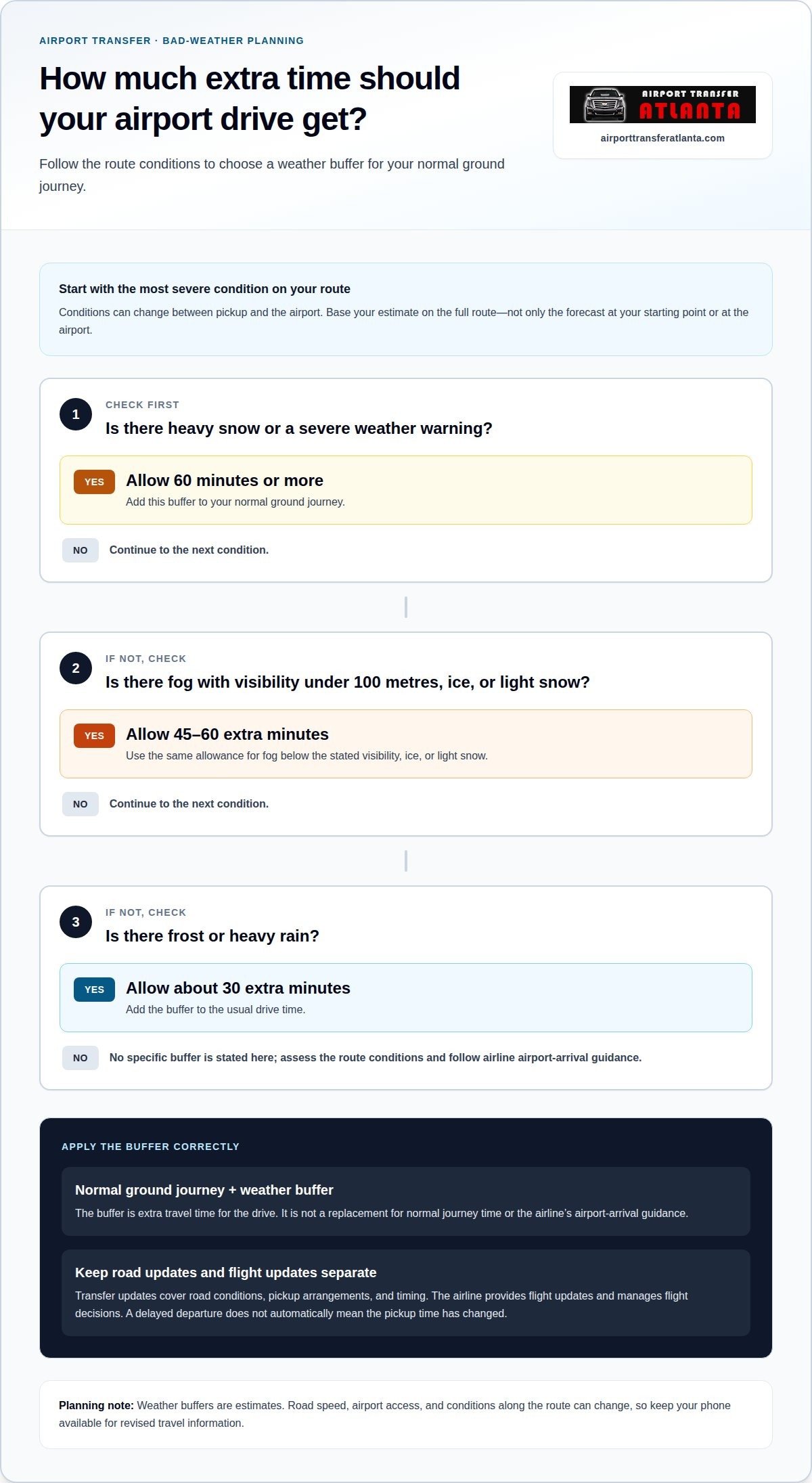
Bad weather can turn a routine airport drive into the part of your itinerary most likely to run late. For an airport transfer for bad weather conditions, allow about 30 extra minutes for frost or heavy rain, 45 to 60 minutes for fog with visibility under 100 metres or for ice and light snow, and at least 60 minutes for heavy snow or a severe weather warning.
These buffers are planning estimates, not a replacement for normal journey time or the airline’s airport-arrival guidance. The right allowance depends on route conditions, and severe weather can disrupt traffic well beyond the airport approach.
This guide explains how to choose a weather buffer, prepare for a winter airport journey, and interpret delay updates. You’ll also learn how a professionally planned transfer can support your trip when road conditions change, while keeping your flight schedule and passenger updates central to the plan.
Key Takeaways
- Build a weather buffer around the conditions on your route, not just the forecast at the airport.
- Understand how airport winter preparations differ from airline responsibilities for aircraft de-icing.
- Follow airline updates for changes to your flight; airport and road conditions can affect different parts of the journey.
- Learn what to expect from a professional transfer when snow, ice, heavy rain, or high winds disrupt normal travel.
How professional airport transfers prepare for a winter journey
Winter travel planning connects the road journey, airport access, and flight schedule. A professional transfer operation reviews pickup details and conditions when planning the trip.
Airport winter operations and vehicle dispatch are separate parts of the journey. Airport teams manage paved surfaces and access areas, while the Federal Aviation Administration can issue ground stops and ground delays. Airlines manage flight decisions and aircraft de-icing. Knowing who handles each part helps you direct questions when a storm affects roads and departures.
For the ground transfer, provide the pickup address, flight details, and passenger and luggage requirements. These details help plan the route and pickup arrangements. Keep identification, essential medication, a phone charger, and a warm layer in your carry-on. A flight delay, for example, may leave you waiting at the terminal, so keep important items with you.
Severe-Weather Transfer Safety
A suitable severe-weather transfer is planned around current road access, with a driver able to adjust the route. Conditions can change between pickup and the airport. Check practical safety features such as functioning seatbelts, headlights, and window defrosting. A vehicle model alone doesn’t confirm that these features are working.
Weather-Related Charges and Vehicle Features
Weather-related charges depend on the transfer’s booking terms; Airport Transfer Atlanta uses all-inclusive rates, with no hidden fees. Cancellations are free up to 1 hour before pickup for standard bookings and up to 24 hours before for hourly charters. These terms concern ground transportation, not an airline ticket refund. Ask about the booking terms before arranging a trip, especially if winter conditions may disrupt plans.
Passenger care and delay communications
A weather advisory can affect road access, pickup timing, and flight departures separately. For an airport transfer, updates should distinguish road conditions from airline schedule changes. This helps you tell whether a delay affects the vehicle, the flight, or both.
To confirm whether a transfer is operating, the provider considers current weather advisories, airport alerts, road closures, and conditions along the planned route. Updates can then explain the service status, pickup arrangements, and any timing changes. Share your flight number and departure time when booking to connect the ground journey with your itinerary.
Road closures and airport alerts can affect transfer routes and terminal access. A closure near your pickup point may require a new meeting location. A restriction on an airport access road may change where the vehicle can drop you off. Useful updates explain what has changed and how it affects the journey.
The airline provides flight updates and manages decisions about delays, cancellations, and diversions. Keep its notifications accessible while travelling, and track flight status separately from your ground-transfer status. A delayed departure doesn’t automatically mean the pickup time has changed.
During a disruption, clear responsibilities matter. Airlines manage passenger care and communication when aircraft delays affect travellers at the airport. Their updates cover the flight and passenger arrangements; transfer updates cover the road journey. Knowing who handles each update helps you direct questions appropriately.
For example, if an airport alert changes terminal access while your flight remains on schedule, the transfer update should explain any change to the pickup or drop-off location. Keep your phone charged and booking details accessible so you can receive revised travel information. To arrange an airport journey, plan your airport transfer with your pickup details and flight schedule ready.
Extra journey time for frost, rain, fog, ice, and snow
Weather can affect road speed and airport access, so base pickup planning on conditions along the route. Planning an airport transfer for bad weather conditions means adding a suitable buffer to normal driving time, then matching departure timing to the airline’s airport-arrival guidance.
Weather-Related Journey Time
A weather buffer is extra travel time added to the usual drive. It matters because arriving late can leave less time for airport procedures before departure.
Allow about 30 minutes extra for frost or heavy rain. For fog with visibility under 100 metres, allow 45 to 60 extra minutes. The same 45-to-60-minute allowance applies to ice or light snow. For heavy snow or a severe weather warning, allow 60 minutes or more.
Apply the buffer to the normal ground journey, not to the airline’s airport-arrival guidance. For example, a drive that usually takes 30 minutes may take considerably longer in bad weather. The route, changing conditions, and airport access all affect the estimate. An airport transfer for bad weather conditions should account for the full trip, rather than only the forecast at your starting point.
Transfer Operations in Severe Weather
Transfer operations adjust timing and routing to road conditions. A clear pickup area doesn’t necessarily mean the route or airport approach is clear.
Heavy rain can slow traffic, while ice and snow can affect road access and safe travel speeds. High winds may also affect exposed sections. Consider the whole route, since conditions can differ between the pickup point and terminal.
Use service updates to follow changes to pickup timing or access arrangements. Keep your phone available and flight details accessible so revised travel plans can be matched to your departure schedule. If conditions worsen after pickup, the remaining drive may take longer than estimated. A weather buffer gives your itinerary room to adapt without treating a forecast as a fixed road schedule.
How do airport transfers operate during snow, ice, heavy rain, or high winds?
In severe weather, an airport transfer depends on road access, traffic conditions, and the airport’s operating arrangements. The provider’s role is to coordinate the ground journey, while the airline manages flight changes. Keeping those responsibilities separate helps travelers understand which update affects pickup and which affects departure.
For snow or ice, the route may need to change if road conditions slow traffic or affect access. Heavy rain can increase congestion and make journey times less predictable. High winds may also affect exposed sections of the route. A professional operation considers conditions throughout the journey, not only the forecast at the pickup address.
Before departure, the key details are the pickup point, terminal, flight schedule, and current route conditions. If a road closure affects the planned approach, the route or meeting point may need to change. Passengers should receive clear instructions, especially if the original pickup location is no longer practical.
As conditions change, the original arrival estimate may become outdated. For example, heavy rain near an airport access road can slow traffic even when roads farther away are clear. An update should explain whether the vehicle is moving, whether the route has changed, and whether the estimated arrival time has shifted.
Flight disruptions require a separate response. If the airline changes a departure time, follow its flight updates and share relevant changes with the transfer provider. A revised flight schedule doesn’t automatically change the ground pickup plan. Coordination matters most when the flight changes while the vehicle is already en route.
For any airport journey, provide accurate pickup and flight details so the transfer plan reflects your itinerary. Arrange an airport transfer with Airport Transfer Atlanta around the journey and its current conditions.
Choose a professional transfer provider that considers conditions along the entire route and can revise the route or meeting point when needed. Clear updates on vehicle progress and arrival estimates help you respond as conditions change.
Airport Transfer Atlanta
Airport Transfer Atlanta provides private airport transportation for travellers planning around winter road conditions. One Way Airport Transfer is suited to a direct airport journey. Sedan and SUV services offer vehicle options for different passenger and luggage needs.
For a weather-sensitive trip, share your pickup address, flight details, and passenger and luggage requirements when arranging transportation. Use the weather buffers above to plan your departure time, and keep airline notifications separate from ground-transfer updates. Road conditions and flight status affect different parts of your itinerary.
Airport Transfer Atlanta offers Lincoln MKT and Cadillac XTS sedan service, as well as GMC Yukon XL and Cadillac Escalade SUV service. Choose an option that suits your travel party and journey. Contact Airport Transfer Atlanta to arrange your airport transfer.
Plan Your Next Airport Journey
Build weather planning into your itinerary before travel day. Allow for conditions to change, keep flight and ground-transfer updates separate, and provide accurate pickup and flight details when arranging your ride. This gives the journey a clearer starting point, even if the forecast shifts.
For an airport transfer for bad weather conditions, choose a service that fits your schedule and travel needs. Airport Transfer Atlanta offers One Way Airport Transfer, Hourly Limo Rental, and Lincoln MKT / Cadillac XTS Sedan Service. Share your trip details to arrange a suitable airport journey.
Contact Airport Transfer Atlanta to plan your transportation. A little preparation can help you approach travel day with a clearer plan and greater confidence.
Frequently Asked Questions
How do airport transfer providers estimate how much extra time to allow?
To estimate a journey buffer, consider the usual route, expected weather, road access, and traffic. A short urban route with several exposed or congested sections may need a different plan from a direct highway journey. Separate normal driving time from extra weather-related time, then plan your pickup around the airline’s required airport-arrival window.
How do airport transfer providers plan departure times in fog?
Fog planning depends on visibility along the route, how long fog is expected to last, and the time needed to reach the terminal. Use the normal journey duration as a baseline, then allow extra time for reduced visibility and slower progress. An airport-only forecast may not reflect conditions at your pickup point or along the roads between.
Is it safe to travel to the airport in icy conditions?
Icy roads increase stopping risk, so safe travel depends on actual road conditions and whether the driver can proceed safely. The Highway Code says stopping distances on ice can be up to ten times greater than on dry roads. If the route is unsafe, don’t treat a tight flight schedule as a reason to travel regardless of conditions.
Should you book a professional airport transfer the day before in winter?
Book once your flight and pickup details are settled, rather than waiting for winter weather to begin. Reserving the day before gives you a planned pickup, but you still need to allow for changing conditions. Include your flight details and luggage needs when arranging the trip, then keep your itinerary and provider updates accessible on travel day.
What will an airport transfer provider do if bad weather delays your flight or pickup?
Provider updates cover the ground journey, such as pickup timing, route access, or a revised meeting point. The airline handles information about flight delays, cancellations, and diversions. If your departure time changes, share the revised itinerary with your transfer provider so the ground arrangements can be considered separately. Don’t assume a flight delay automatically shifts your pickup.
How early should you book a professional airport transfer or schedule pickup in bad weather?
Arrange the transfer once your itinerary is firm, then set pickup timing based on the usual drive, weather conditions, and the airline’s airport-arrival guidance. Booking lead time depends on your plans and the service arrangements. For pickup timing, consider the full route and airport access, not just the forecast at your starting point.


