

A metered taxi may seem less expensive at pickup, but traffic and other charges can change the final fare. In the fixed-rate airport transfer vs. metered taxi comparison, neither option is always cheaper: a short, direct ride may favor a taxi, while a fixed quote makes the fare more predictable when traffic slows the trip.
Compare the fare before choosing, especially when balancing cost with a dependable arrival. The key difference is how the total is calculated: a meter can keep running in traffic, while a fixed transfer quote is based on the trip details.
This comparison explains when each option may cost less, what can affect a taxi fare, and how booking details shape a transfer quote. Use the practical guide to choose an airport ride that fits your route, schedule, and group.
Key Takeaways
- A metered taxi may cost less for a short, straightforward ride, while a fixed quote can offer more predictable costs when traffic or distance adds uncertainty.
- Compare how each option handles pickup details, vehicle choice, added charges, and delays before deciding whether to book ahead.
- Understand why a taxi meter can continue adding time-based charges in traffic and which extra fees may affect the final fare.
- There is no single average transfer cost that fits every U.S. trip; route, vehicle, passenger count, and timing all shape the quote.
Is a fixed airport transfer price always cheaper than a taxi?
No. A taxi may cost less for a short, direct ride, while a fixed quote limits fare uncertainty when traffic slows the trip. Compare the route, journey length, and applicable charges before choosing.
Fixed Airport Transfer Prices
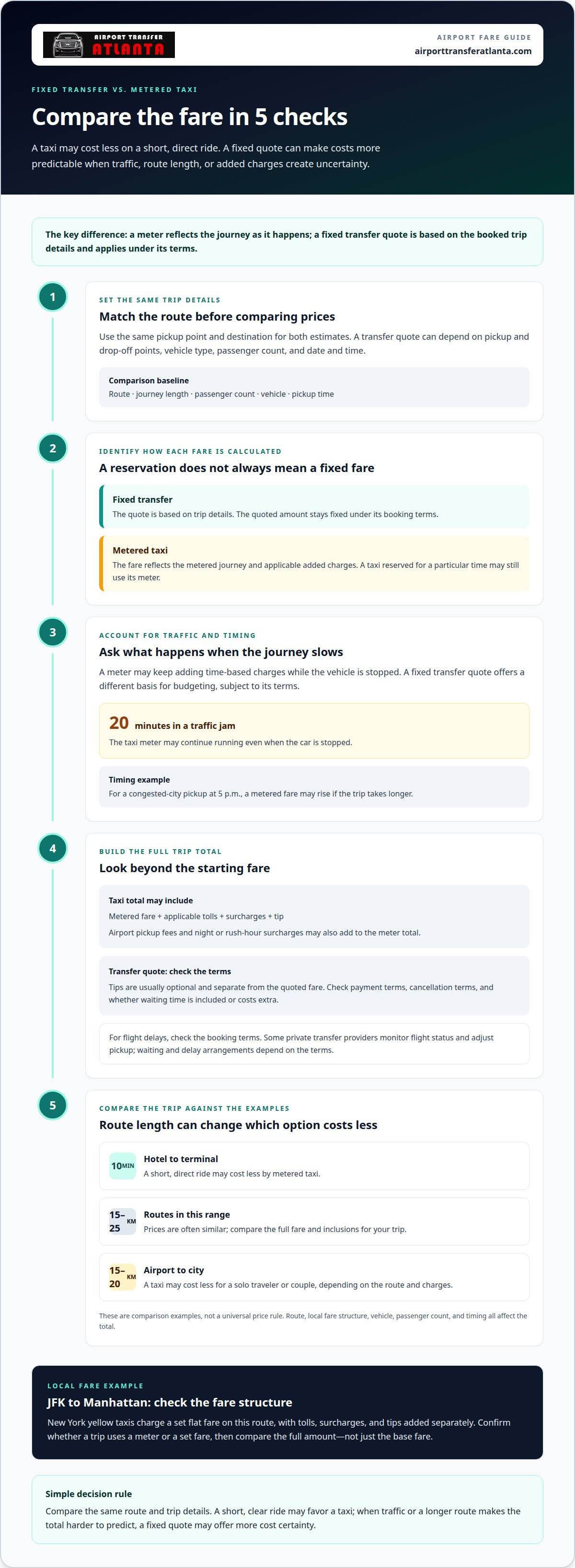
A fixed transfer quote is based on the pickup and drop-off points, vehicle type, passenger count, and date and time. It gives you an amount to compare before travel, rather than a fare that changes with each mile or minute. Choose this option when a longer route or unpredictable traffic makes a defined fare more useful than a potentially lower starting cost.
For example, a ten-minute hotel-to-terminal ride may cost less by metered taxi. Routes of 15-25 km are often similar in price, while a taxi for a 15-20 km airport-to-city trip may cost less for a solo traveler or couple. A fixed quote should state which trip details and inclusions it covers.
Running Taxi Meters
A metered taxi fare changes with the journey, so traffic can affect the final amount. The meter may keep running during a twenty-minute traffic jam, even when the car is stopped. This can make a taxi less predictable on a congested route, though a short, clear trip may still cost less.
Airport taxis and pre-booked transfers both provide transportation, but price alone does not establish safety or reliability. Compare how each service handles pickup and the route. Choose a pre-booked transfer when knowing the quoted fare matters more than the possibility of a lower meter fare.
Payment and Price Certainty
Tips for a fixed airport transfer are usually optional and separate from the quoted fare. A taxi’s final total may include the metered fare plus applicable tolls, surcharges, and tip. Check the fare components and payment terms shown for each option; don’t treat the meter’s starting amount as the total trip cost.
A fixed quote should be read alongside its booking terms. Those terms govern cancellation and waiting time, including whether waiting is included or costs extra. There is no universal legal guarantee implied by the words “fixed rate”; applicable rules and booking terms depend on location. A professional can compare a taxi’s applicable fare components with a transfer quote using the same route and trip details.
| Option | Fare basis | Traffic impact | Best fit |
|---|---|---|---|
| Fixed transfer | Trip details and quoted fare | Quote stays fixed under its terms | Predictability on longer or slower routes |
| Metered taxi | Metered journey and added charges | Time in traffic may raise the fare | Short, direct rides where the meter may cost less |
Choose by weighing route length, expected traffic, applicable fare components, and the value of knowing the quoted amount in advance.
Pre-booking and surge pricing
Booking ahead clarifies the pickup plan, but it does not automatically make every fare fixed. A taxi reserved for a particular time may still use its meter, while a private transfer quote is based on trip details. The fixed-rate airport transfer vs. metered taxi comparison should focus on how each fare is calculated, not simply whether you have a reservation.
Consider a congested-city pickup at 5 p.m. A metered fare may rise as the journey takes longer. Airport pickup fees, tolls, night or rush-hour surcharges, and tips can also add to the meter total. A quoted transfer offers a different basis for planning: the stated fare applies to the booked trip under its terms.
Pre-booking lets you provide your flight details and pickup information in advance. Some private transfer providers monitor flight status and adjust pickup for delayed arrivals. Waiting time and delay arrangements depend on the booking terms, so these details affect how useful the reservation is for your itinerary.
- Match the pickup location and destination across both fare estimates.
- Include applicable tolls, surcharges, and tips in the taxi estimate.
- Review the transfer terms for flight delays and waiting time.
Surge pricing and a taxi meter are not the same. A meter calculates the fare during the trip, while demand-based adjustments depend on the service’s pricing terms. For a clear comparison, identify whether each fare is fixed or variable and which charges are included.
A useful fixed-rate airport transfer vs metered taxi decision starts with the conditions you expect. If a 5 p.m. delay could make a variable fare difficult to budget, a quoted transfer may better suit your preference for cost certainty. For a direct route with clear taxi charges, a taxi reservation may fit your plans. Consider your itinerary, pickup timing, and tolerance for a changing fare before booking.
Airport taxi fare uncertainty
A taxi’s final charge can differ from an initial estimate when the meter reflects trip conditions. New York’s JFK route illustrates why local fare rules matter.
Uncertain Metered Taxi Fares
A metered fare depends on the trip recorded by the taxi meter. Time spent moving slowly or stopped in traffic can affect the total, so a driver’s initial estimate may not match the fare at drop-off.
New York yellow taxis charge a set flat fare between JFK and Manhattan, with tolls, surcharges, and tips added separately. That differs from a meter-based trip: the base fare is fixed, but additional charges still affect the total. Compare the full amount, not just the flat-fare component.
At pickup, identify whether the airport-to-destination trip uses a meter or a set fare. Then account for applicable extras and the route. This is more useful than assuming every airport taxi uses the same pricing method.
Typical Airport Taxi Fares
There is no typical metered fare that applies across major U.S. airports. The total depends on the airport, destination, route, and local fare structure. A trip from JFK to Manhattan, for example, uses New York’s set flat fare, while other routes may use a meter.
For a practical estimate, define the pickup terminal and destination first. Then determine whether the route has a set fare or uses a meter. Include applicable tolls, surcharges, and tips when comparing the taxi cost with a private transfer quote.
Route length alone does not settle the comparison. A longer trip may involve more time in traffic, while a direct route can keep the metered journey shorter. These conditions affect the meter, whereas a set-fare route follows its local fare structure plus applicable extras.
Use the route and fare method as your baseline. For JFK to Manhattan, compare the set fare and separate charges; for a metered airport ride, consider the trip conditions that affect the meter. This gives you a more accurate comparison than a single nationwide average.
What is the average cost of a fixed-rate airport transfer in the United States?
There is no single average for every fixed-rate airport transfer in the United States. A quote depends on the pickup and drop-off points, vehicle type, passenger count, and date and time. A route-specific quote is more useful than a nationwide figure.
For example, a pickup from an airport to a nearby hotel differs from a longer trip across a metropolitan area. Distance affects the quote, while vehicle choice and passenger count help determine what fits the travel party. A sedan and a larger vehicle are not equivalent comparisons.
The price depends on the trip and is given after a quote request; cost factors include mileage, time, pickup and drop-off points, vehicle type, passenger count, and date and time. This is why a quoted amount for one route cannot stand in as the average for all U.S. airport transfers.
For a useful comparison, use the same itinerary for both options. Set the airport, destination, travel date, and passenger count, then compare the transfer quote with the taxi’s applicable fare and additional charges. This prevents differences in route or group size from distorting the decision.
- Identify the airport pickup and exact destination.
- Use the same passenger count and travel date.
- Compare suitable vehicle types and all applicable taxi charges.
For a solo traveler on a short, direct ride, a metered taxi may cost less. A fixed quote can be valuable when the route is longer or a defined fare matters more than a potentially lower meter total. The deciding factor is the actual itinerary, not a national average.
When planning your next journey, make sure to request a route-specific transfer quote using your exact pickup, destination, travel date, and passenger count.
Costs vary by itinerary, so there is no nationwide average price.
Airport Transfer Atlanta
Airport Transfer Atlanta helps travelers compare a private airport ride with a metered taxi by offering structured transportation and flat-rate pricing based on mileage and time. It’s a practical option when you want to know the trip details behind a quote before choosing how to travel.
For a direct airport journey, a One Way Airport Transfer provides a private ride. Vehicle choices include sedan and SUV services, with Hourly Limo Rental available for trips requiring transportation beyond a single transfer. The right fit depends on your route, schedule, and passenger needs.
Share your pickup and drop-off points, travel timing, and passenger count to request a quote and compare your options. Contact Airport Transfer Atlanta to discuss your airport transportation needs.
Plan the ride around your priorities
The fixed-rate airport transfer vs. metered taxi decision is most useful when it reflects how you want the trip to fit your itinerary. Consider whether you value a defined fare, a specific pickup arrangement, or the option to continue traveling beyond the airport journey. Your priorities can guide the choice more clearly than a general rule about which ride costs less.
Before arranging transportation, bring together the practical details: your pickup and destination, travel timing, passenger count, and preferred vehicle type. A clear itinerary makes it easier to choose the right arrangement. For several stops or changing travel needs, consider how those requirements affect the service you want.
For a ride planned around your itinerary, contact Airport Transfer Atlanta to plan your ride. A clear starting point can help you move forward with confidence.
Frequently Asked Questions
Does a fixed rate include tolls, tips, and waiting time?
Not every fixed-rate quote includes the same items, so inclusions depend on the provider’s terms. Airport Transfer Atlanta’s All-inclusive rates include applicable fees, taxes, surcharges, tolls, and gratuity. Airport pickups include 1 hour of complimentary wait time; other pickups include 15 minutes. These specific inclusions make it easier to understand what the quoted rate covers.
How Do Traffic Jams Affect Metered Fares?
Traffic can increase a metered fare when the meter accounts for time as well as distance. During a slow queue, the vehicle may cover little ground while elapsed time continues to affect the total. A fixed quote works differently under its stated terms. On a congested route, compare the taxi’s time-based charges with the transfer’s quoted amount.
How much more does a taxi cost for a group of 4?
There is no single additional amount for a group of four; the total depends on the route, local fare method, and vehicle capacity. If the party and luggage do not fit in one taxi, multiple vehicles may be needed, increasing the combined fare. Compare the total for everyone’s ride, not one taxi’s fare with one private vehicle quote.
What Are the Benefits of Pre-Booking?
Pre-booking lets you arrange the pickup location, destination, travel time, and vehicle before arrival. It also gives you time to review fare terms and plan for luggage or passenger needs. For a business trip or family arrival, arranging transportation ahead can reduce decisions at the airport curb. Complimentary car seats and boosters are available for infants and toddlers.
What happens to a fixed-rate booking if my flight is delayed?
A delayed flight doesn’t have one universal effect on every booking; the provider’s pickup and waiting terms determine what happens. Airport Transfer Atlanta includes 1 hour of complimentary wait time for airport pickups. That stated allowance is useful when planning an arrival, but it does not establish how every provider handles flight monitoring or delays.
What hidden fees do airport taxis charge?
Possible additions to a taxi fare include airport pickup fees, tolls, night or rush-hour surcharges, and tips. These vary by route and fare rules, so account for them when estimating the total. Airport Transfer Atlanta’s All-inclusive rates include applicable fees, taxes, surcharges, tolls, and gratuity, with no hidden fees.


