

Golf trip airport transportation works best when you account for golf bags, regular luggage, and passenger seats before booking. Golf clubs travel as checked baggage, so allow time to collect them after landing. Include the airport-to-accommodation ride and any later trips to the course in your itinerary.
Your golf clubs and luggage affect which vehicle can accommodate your group. Before booking, note the number and type of golf bags, their approximate lengths, and the number and size of your suitcases. This guide explains how to prepare golf equipment for air travel, choose suitable ground transportation, and plan rides between the airport, your accommodation, and the course. It also covers which details to provide when booking so your transportation plan reflects your equipment and passenger load.
Key Takeaways
- Review airline rules for golf-bag dimensions, weight, case type and contents. The Transportation Security Administration limits liquid golf-club cleaning supplies in carry-on baggage to 3.4 ounces or smaller.
- Build your pickup plan around baggage collection, including extra time if your clubs go through oversized-baggage handling.
- Choose a vehicle based on passengers and the full luggage load. Share the number and type of equipment bags, their approximate lengths, and the size and number of suitcases.
- Map airport, accommodation and course transfers together so each ride fits the timing and purpose of that part of your trip.
Choosing airport transportation for sports equipment
For a golf trip, a prearranged private car or SUV is a practical airport option. Choose based on passenger count, golf-bag dimensions, regular suitcases, and available cargo space.
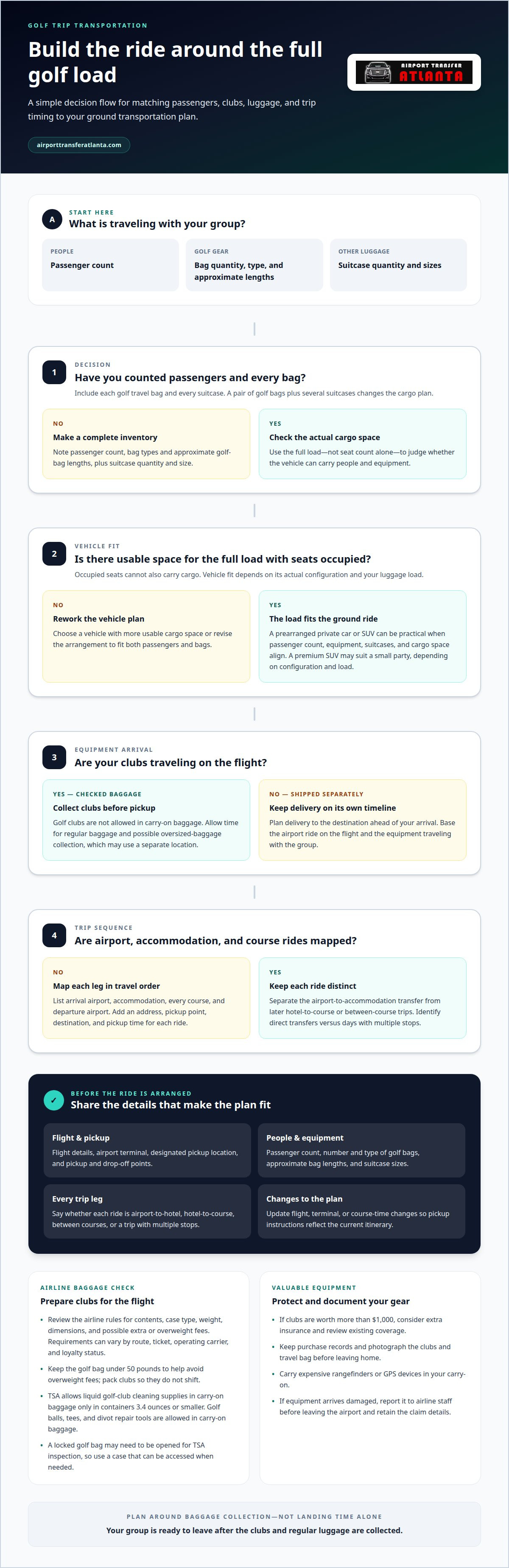
- Count passengers and bags. Include each golf travel bag, its approximate length, and every suitcase. A pair of golf bags plus several suitcases changes the cargo plan. One traveler with one bag needs less space. A premium SUV may suit a small party carrying equipment, depending on its actual configuration and luggage load. Occupied seats cannot also carry cargo, so consider usable space, not just seat count.
- Pack clubs for checked baggage. Golf clubs aren't allowed in carry-on baggage, while golf balls, tees, and divot repair tools are allowed. The Transportation Security Administration says liquid golf-club cleaning supplies in carry-on baggage must be 3.4 ounces or smaller. TSA may ask to open a locked golf bag for inspection, so use a case that can be accessed when needed.
- Review the airline’s baggage rules. Check requirements for equipment contents, case type, weight, dimensions, and possible extra or overweight baggage fees. Rules and fees can vary by route, ticket, operating carrier, and loyalty status. Keeping the golf bag under 50 pounds can help avoid overweight fees. Pack clubs so they don’t shift, and carry expensive rangefinders or GPS devices in your carry-on.
- Consider protection for valuable gear. If your clubs are worth more than $1,000, consider extra insurance. Review any existing coverage before travel, and keep purchase records for expensive equipment. Photograph the clubs and travel bag before leaving home. If equipment arrives damaged, report it to airline staff before leaving the airport and retain the claim details.
Advance and last-minute bookings
- Set the trip sequence before arranging rides. List your flight dates, airport, accommodation, course visits, and departure plan. Mark which legs need a pickup, then identify the destination for each. This gives golf trip airport transportation a clear itinerary to follow as tee times and lodging plans develop.
- Share the complete journey plan in one booking request. Include flight details, pickup and drop-off locations, passenger count, golf-bag quantities, and regular luggage. State whether each ride is airport-to-hotel, hotel-to-course, or between courses. This makes it easier to distinguish a direct transfer from a day with multiple stops.
- Account for airline changes and connections. Equipment policies and fees can vary by route, ticket, operating carrier, and loyalty status. For partner airlines or multiple flight segments, review the baggage rules for every carrier. If an airline changes, update the checked-bag and pickup plan to reflect the actual flight operating each segment.
- Allow for baggage collection before pickup. Golf bags may require oversized-baggage handling, and some airports use a separate collection point. Build the airport pickup around the time needed to retrieve clubs and regular luggage. The scheduled landing time alone doesn’t describe when the group will be ready to leave the terminal.
- Send useful details even for a last-minute arrangement. Provide the current itinerary, passenger count, equipment-bag types, approximate lengths, and suitcase sizes together. If a flight or course time changes, send the revised details as one update. Clear information helps make golf trip airport transportation fit the real schedule, rather than an earlier version.
- Keep shipped equipment on its own timeline. If clubs travel separately, plan delivery to the destination ahead of your arrival. For a golf trip airport transportation plan, distinguish shipped bags from the luggage arriving with the group. Plan your airport transfer around the flight and the equipment you’ll bring on board.
Airport and golf-course coverage
- Map each leg from arrival through departure. List the arrival airport, accommodation, every golf course, and the departure airport in travel order. Add an address and pickup point for each destination. This itinerary shows whether you need a direct airport-to-hotel ride, a separate course transfer, or transportation between courses during the trip.
- Plan for checked clubs at the airport. Collect golf clubs before continuing to your accommodation or course. Some airports deliver golf bags at a separate oversized-baggage location rather than alongside regular suitcases. Include time to retrieve both types of baggage, then proceed to the agreed pickup point with your full equipment load.
- Make pickup instructions specific to your flight. Include the airport terminal, arrival details, and designated pickup location in the itinerary. If a schedule change affects the flight or terminal, update those instructions. Clear details connect the baggage-claim process with the onward ride and help prevent confusion about where the group should meet its driver.
- Schedule airport and course rides as distinct legs. A chauffeured SUV or van can carry passengers and equipment between local or intercity destinations without airline check-in or baggage-claim pickup. For example, arrange the airport-to-accommodation journey separately from a later hotel-to-course trip. Record each destination and pickup time so the sequence remains clear.
- Compare the equipment load with usable vehicle space. Share the number and type of golf bags, their approximate lengths, and the number and sizes of regular suitcases. Include the passenger count. The actual vehicle configuration matters because occupied seats cannot also carry cargo. Airline baggage charges and weight limits apply to the flight; they don’t determine cargo capacity for the ground journey.
Golfers can ship clubs to their destination and arrange delivery to a hotel or golf course. Airlines typically cover damage to golf clubs when they are packed in hard-sided cases.
Airport-to-accommodation and golf-course transfers
- Plan the ground journey as part of the golf itinerary. Write down the arrival airport, accommodation, each course, and the departure airport in travel order. Add the address and pickup point for every leg. This makes it easier to see whether a ride goes directly from the airport to lodging or needs a separate course destination.
- Separate ground transport from airline baggage rules. Airline policies govern checked golf travel bags, including their dimensions and weight limits. A chauffeured ground transfer has no airline check-in or baggage-claim process. Once you have collected your equipment, a direct ride can take passengers and bags to a hotel, rental accommodation, or golf course.
- Match each pickup to the day’s schedule. Note arrival details for the airport leg and the required pickup point for each course visit. For example, an airport-to-hotel journey and a hotel-to-course journey have different destinations and timing needs. Keep those legs distinct in the itinerary so a course pickup isn’t mistaken for the airport arrival transfer.
- Describe the full load before arranging the ride. Include passengers, golf bags, their approximate lengths, and regular luggage. A golf travel bag can take up cargo space that would otherwise hold suitcases. If an airline classifies a bag as overweight, that affects flight handling; it doesn’t establish how much room the ground vehicle needs. Seats used by passengers can’t also hold cargo.
- Choose a practical sequence for multiple destinations. Group course visits around the accommodation and avoid adding unnecessary backtracking between locations. For an intercity course, treat the drive as its own planned journey and include the destination address. A clear itinerary helps align airport pickup, lodging arrival, and subsequent golf travel. Arrange an airport-to-accommodation transfer around your arrival plan.
Airport Transfer Atlanta
Airport Transfer Atlanta helps golfers plan private ground transportation between the airport, accommodation, and golf destinations. Share your flight details, passenger count, golf-bag quantity, and regular luggage so the ride plan reflects the full load. A One Way Airport Transfer suits a direct airport-to-accommodation journey, while Hourly Limo Rental can fit an itinerary with separate stops or course visits. Sedan and SUV service options include Lincoln MKT / Cadillac XTS Sedan Service and GMC Yukon XL / Cadillac Escalade SUV Service. Choose based on your group and equipment, keeping passenger seating and cargo space in mind. For coordinated airport and course transportation, contact Airport Transfer Atlanta with your itinerary and luggage details.
Set your travel plan before departure
Add transportation to your golf itinerary while you organize tee times and flights. Record your arrival and departure details, lodging dates, course reservations, and planned stops in one schedule. If a tee time or flight changes, update the schedule so your transportation plan reflects the latest details.
Good golf trip airport transportation starts with a clear picture of the whole itinerary, not just the airport pickup. Decide which trips need a direct ride and where an hourly arrangement may suit your plans. Share the itinerary and equipment details when booking so the transportation plan accounts for your passengers and bags.
For a ride plan shaped around your itinerary, contact Airport Transfer Atlanta to plan your ride. A clear schedule is a useful first step toward a more organized golf trip.
Frequently Asked Questions
How do you book an airport shuttle that accommodates golf clubs and luggage?
For a coordinated airport ride with golf equipment, book a private transfer and specify the full passenger and baggage load. Give the pickup airport, arrival details, destination, number of golf bags, and suitcase count. A golf travel case takes cargo space, so include it separately rather than treating it as a small personal item. This helps align the ride plan with the group’s actual equipment.
Are private car services or rental cars better for transporting golf groups and golf bags?
A private car service provides a chauffeur for the airport journey, while a rental car puts the driving in your hands. For a group arriving together, an arranged pickup can keep passengers and equipment on the same itinerary. Consider who will drive, where the group is going, and whether the vehicle’s stated passenger and bag capacity fits your golf bags and suitcases.
What vehicle size is needed for a group traveling with golf clubs and luggage?
Match passenger capacity and luggage capacity to the entire group’s load. The Lincoln MKT accommodates 3 passengers and 3 bags; the GMC Yukon XL accommodates 6 passengers and 6 bags; the Luxury Mercedes Sprinter accommodates 14 passengers and 14 bags. Count each golf travel case among the bags, then account for suitcases. Choose based on both passenger seats and total baggage.
How far in advance should you arrange airport transportation for a golf trip?
Arrange transportation once your flights, lodging, and golf itinerary are taking shape. This lets you provide pickup details, passenger numbers, and equipment quantities together. If your arrival time or course schedule changes, update the transportation details promptly. For a trip planned on short notice, send the complete itinerary and baggage information in one message.


