

Choosing the most expensive booking option doesn't always guarantee the best logistical outcome for your trip. While many travelers assume hourly rentals offer the highest level of service, a fixed-rate transfer is often the superior choice for direct, time-sensitive routes. You deserve a transportation plan that aligns with your schedule without the frustration of hidden fees or paying for idle time when the vehicle isn't in motion.
Understanding the nuances of flat rate vs hourly car service is essential for maintaining a predictable travel budget and seamless logistics. You'll discover exactly how to match your itinerary to the right pricing model, whether you're booking a Lincoln MKT for a swift airport run or a Mercedes Sprinter for a day of corporate meetings. This overview clarifies the functional differences between these two professional models, ensuring you never pay for more service than your schedule requires. We'll break down the cost-effectiveness of point-to-point transfers and the specific scenarios where the flexibility of an hourly chauffeur becomes a logistical necessity.
Key Takeaways
- Understand the fundamental choice between flat rate vs hourly car service to ensure your booking matches your specific travel logistics and budget requirements.
- Select flat-rate pricing for predictable point-to-point transfers, such as airport arrivals and departures, where cost certainty is the primary objective.
- Utilize hourly "As-Directed" service for complex itineraries involving multiple stops or fluid schedules that require a chauffeur to remain on standby.
- Evaluate luxury vehicle classifications, such as the Lincoln MKT or Mercedes Sprinter, to align passenger capacity and professional standards with your trip type.
- Identify efficiency gaps by applying a decision framework based on your itinerary's duration and the frequency of your destinations.
Understanding the Core Differences Between Flat Rate and Hourly Car Services
Professional ground transportation relies on two primary pricing structures to meet diverse travel needs. A flat-rate model provides a pre-determined price for a specific route, regardless of the time spent in traffic or the specific path taken. Conversely, hourly car service, frequently referred to as "As-Directed" transportation, bills for a set duration where the vehicle and chauffeur remain at the passenger's exclusive disposal. Understanding the nuances of flat rate vs hourly car service is the first step in optimizing your travel logistics. Unlike taxis or rideshare apps that use metered or surge pricing, professional services prioritize transparency. Metered pricing often leads to unpredictable costs that fluctuate based on road conditions; this contradicts the high standards of executive travel.
When Predictability Matters Most
Flat-rate pricing is designed for point-to-point efficiency. It eliminates "meter anxiety," a common issue where passengers feel stressed watching costs rise during heavy traffic or unexpected detours. For corporate travelers, this model is essential for accurate budget forecasting. Standard inclusions often include:
- Transparent route-based pricing
- Integrated toll and fee management
- Scheduled wait time for airport pickups
When you book a flat-rate transfer in a vehicle like a Lincoln MKT or Cadillac XTS, the quote remains stable. This structure ensures that the focus remains on the destination. It's the gold standard for airport transfers where the route is direct and the objective is simple: reliable transportation from point A to point B without financial surprises.
The Concept of 'As-Directed' Transportation
Hourly service offers a level of logistical control that fixed transfers cannot match. In an "As-Directed" scenario, the chauffeur acts as a mobile concierge, waiting on-site at every stop for immediate departure. This is the industry standard for executive itineraries involving back-to-back meetings or social events where the schedule might shift. Most professional rentals require a minimum booking duration, typically two to three hours, to ensure the vehicle is dedicated solely to your itinerary. This model transforms the vehicle into a private, mobile office. Whether you require a GMC Yukon XL for a small group or a luxury Mercedes Sprinter for a larger team, the hourly model ensures the vehicle stays with you. When evaluating flat rate vs hourly car service, choose the hourly option if your day involves multiple destinations or an unpredictable timeline.
The Efficiency of Flat-Rate Pricing for Point-to-Point Transfers
Flat-rate pricing serves as the logistical foundation for point-to-point travel. It's the most efficient model for airport arrivals, departures, and direct transfers between two specific locations. When you book a flat rate vs hourly car service for a one-way trip, your cost is determined by distance and vehicle classification rather than the clock. A Lincoln MKT or Cadillac XTS sedan is ideal for solo travelers or couples with standard luggage. If your party is larger or carries significant equipment, moving to a GMC Yukon XL or Cadillac Escalade SUV ensures everyone travels comfortably without compromising on storage space. Selecting the correct vehicle class at the time of booking prevents last-minute logistical failures that occur when luggage exceeds a sedan's capacity.
Streamlining Airport Logistics
Professional limo companies utilize advanced flight tracking software to synchronize pickups with actual arrival times. This integration is vital for flat-rate transfers, as it allows the service to manage arrival delays without penalizing the passenger. Most fixed-rate models include a specific grace period for wait time, providing a buffer as you clear customs or wait at baggage claim. You also have the choice between a swift curbside pickup or a formal meet and greet service. While curbside is faster for frequent flyers, the meet and greet option adds a layer of convenience where your chauffeur assists with luggage directly inside the terminal. This level of planning ensures that the transition from the aircraft to the vehicle is seamless and stress-free.
Cost-Benefit Analysis of Fixed Transfers
While high-tier rideshare options may seem convenient, they often lack the reliability and transparency of a pre-arranged transfer. Flat rates provide a predictable expense that doesn't fluctuate due to surge pricing during peak hours or inclement weather. For the individual business traveler, the value lies in the chauffeur’s expertise. Professional drivers navigate complex terminal layouts and security checkpoints with precision, ensuring you reach your destination on time. This model prioritizes the passenger's schedule, making it the logical choice for those who value punctuality over the perceived flexibility of on-demand apps. Choosing a fixed-rate model means you aren't paying for the driver's time if they get lost or take a longer route. If you need a reliable ride for your next flight, consider a One Way Airport Transfer to experience this efficiency firsthand.
Maximizing Flexibility with Hourly Chauffeur-Driven Service
Hourly service is the definitive choice for fluid schedules and multi-destination travel. When comparing flat rate vs hourly car service, the latter excels in environments where the itinerary is subject to change. This "As-Directed" model ensures that your chauffeur remains on-site and ready for immediate departure. This eliminates the downtime associated with waiting for a new dispatch between meetings. The chauffeur acts as a professional extension of your team, managing luggage and adjusting routes on the fly to avoid congestion. Maintaining a consistent vehicle and driver throughout the day projects a polished, professional image to clients and colleagues alike. Most hourly agreements include a standard mileage allowance; it's essential to confirm these limits if your itinerary involves long-distance travel between stops.
Executive Roadshows and Multi-Stop Itineraries
Managing tight schedules between corporate headquarters and satellite offices requires a high degree of logistical precision. An hourly limo rental provides an essential "mobile office" environment. You can utilize travel time for confidential calls or final presentation prep without the distractions of public transit or the inconsistency of rideshare apps. Because the vehicle is booked for a block of time, it stays seconds away from your current location. This eliminates the stress of coordinating pickups in high-traffic business districts. Whether you're using a Lincoln MKT or a Cadillac XTS, the dedicated nature of hourly service ensures your schedule remains the priority.
Group Coordination and High-Capacity Needs
For team site visits or high-profile corporate events, keeping the group together is a matter of both efficiency and security. A mercedes sprinter rental with driver is the most effective solution for high-capacity hourly needs. Consolidating your team into a single luxury van is more efficient than booking multiple individual transfers. This approach simplifies logistics for VIP dinners, gala transportation, or field inspections. The Mercedes Sprinter offers ample headroom and professional amenities, allowing for group briefings while in transit. When your itinerary involves moving five or more people across multiple locations, the hourly model provides the necessary structure to keep the entire group on schedule. This level of coordination is a primary differentiator when evaluating the benefits of flat rate vs hourly car service for larger parties.
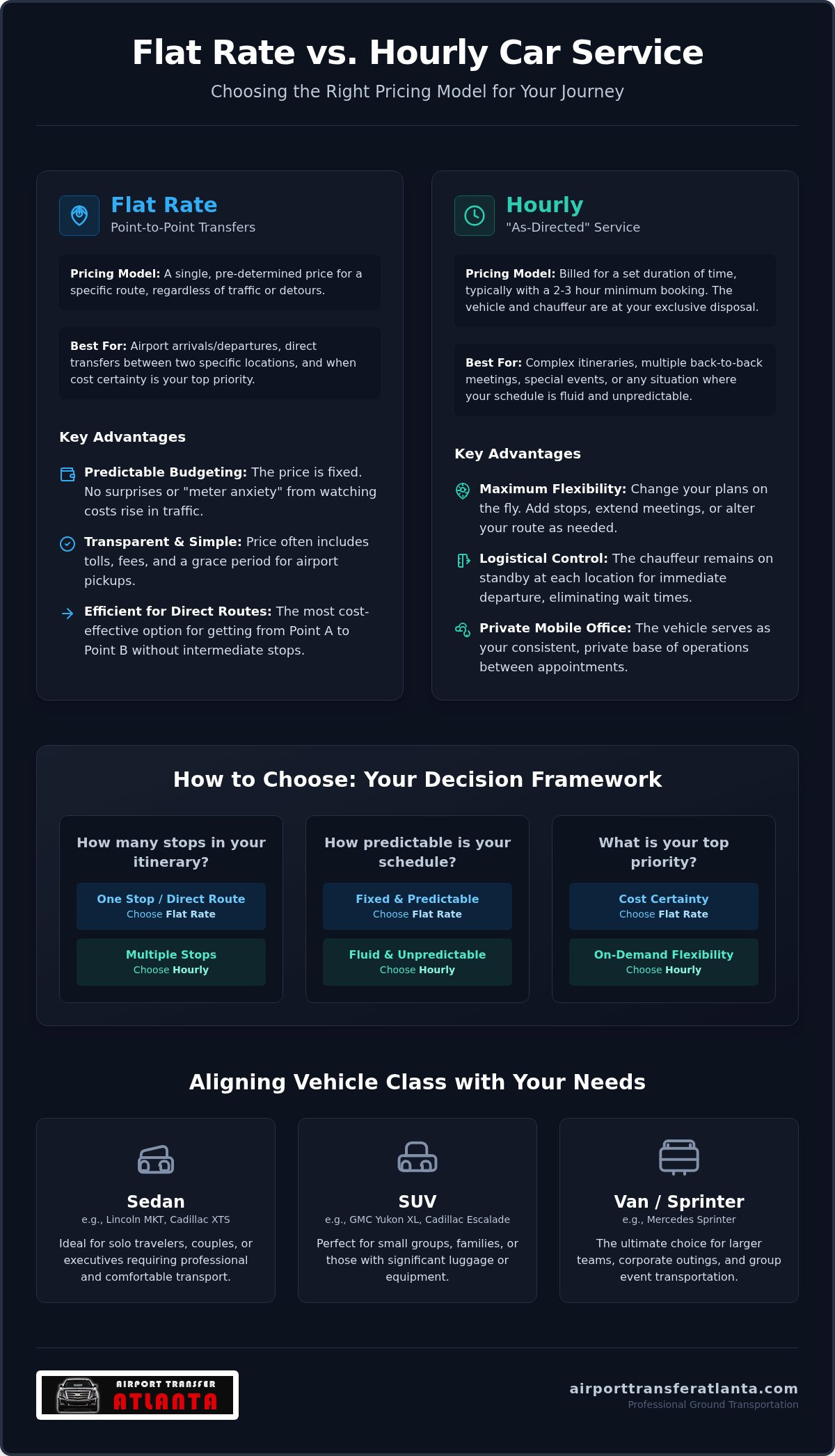
Decision Framework: Flat Rate vs. Hourly Based on Your Itinerary
Selecting the optimal billing model depends on the frequency of your stops and the predictability of your timeline. While cost is a factor, the value of your time often dictates the final choice. By evaluating specific travel scenarios, you can determine whether a fixed-price transfer or a time-based rental offers the best return on investment. The choice between flat rate vs hourly car service isn't just about the bottom line; it's about the logistical flow of your day.
For the standard airport dash, a flat-rate transfer is the logical choice. It provides a guaranteed price for a direct route from your residence or office to the terminal. In this scenario, the flat rate wins because you aren't paying for the vehicle to sit idle while you're in the air. Conversely, the corporate roadshow requires hourly service. When an executive has back-to-back meetings at different locations, the administrative burden of booking four separate flat-rate transfers is inefficient and risky. An evening gala presents a similar need. While you could book two separate transfers, an hourly rental ensures your chauffeur is on-site the moment you're ready to leave, removing the frustration of waiting for a new dispatch in a crowded valet line.
Itinerary Complexity and Time Management
A common industry rule of thumb suggests that if your itinerary includes more than two stops, you should switch to an hourly model. This approach accounts for "deadhead" time, which refers to the duration a vehicle travels from the garage to your first pickup. Hourly billing typically follows a garage-to-garage structure. While this might seem like an extra cost, it saves significant administrative time. You won't need to manage multiple receipts or coordinate with different drivers throughout the day. Calculating the break-even point often shows that a four-hour hourly rental is more cost-effective than booking three separate premium transfers once you factor in the value of seamless transitions and chauffeur standby time.
Vehicle Selection and Its Impact on Pricing Models
The type of vehicle you require also influences which model is most efficient. Individual travelers often find the Lincoln MKT or Cadillac XTS perfect for flat-rate airport runs where efficiency is the priority. If you're coordinating a group airport transfer, a GMC Yukon XL or Cadillac Escalade provides the necessary space at a predictable fixed rate. However, for large-scale logistics involving team site visits or branding events, the luxury Mercedes Sprinter van is best utilized on an hourly basis. This keeps your entire group together and maintains a consistent professional image across every stop. To secure the right vehicle for your specific schedule, you can book your professional transportation online to ensure absolute punctuality.
Professional Standards in Luxury Vehicle Service Selection
The choice between flat rate vs hourly car service is only effective if the provider adheres to rigorous professional standards. While the pricing model dictates the billing structure, the quality of the fleet and the expertise of the chauffeur define the actual travel experience. High-end transportation requires a commitment to reliability that goes beyond simple point-to-point movement. You should look for an airport limo service that prioritizes transparent communication and operational excellence. This includes clear documentation of all fees and a proactive approach to itinerary management. Transparent billing practices are not just a convenience; they are the foundation of long-term corporate trust and budget predictability.
Vetting a service provider involves looking at the human element of the operation. A professional chauffeur represents a significant upgrade over a standard driver. They possess deep local knowledge and maintain a formal conduct that respects the passenger's privacy and time. This expertise is particularly valuable during hourly rentals where the chauffeur must adapt to shifting schedules and complex urban navigation. Whether you're in a sedan or a high-capacity van, the driver's ability to provide a calm, efficient environment is paramount. This level of service ensures that the "flat rate" doesn't mean "low priority," and "hourly" doesn't mean "unstructured."
Fleet Quality and Maintenance Standards
Reliability is directly linked to the age and maintenance of the vehicle fleet. Professional carriers utilize late-model vehicles like the Cadillac XTS, Lincoln MKT, and GMC Yukon XL to ensure mechanical integrity and passenger comfort. A modern fleet offers advanced safety features and superior interior amenities that define the luxury experience. These vehicles undergo frequent inspections to meet national standards for professional ground transportation. Furthermore, a reputable provider maintains comprehensive insurance coverage that exceeds standard commercial requirements. This dedication to safety and quality protects the passenger and ensures that the vehicle arriving for your transfer is in peak condition, both mechanically and aesthetically.
Securing Your Reservation
Managing your booking requires an understanding of lead times and cancellation policies. While flat-rate airport transfers can often be secured with 24-hour notice, hourly services involving high-capacity vehicles like the Mercedes Sprinter should be booked further in advance. This ensures the specific vehicle class you require is dedicated to your itinerary. Cancellation policies often vary based on the pricing model; hourly bookings typically have longer lead times for changes due to the dedicated nature of the chauffeur's schedule. Understanding these logistical details prevents friction and ensures your transportation plan remains flexible yet firm. You can book your flat-rate transfer or hourly service today to secure your professional chauffeur and vehicle.
Optimizing Your Professional Ground Transportation Plan
Choosing the right model ensures your travel remains both cost-effective and logistically sound. Use flat rates for direct airport transfers to maintain a predictable budget. Switch to hourly service for complex, multi-stop itineraries where having a chauffeur on standby is a necessity. Evaluating flat rate vs hourly car service allows you to align your vehicle choice with the specific demands of your schedule. High standards are maintained through a luxury fleet featuring Cadillac sedans, GMC SUVs, and Mercedes-Benz Sprinter vans. Expert chauffeurs trained for executive travel provide the reliability required for high-stakes itineraries.
Whether you're heading to a single destination or managing a full day of corporate site visits, selecting the appropriate pricing structure eliminates logistical friction. You'll travel with the confidence that comes from transparent pricing and professional execution. Reserve Your Professional Car Service with Airport Transfer Atlanta today to experience a seamless journey tailored to your itinerary.
Frequently Asked Questions
Is a flat rate always cheaper than an hourly car service?
A flat rate is generally more cost-effective for direct, point-to-point transfers such as airport runs or simple one-way trips. However, if your itinerary involves multiple stops or standby time, booking several flat-rate transfers can become more expensive than a single hourly block. The choice between flat rate vs hourly car service should be based on the total duration and the number of destinations on your schedule to ensure budget efficiency.
Do hourly car services include a mileage limit?
Hourly car services typically include a specific mileage allowance per hour of service. This ensures the vehicle remains within a reasonable radius of the primary destination. If your itinerary requires long-distance travel that exceeds this allowance, additional mileage fees may apply. It is standard industry practice to confirm these limits during the booking process to maintain a predictable travel budget for your professional itinerary and avoid unexpected surcharges.
What happens if my flight is delayed for a flat-rate airport transfer?
Professional transportation providers utilize flight tracking software to monitor arrival times in real-time. If your flight is delayed, the chauffeur adjusts the pickup time automatically to ensure they are on-site when you land. Most flat-rate airport transfers include a specific grace period for wait time at the terminal, providing a buffer for baggage claim and customs without immediate additional charges. This reliability is a core standard for executive ground transportation.
Can I change my itinerary during an hourly 'As-Directed' service?
You have total flexibility to change your itinerary during an "As-Directed" hourly service. This model is designed for fluid schedules where destinations may shift at a moment's notice. Your chauffeur remains at your exclusive disposal, allowing for immediate route adjustments or additional stops without needing a new reservation. This level of adaptability is the primary reason executive travelers prefer hourly rentals for high-stakes business days and multi-stop corporate events.
Are tolls and gratuity included in flat-rate car service fees?
Transparency in billing is a professional standard, though specific inclusions vary by provider. Many flat-rate quotes are structured to be all-inclusive, covering the base fare, tolls, and standard gratuity to provide a predictable final cost. You should always review your reservation summary to confirm whether these fees are bundled or itemized separately. This prevents unexpected expenses and ensures a seamless, transactional experience at the conclusion of your luxury transfer.
What is the typical minimum hour requirement for a luxury car rental?
The typical minimum requirement for a professional hourly rental is between two and three hours. This minimum ensures the vehicle and chauffeur are dedicated exclusively to your schedule, covering the costs of garage-to-garage logistics. Minimums may increase during peak travel periods or for specialized vehicles like the Mercedes Sprinter. Confirming these durations early helps you determine the most efficient booking model for your specific time requirements and logistical needs.
Which vehicle is best for a group of 10 people needing hourly service?
The luxury Mercedes Sprinter van is the superior choice for a group of 10 passengers. This vehicle offers ample headroom, professional amenities, and significant luggage capacity, making it ideal for team site visits or group gala transportation. Using a single high-capacity vehicle is more efficient than coordinating multiple SUVs. It allows your entire group to remain together, facilitating briefings and team coordination while in transit between multiple destinations.
How do I know which pricing model is right for a business roadshow?
An hourly "As-Directed" model is the standard choice for a business roadshow involving multiple stops. When navigating a series of back-to-back meetings, the predictability of having a chauffeur on standby is more valuable than the cost certainty of a flat rate. Evaluating flat rate vs hourly car service for roadshows reveals that hourly service saves administrative time and eliminates the risk of being stranded between stops if a meeting runs over its scheduled time.


