

A ground transportation policy is more than a list of approved rides. A corporate travel policy for ground transportation should specify approved options, when chauffeured service is appropriate, who can authorize it, and how to handle exceptions. It may cover airport transfers, point-to-point trips, roadshows, and convention transportation.
Rideshares and taxis can work well for short urban trips, while planned transportation can add structure to airport pickups and business itineraries. Clear rules help employees know what to book and give the company a consistent way to address safety, service standards, and travel goals.
This guide explains what a corporate ground transportation program can include, how to set practical rules for rideshares and taxis, and what to consider for employee safety and policy oversight. It also shows how to match transportation to the trip, from a quick city ride to a scheduled airport transfer.
Key Takeaways
- Set clear rules for approved transportation options, vendor standards, trip authorization, and exceptions.
- Match rideshares, taxis, and scheduled service to the trip’s distance, timing, and pickup requirements.
- Build employee safety into travel procedures with defined contacts, pickup details, and delay plans.
- Use policy goals such as safety, cost control, and consistency to guide transportation choices and review results.
1. What is a corporate ground transportation program?
A corporate travel policy for ground transportation defines how employees arrange and report business trips by car. It identifies approved options, sets booking and authorization steps, and explains which expenses employees can claim. Coverage can include airport transfers, point-to-point trips, roadshows, and convention transportation.
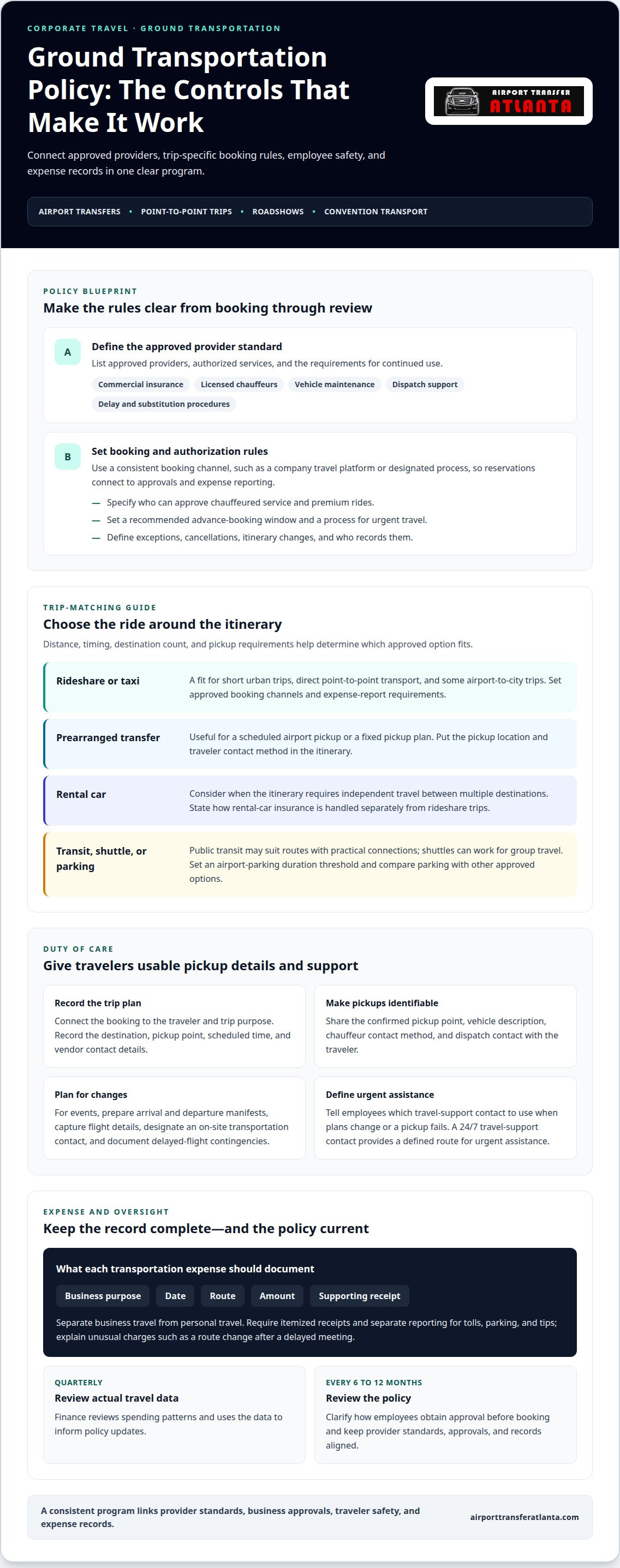
Start with a vendor approval process. List each approved provider, the authorized services, and the standards required for continued use. These may include commercial insurance, licensed chauffeurs, vehicle maintenance, dispatch support, and procedures for delays or vehicle substitutions. Set a recommended advance-booking window and a process for urgent travel.
Match approval rules to the trip. A traveler going to client meetings might book a point-to-point ride through an approved channel, while a planned roadshow may require pre-trip authorization. Identify who can approve chauffeured service, define exceptions, and explain how to record cancellations or itinerary changes.
For U.S. tax and accounting purposes, document each transportation expense with its business purpose, date, route, amount, and supporting receipt. Separate business travel from personal travel in expense reports, then follow the company’s reimbursement and recordkeeping procedures. These details help finance teams classify and review claims under applicable tax rules.
Use a consistent booking channel, such as a company travel platform or designated process, so reservations connect to approvals and expense reporting. Require employees to submit receipts and explain unusual charges, such as a route change after a delayed meeting. A clear cancellation rule should state who records the change and how any resulting charge is handled.
Budgets become more useful when finance reviews actual travel data quarterly and updates policy based on spending patterns. Review the policy at least every 6 to 12 months, and clarify how employees obtain approval before booking. The result is a documented travel program that links provider standards, business approvals, and expense records.
2. Rideshares and taxis for airport transfers and short urban trips
Rideshares and taxis suit short city trips when employees need direct point-to-point transport. A policy can designate them for airport transfers and urban meetings, while setting approved booking channels and expense-report requirements. For a client visit, employees should record the business purpose, route, receipt, and any change affecting billing.
Airport pickup instructions matter, particularly after international arrivals or at busy convention venues. Record the confirmed pickup point, vehicle description, chauffeur contact method, and dispatch contact in the itinerary. These details help travelers identify their ride and provide a reference if a flight delay changes the arrival time.
For airport business travel, choose transportation based on the arrival schedule, destination, and meeting commitments. A taxi or rideshare may suit a direct trip into a city, while a prearranged transfer can work well with a fixed pickup plan. Include the pickup location and traveler contact method in the itinerary so employees know where to meet their ride.
Choose rental cars when the itinerary requires independent travel between multiple destinations; use rideshares or taxis for direct urban trips. Public transit may suit routes with practical connections, while shuttles can work for group travel. Set a company threshold for airport parking duration, then compare parking with other approved ground transportation options.
Set approval rules for premium rides and personal-vehicle mileage before travel. Require documentation of the business purpose, itemized receipts, and separate reporting for tolls, parking, and tips. Define reimbursable expenses and how employees should record exceptions. This gives finance a consistent basis for reviewing claims and billing details.
Insurance rules should distinguish rideshare trips from rental-car use. State the company’s coverage process, employee reporting steps, and documentation needed after an incident. For scheduled airport pickups, prearranged airport transfers provide a defined pickup plan for the itinerary.
3. How can companies fulfill its duty of care for traveling employees?
Duty of care starts with evaluating transportation vendors against documented standards. A company policy can require commercial insurance, licensed chauffeurs, professionally maintained vehicles, and dispatch support. Record vendor credentials, insurance details, maintenance practices, and procedures for delays or substitutions. Review these areas before approving a vendor and during scheduled program reviews.
For each business trip, connect the employee’s transportation booking to the itinerary and trip purpose. Record the traveler, destination, pickup point, scheduled time, and vendor contact details. This creates a usable record of planned movements without implying continuous location tracking. Employees should know which travel-support contact to use if plans change or a pickup fails.
Set a clear safety process for airport and meeting pickups. For a company event, prepare arrival and departure manifests, capture flight details, designate an on-site transportation contact, and document contingencies for delayed flights. Give travelers the pickup point, vehicle description, chauffeur contact method, and dispatch contact. A 24/7 travel-support contact gives employees a defined route for urgent assistance.
Exceptions need a defined process, not an informal workaround. State who can authorize an urgent booking, which approved standards still apply, and how employees report the change afterward. For cancellations, require the traveler or coordinator to record the reason, notify the relevant transportation contact, and submit any resulting expense through normal reporting. Identify the approval contact and escalation procedure for emergency travel in advance.
Companies can use ISO 31030, an international framework for managing travel risk, to inform their travel-risk planning. Apply its risk-management perspective to transportation categories, destinations, traveler needs, and response procedures. Review incident reports and traveler feedback for patterns, then update vendor requirements or pickup procedures where gaps appear. This makes employee safety an ongoing part of the travel program, rather than a one-time vendor approval step.
4. Corporate ground transportation policy goals
A useful policy connects each transportation choice to a defined business goal. Include safety, cost control, punctuality, traveler experience, and consistent expense reporting. In a U.S. and Canada survey, 73% of travel managers ranked safety as the single greatest priority for managed ground transportation. That finding makes safety a practical starting point for policy design.
Set a clear goal for each trip category. An executive traveling to a sensitive facility may need prearranged service, while an employee attending nearby meetings may use an approved taxi or rideshare. Define who can select each option, how the destination affects the decision, and which approval applies. This gives travel management a consistent framework without treating every itinerary alike.
Cost control should consider the whole itinerary, not one ride in isolation. For group or project travel, compare coordinated transportation with separate employee trips. In the same survey, 63% of travel managers believed shuttles and vans were more cost-effective for group or project travel. Include billing accuracy, cancellations, and expense reporting in reviews.
Environmental goals can also shape approved choices. In that survey, 79% of travel managers believed shuttles and vans were more sustainable than individual transportation. A company pursuing lower travel emissions can select shared group options where schedules and destinations align. Avoid making that choice a blanket rule when separate itineraries or timing make it impractical.
Turn goals into measurable review questions. Track on-time performance, response time, complaint resolution, billing accuracy, cancellation handling, and traveler feedback. Review actual results quarterly, then adjust provider coverage, booking rules, or approval paths to address recurring issues. A policy review at least every 6 to 12 months keeps the program aligned with business needs. The key takeaway: select transportation rules by trip purpose, then evaluate whether they deliver the intended safety, service, and spending outcomes.
Airport Transfer Atlanta
Airport Transfer Atlanta arranges ground transportation for business travelers, including airport arrivals, departures, and scheduled itineraries. Choose a One Way Airport Transfer for a direct airport journey, or an Hourly Limo Rental when a business schedule includes multiple stops. Sedan and SUV options include Lincoln MKT / Cadillac XTS Sedan Service and GMC Yukon XL / Cadillac Escalade SUV Service.
These services give travel managers a defined transportation option for trips where a planned pickup and vehicle booking fit company policy. Share the itinerary, pickup details, and travel requirements when arranging service so the reservation aligns with the employee’s schedule.
To arrange business transportation for an upcoming trip, contact Airport Transfer Atlanta.
Put the Policy Into Practice
A written policy becomes useful when employees can apply it to a real itinerary. Turn each rule into a clear booking workflow, from choosing an approved option to recording a change or submitting an expense. Assign responsibility for policy questions and review recurring exceptions so the travel program can respond to operational needs.
Before the next business trip, identify the pickup details, approval path, and reporting steps employees need. A corporate travel policy for ground transportation should guide decisions without making routine bookings difficult. Keep instructions accessible to travelers and update them when company priorities or trip patterns change.
For a scheduled airport journey, Airport Transfer Atlanta can support the transportation portion of the itinerary. Plan your next airport transfer with a clear pickup schedule and travel details. A practical policy and a well-organized booking process help your team move forward with greater clarity.
Frequently Asked Questions
What is a corporate ground transportation program?
It is the operating framework for arranging employee transportation during business trips. It translates broader travel rules into practical decisions, such as which trip details belong in a reservation, how transportation costs are coded, and who handles itinerary changes. For example, a travel team can connect each ride record to the employee’s trip file, giving finance and travel managers a shared reference.
What is a corporate travel policy?
A corporate travel policy is a company’s written guidance for planning, approving, and documenting work-related travel. Ground transportation is one part of it, alongside booking responsibilities, expense procedures, and exception handling. A useful policy explains who owns each decision and where employees can find current instructions. For example, a new employee should be able to identify the approval route without relying on informal team messages.
How can companies fulfill their duty of care for traveling employees?
Build a response process employees can use before, during, and after a trip. Assign a clear escalation contact, explain how to report a safety incident, and define who communicates with the traveler when plans change. If a pickup is missed, the employee should know whom to call and what trip details to provide. After an incident, document the response and use it to improve procedures.
How should travel managers compare providers?
Use a consistent evaluation method tied to actual trip needs. Compare coverage for common destinations, booking and billing processes, contract terms, and the provider’s ability to supply the required vehicle types. Assess each candidate against the same priorities rather than relying on a single feature. A short trial using a representative itinerary can reveal practical fit before wider use.
How should companies set ground transportation spending limits and reimbursement rates?
Set limits by trip purpose and transportation category, then define who may approve exceptions. Keep company-paid rides separate from employee mileage claims, since each requires its own documentation and review process. Finance can use actual trip patterns and departmental budgets to shape internal limits, then review them as business needs change. Employees should know which records they need for reimbursement before submitting an expense.
What are typical corporate travel rules for airport transfers and local transportation?
Rules commonly distinguish a planned airport journey from a short local trip. For example, a company might require advance approval for a scheduled airport pickup while allowing an approved taxi for a direct meeting transfer. Policies can also state where travelers should meet a driver, how to report an itinerary change, and which local transportation expenses require receipts. Apply the same instructions across booking channels.


