

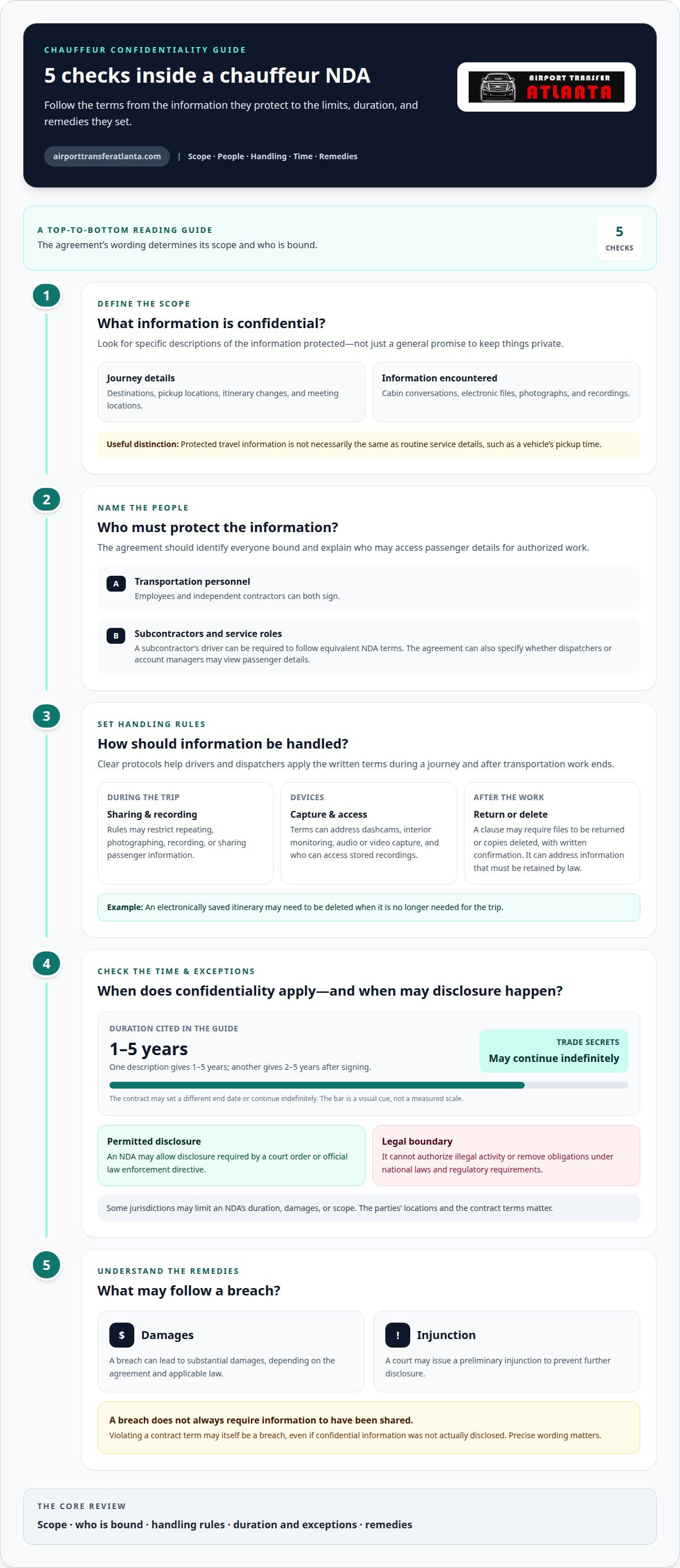
A chauffeur’s NDA can protect more than a passenger’s name: non-disclosure agreements for chauffeurs may cover cabin conversations, travel itineraries, electronic files, and recordings. Terms usually last 2 to 5 years after signing, while trade-secret obligations may continue indefinitely.
It’s reasonable to expect a confidentiality agreement to keep private details private, but its actual scope depends on the terms. An NDA may also set limits on photography, recording, and sharing information, while allowing disclosure required by a court order or law enforcement directive. It doesn’t authorize illegal activity or override legal obligations.
This guide explains what chauffeur NDAs cover, how duration and exceptions work, and what remedies may follow a breach, including damages or an injunction. It also explains how confidentiality terms relate to arranging professional transportation, so you can understand the protections before a journey begins.
Key Takeaways
- Identify whether the agreement covers cabin conversations, itineraries, electronic files, and recording or photography.
- Read the term and any continuing trade-secret duties to understand how long confidentiality may apply.
- Separate protected information from permitted disclosures, such as those required by a court order or law enforcement directive.
- Understand that a breach may lead to damages or an injunction, while enforceability can depend on the agreement and applicable law.
What Is a Non-Disclosure Agreement in Chauffeur Services?
A chauffeur-service NDA is a contract requiring transportation personnel to keep passenger information confidential. Non-disclosure agreements for chauffeurs can cover details observed during a journey, such as a destination or cabin conversation. The agreement’s wording determines its scope and who is bound.
Confidentiality Obligations and Authorized Disclosures
The document should specify what is confidential, who must protect it, and when disclosure is authorized. For example, it may prohibit a chauffeur from repeating or recording a passenger’s cabin conversation. Disclosure may be permitted when required by a court order or official law enforcement directive. Employees and independent contractors can both sign; the agreement should identify everyone bound and the duties that apply.
Returning or Destroying Confidential Information
A return-or-destruction clause explains what happens to confidential information after transportation work ends. It may require the receiving party to return files or delete copies, then confirm in writing that this is done. For example, an electronically saved itinerary may need to be deleted when no longer needed for the trip. The clause can also address information that must be retained by law.
Driver Briefings and Confidentiality Protocols
A driver briefing turns the agreement into practical instructions before a passenger is transported. It can identify protected details, such as pickup locations and destination changes, and explain rules against photographing, recording, or sharing passenger information. If a subcontractor supplies the driver, that driver should be bound by the same NDA terms. Non-disclosure agreements for chauffeurs are most useful when briefings help dispatchers and drivers follow consistent protocols.
A lawyer’s drafting fee depends on the work involved, such as reviewing existing terms, defining confidential information, and addressing subcontractors or recording devices. A straightforward agreement requires different drafting work from one covering these additional circumstances.
NDA duration, exclusions, and remedies
The contract should define how long confidentiality lasts, which disclosures are permitted, and what may follow a breach. These terms help both parties understand the protection’s limits.
Duration Clauses
A duration clause sets the period when confidentiality obligations apply. Some descriptions place NDA terms at 2 to 5 years after signing; another states protection often lasts between 1 and 5 years. The contract may instead set an end date or continue indefinitely. Trade-secret duties may survive the stated term. Review the wording to see when information stops qualifying as confidential.
Duration is only one part of the clause. It should also define the information covered and any duties that continue after the service ends. For example, an itinerary may cease to be confidential under the agreement’s terms, while a trade secret may remain protected. Some jurisdictions may limit an NDA’s duration, damages, or scope, so the parties’ locations and contract terms matter.
Remedies for NDA Breaches
A remedies clause describes what the party seeking enforcement may pursue after a breach. Breaching an NDA can lead to substantial damages, and a court may issue a preliminary injunction to prevent further disclosure. A breach can involve violating a contract term even if confidential information was not actually shared. Precise wording matters to both the client and the receiving party.
Exceptions also define the limits of confidentiality. An NDA can permit disclosures required by official law enforcement directives or court orders. It cannot authorize illegal activity or remove obligations under national laws and regulatory requirements. For instance, a chauffeur cannot rely on a privacy clause to justify unlawful conduct in a vehicle. The agreement should make these boundaries clear.
Before signing, review the duration, permitted disclosures, and remedies as separate terms. As you plan a journey, keep those written protections alongside your airport transfer arrangements.
What non-disclosure agreements protect
A signed chauffeur NDA can cover sensitive information encountered during a passenger’s journey, such as an executive’s destination, a meeting location, a cabin discussion, or electronic files shared with the driver. A clause should specify which details are confidential and who may access them. Clear boundaries distinguish protected travel information from routine service details, such as a vehicle’s pickup time. That distinction matters when an itinerary changes during a trip.
Travel details can reveal more than a destination. A pickup at a named office followed by a stop at a negotiation venue may expose business activity. The agreement can restrict sharing those observations with people outside authorized roles. It may also specify whether dispatchers or account managers can view passenger details. For example, a dispatcher may need a revised destination to coordinate a ride, but not the substance of a passenger’s call.
Recording equipment deserves specific treatment. A clause can set rules for dashcams, interior monitoring, and electronic recording devices, including prohibitions on photographing passengers or recording cabin activity. For example, the document can clarify whether a device captures audio, video, or both, and who can access stored recordings. Specific language helps the parties understand how sensitive information will be handled during routine operations.
Confidentiality terms may also cover subcontractors and external vendors. If a subcontractor’s driver receives an itinerary, the agreement can require equivalent confidentiality obligations. A client can ask for protections to extend to everyone handling the journey, not just the primary chauffeur. The document should identify who is authorized to receive passenger details and restrict unnecessary sharing beyond that group.
Some agreements include a clause limiting public criticism of an employer after termination. This differs from passenger privacy protection, and enforceability can depend on applicable law and wording. For example, a driver’s agreement should clearly distinguish company-related restrictions from travel information. A defined scope makes the agreement easier to review and helps the parties understand which remedies relate to each obligation.
Are chauffeur non-disclosure agreements enforceable in the United States?
In the United States, courts generally enforce nondisclosure agreements, but statutes and public policy can limit enforcement. Criminal acts are one example of circumstances that can affect an agreement’s enforceability. Courts may also consider whether procedural requirements were met. A clearly written clause identifying protected passenger information gives the parties a defined obligation to assess.
The federal Speak Out Act of 2022 limits enforcement of certain pre-dispute nondisclosure clauses. According to the U.S. Government Publishing Office, such a clause is not judicially enforceable for a sexual assault or sexual harassment dispute alleging conduct that violated federal, state, or tribal law. The rule concerns disputes arising from alleged unlawful conduct, not ordinary travel details such as an itinerary or pickup location.
Employee agreements have another legal boundary. The National Labor Relations Act may restrict overbroad employee NDAs or terms that prevent employees from engaging in future conduct. For example, a confidentiality clause focused on a passenger’s destination differs from a broad restriction on what an employee can say after leaving a job. Scope and wording matter.
Before signing, review who is bound, what information is covered, and which disclosures are permitted. Confirm that authorized representatives of both the client organization and transportation provider sign before dispatch. A breach can lead to substantial damages, and a party seeking enforcement may request a preliminary injunction. A person can breach an agreement by violating its terms even without disclosing confidential information.
For a scheduled airport journey, plan your ground transportation while keeping confidentiality terms clear between the agreement’s parties.
Airport Transfer Atlanta: One Way Airport Transfer
For executive travelers seeking seamless logistics, Airport Transfer Atlanta provides specialized one-way airport transfer services designed for direct travel to and from major aviation hubs. When itineraries involve multiple stops or unpredictable schedules, an hourly chauffeur rental offers the necessary flexibility. Clients can select from premium options such as Lincoln MKT and Cadillac XTS sedan services, or larger GMC Yukon XL and Cadillac Escalade SUV services, depending on their specific capacity and luggage requirements.
While confidentiality agreements and non-disclosure agreements for chauffeurs establish strict privacy obligations, professional transportation arrangements focus entirely on safe and efficient transit. Maintaining the signed privacy agreement and ride itineraries as distinct components of your corporate travel plan ensures seamless organization. This approach is particularly valuable for executive airport trips, where precise pickup schedules and direct destination coordination safeguard both privacy and productivity.
Contact Airport Transfer Atlanta today to coordinate professional airport transportation tailored to your upcoming itinerary and executive travel needs.
Make Privacy Part of Your Travel Planning
Once confidentiality terms are clear, coordinate the practical details of the journey with the same care. Keep pickup instructions, destination details, and the transportation plan aligned with the traveler’s needs. Non-disclosure agreements for chauffeurs work best alongside a well-organized itinerary, with privacy expectations and ride logistics considered together.
For airport travel, Airport Transfer Atlanta offers One Way Airport Transfer and Hourly Limo Rental. Lincoln MKT / Cadillac XTS Sedan Service is another option for arranging your trip. Choose the service format that fits your itinerary, then organize the ride details around your travel schedule.
Move ahead with a clear transportation plan. Contact Airport Transfer Atlanta to discuss your airport travel arrangements, and take the next step with confidence.
Frequently Asked Questions
Do your chauffeurs sign NDAs for VIP work?
VIP status alone doesn’t establish that a chauffeur is bound by an NDA. The written agreement determines who must protect information and which journey details it covers. For a private itinerary involving a confidential meeting, the document should identify the people or roles covered and the information treated as confidential. Don’t assume a passenger’s profile or booking category creates a separate confidentiality contract.
How Do Providers Enforce Confidentiality in Practice?
Providers can set confidentiality terms in written agreements and reinforce them through consistent handling of trip information. For example, limit itinerary access to personnel who need it to coordinate the ride, and avoid discussing a passenger’s destination in public areas. If an incident occurs, preserve relevant records and follow the agreement’s reporting process. These operational steps support the written terms but don’t replace them.
How Long Does an NDA Last?
An NDA lasts for the period stated in its contract, and some duties may continue after that term ends. Read the clause for its start point, end point, and any separate treatment of trade secrets. For example, a contract may distinguish routine trip details from information that remains confidential longer. The wording matters because the service date alone doesn’t explain when every obligation ends.
How do you protect confidentiality?
Protect trip details by sharing only what is needed for the ride. Keep pickup instructions and destination changes within the appropriate coordination channel, and don’t discuss a passenger’s plans with people who aren’t involved. Avoid taking or sharing photos of passengers or cabin activity. If you handle travel documents, follow the agreement’s rules for access, storage, return, or deletion after the work ends.
What Are Common Misconceptions About Chauffeur NDAs?
A common misconception is that an NDA guarantees every passenger detail stays secret in every circumstance. Agreements have a defined scope and may permit disclosures required by legal orders or official directives. Another misconception is that confidentiality language permits unlawful conduct; it does not remove legal obligations. For example, a clause about private cabin conversations does not make unrelated information confidential unless the agreement’s wording covers it.
What Happens If You Break an NDA?
Breaking an NDA can trigger remedies described in the agreement and available under applicable law. A party seeking enforcement may pursue damages or request a preliminary injunction. If you discover a possible breach, stop further sharing, preserve relevant messages or files, and review the contract’s notice process. A prompt, documented response helps clarify what happened and which terms may apply.


